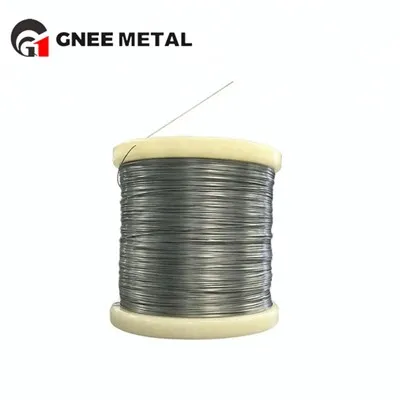
Grade 12 Titanium Coils: Ti-0.3Mo-0.8Ni Strip to ASTM B265
Mar 28, 2024
What Grade 12 Titanium Actually Is
Grade 12 is a near-alpha titanium alloy made by adding a small, controlled amount of molybdenum and nickel to commercially pure titanium. The nominal chemistry is Ti-0.3Mo-0.8Ni, and the alloy is specified for strip, sheet and plate under ASTM B265 (ASME SB-265), for welded and seamless tube under ASTM B338, and for pipe under ASTM B861 and ASTM B862. The additions are deliberately modest. They do not convert the material into a high-strength structural alloy, but they change how the passive oxide film behaves in hot chloride and mildly reducing environments.
| Element | ASTM B265 Grade 12 limit, wt% |
|---|---|
| Mo | 0.2 - 0.4 |
| Ni | 0.6 - 0.9 |
| Fe | 0.30 max |
| O | 0.25 max |
| N | 0.03 max |
| C | 0.08 max |
| H | 0.015 max |
| Ti | balance |
Because the matrix remains predominantly alpha titanium, the coil keeps the fabrication behaviour that made unalloyed titanium popular: good cold formability, straightforward gas tungsten arc welding, and no general requirement for post-weld heat treatment in normal process service.
Mechanical and Physical Data for Coil Product
ASTM B265 fixes room-temperature tensile requirements for Grade 12 sheet, strip and plate regardless of width, so a coil buyer can compare offers on a single basis. Typical coil dimensions run from about 0.3 mm to 3.0 mm thick and up to roughly 1250 mm wide, with slit widths supplied to the customer's forming line.
| Property | Value / requirement |
|---|---|
| Tensile strength, min | 483 MPa (ASTM B265, Grade 12) |
| Yield strength, 0.2% offset, min | 345 MPa |
| Elongation, min | 18% |
| Density | 4.51 g/cm3 |
| Melting range | about 1668 C |
| Elastic modulus | about 102 GPa |
The low modulus relative to steel, roughly half, is the single most important number on this table for anyone forming the coil. It governs springback, tool design and the minimum bend radius that can be held repeatedly in production.
Why the Molybdenum and Nickel Addition Matters
Commercially pure titanium depends on a thin titanium dioxide film for corrosion resistance. In aerated neutral solutions the film repairs itself almost instantly. In hot, concentrated chlorides at low pH, however, the film can break down locally where geometry creates a crevice: under gaskets, at lap joints, beneath deposits or inside rolled tube-to-tubesheet joints. Once breakdown starts, the local environment acidifies and the attack accelerates.
Nickel additions raise the cathodic efficiency of the surface and help the film repassivate in mildly reducing conditions.
Molybdenum stabilises the passive film in acidic chloride media, which is why the same addition appears in higher-alloy titanium grades used for chemical plant.
The result is a grade that tolerates crevices and hot brines that would attack Grade 2, while remaining far cheaper than palladium-bearing titanium.
The passive film remains effective to about 315 C in oxidising service. Above that range, oxide growth and increased oxygen pickup become design considerations, and creep resistance of the low-alloy matrix also has to be reviewed.
Forming and Welding Grade 12 Coil
Coil-fed operations - roll forming, press braking, deep drawing to form heat exchanger shells, and continuous strip welding - are routine for Grade 12, but the process windows differ from stainless steel.
Springback: expect roughly twice the elastic recovery of austenitic stainless for the same tooling, because the modulus is about half. Overbend compensation or a final sizing pass is normally required.
Bend radii: generous radii, clean dies and a lubricant designed for titanium reduce the risk of surface cracking. All tooling should be free of embedded iron, since iron smeared onto titanium becomes a corrosion site.
Welding: gas tungsten arc welding with ERTi-12 filler to AWS A5.16 is the standard route. Argon shielding of 99.99% purity or better, a trailing shield for the hot bead, and adequate back purge are essential; nitrogen and oxygen pickup produce hard, brittle and discoloured welds.
Cleaning: oxide scale and heat tint are removed by pickling per ASTM B600 practice, typically in a nitric-hydrofluoric bath, followed by a thorough water rinse to avoid residue that itself promotes crevice attack.
Common Mistakes That Shorten Service Life
Assuming any titanium resists any acid. Grade 12 handles chlorides well, but strongly reducing acids still require palladium-bearing grades or a different alloy family entirely.
Ignoring crevice geometry. A correct alloy with a badly designed gasket still fails; the alloy buys tolerance, not immunity.
Letting carbon steel brushes, slings or grinding wheels touch the strip, leaving iron contamination that rusts and stains the finished component.
Treating the service temperature limit as a corrosion limit only, without checking creep and oxygen embrittlement at elevated temperature.
Buying on thickness tolerance alone without confirming the heat is traceable to ASTM B265 Grade 12 rather than a generic titanium label.
FAQ
Q: How does Grade 12 differ from Grade 2?
Grade 2 is unalloyed titanium with lower strength and lower tolerance of crevices in hot chlorides. Grade 12 adds 0.2-0.4% Mo and 0.6-0.9% Ni, which raises minimum tensile strength to 483 MPa and improves film stability in reducing chloride environments.
Q: Should Grade 12 coils be stress relieved after forming?
In most chemical and heat exchanger service, no heat treatment is needed after forming or welding. Where dimensional stability matters, a low-temperature anneal can be applied, but it must be agreed before order because it changes the delivered temper condition.
Q: What filler metal is used for welding Grade 12?
ERTi-12 filler to AWS A5.16 matches the base chemistry. Matching filler keeps the weld metal's corrosion performance close to the parent coil and avoids the galvanic mismatch that unmatched filler can create.
Q: Is Grade 12 suitable for seawater heat exchangers?
Yes, it is used in seawater and brine coolers where crevices at tubesheets or under deposits are a concern. Design should still avoid stagnant dead zones and should keep the tubesheet joint clean and well fitted.
Q: How is the coil protected during shipping?
Dry, clean packaging with adequate moisture barriers is standard. Titanium strip is not galvanically protected by a coating, so contact with wet packaging, salt air or iron-bearing strapping should be excluded throughout transport and storage.
Q: Can Grade 12 be laser cut on the coil line?
Yes, using nitrogen or argon assist gas rather than oxygen, and with the cut edge subsequently checked for tinting. Discoloured or hardened edges should be removed or pickled before the component enters chloride service.