
Characteristics and Heat Treatment of Titanium Rods and Titanium Alloy Rods
Aug 12, 2025
Titanium is very stable in air at room temperature. When heated to 400-550°C, a strong oxide film forms on its surface, protecting it from further oxidation. Titanium has a strong ability to absorb oxygen, nitrogen, and hydrogen. These gases are extremely harmful impurities to titanium metal, and even trace amounts (0.01%-0.005%) can significantly affect its mechanical properties.
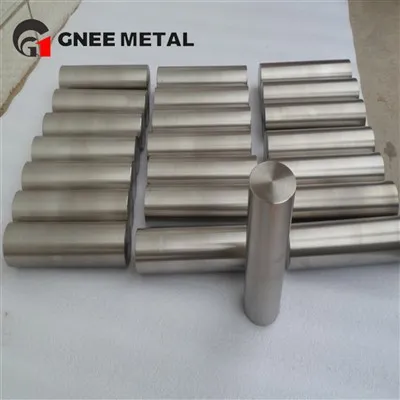
Among titanium compounds, titanium dioxide (TiO2) has the greatest practical value. TiO2 is inert to the human body and non-toxic. It possesses a range of excellent optical properties. TiO2 is opaque, has high gloss and whiteness, a high refractive index and scattering power, strong hiding power, and good dispersibility. The pigment produced from it, a white powder commonly known as titanium dioxide, is widely used. Titanium rods have an appearance very similar to steel. With a density of 4.51 g/cm3, less than 60% of that of steel, it is the lowest-density metallic element among refractory metals. Titanium's mechanical properties, generally known as mechanical performance, are closely related to its purity. High-purity titanium offers excellent machinability, with high elongation and reduction of area, but its low strength makes it unsuitable for structural applications. Industrial-purity titanium, which contains a moderate amount of impurities, possesses higher strength and plasticity, making it suitable for structural applications.


Titanium alloys are classified as low-strength, high-plastic, medium-strength, and high-strength, ranging from 200 (low-strength) to 1300 MPa (high-strength). However, titanium alloys can generally be considered high-strength alloys. They are stronger than aluminum alloys, which are considered medium-strength, and can completely replace certain types of steel in terms of strength. Unlike aluminum alloys, which experience a rapid drop in strength at temperatures above 150°C, some titanium alloys can maintain good strength at 600°C.
Dense titanium is highly valued in the aviation industry due to its light weight, higher strength than aluminum alloys, and ability to maintain higher strength than aluminum at high temperatures. Given that titanium has a density of 57% that of steel, it boasts a high specific strength (strength-to-weight ratio or strength-to-density ratio), as well as strong resistance to corrosion, oxidation, and fatigue. Three-quarters of titanium alloys are used as structural materials, particularly in aviation, while one-quarter are primarily used as corrosion-resistant alloys. Titanium alloys offer high strength combined with low density, excellent mechanical properties, toughness, and excellent corrosion resistance. However, titanium alloys have poor processability and are difficult to cut. During hot working, they readily absorb impurities such as hydrogen, oxygen, nitrogen, and carbon. They also have poor wear resistance and complex production processes. Industrial production of titanium began in 1948. Driven by the needs of the aviation industry, the titanium industry has grown at an average annual rate of approximately 8%. Currently, the global annual output of titanium alloy processed materials exceeds 40,000 tons, with nearly 30 titanium alloy grades. The most widely used titanium alloys are Ti-6Al-4V (TC4), Ti-5Al-2.5Sn (TA7), and industrially pure titanium (TA1, TA2, and TA3). There are three heat treatment processes for titanium rods and titanium alloy rods:
1. Solution treatment and aging: This process aims to improve strength. α-titanium alloys and stable β-titanium alloys cannot undergo strengthening heat treatment and are only annealed during production. α+β-titanium alloys and metastable β-titanium alloys containing a small amount of α phase can be further strengthened through solution treatment and aging.
2. Stress relief annealing: This process aims to eliminate or reduce residual stresses generated during processing. It prevents chemical attack in some corrosive environments and reduces deformation.
3. Full annealing: This process aims to achieve good toughness, improve processability, facilitate reprocessing, and enhance dimensional and structural stability.
The company boasts leading domestic titanium processing production lines, including:
German-imported precision titanium tube production line (annual production capacity: 30,000 tons);
Japanese-technology titanium foil rolling line (thinnest to 6μm);
Fully automated titanium rod continuous extrusion line;
Intelligent titanium plate and strip finishing mill;
The MES system enables digital control and management of the entire production process, achieving product dimensional accuracy of ±0.01μm.