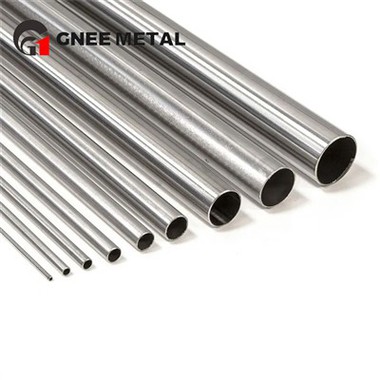

GR1 Titanium Pipe – Grading, Characteristics
May 18, 2026
GR1 titanium pipe is unalloyed pure titanium (35A alloy), ranked first among four commercially pure titanium grades. On account of its outstanding corrosion resistance, GR1 titanium has the lowest oxygen and iron levels and is widely used in various applications such as GR1 titanium heat exchanger, organism parts, low-temperature vessels, and more.

How Many Grades Does Non-Alloyed Titanium Have?
Commercially pure (CP) titanium is characterized by four main grades (GR1, GR2, GR3, GR4), developed for individual purposes depending on mechanical properties (strength, ductility, and formability).
| Grade | Key Characteristics |
|---|---|
| GR1 | Embodiment of extreme formability and corrosion resistance – best choice for applications requiring these properties |
| GR2 | Most versatile alloy – appropriate balance of strength, ductility, and malleability |
| GR3 | Higher strength than GR2, less formability – suitable for requirements needing higher strength but not extreme ductility |
| GR4 | Strongest CP grade – used where high strength and moderate ductility are required |
These grades are determined by various applications where titanium's corrosion resistance serves as the main basis. GR1 titanium pipe represents the extreme formability end of the spectrum.
What Is the Basis for Grading Titanium?
The grade of titanium is determined on the basis of its chemical composition, mechanical properties, microstructure, corrosion resistance, formability, and weldability.
| Grading Factor | Description |
|---|---|
| Chemical composition | Only difference between commercial pure titanium grades is percentage of iron and oxygen, which affects strength and elasticity |
| Mechanical properties | Tensile strength, yield strength, ductility, and toughness balanced for real-world applications |
| Manufacturing processes | Grade selection takes into account fabrication requirements |
| Environmental conditions | Service environment impacts grade choice |
Chemical Composition of GR1 Titanium Pipe
GR1 titanium chemical composition:
| Chemical Element | % Present |
|---|---|
| Titanium (Ti) | 99.1 – 100 |
| Iron (Fe) | 0 – 0.20 |
| Oxygen (O) | 0 – 0.18 |
| Carbon (C) | 0 – 0.01 |
| Nitrogen (N) | 0 – 0.03 |
| Hydrogen (H) | 0 – 0.015 |
Do Other Elements in GR1 Titanium Affect Its Properties?
| Element | Effect on Properties |
|---|---|
| Oxygen (O) | Increases strength; kept low to maintain ductility and formability |
| Nitrogen (N) | Increases strength; kept low to maintain ductility |
| Carbon (C) | Limited to prevent carbide-forming; keeps corrosion resistance and ductility in check |
| Hydrogen (H) | Leads to embrittlement; minimized to lowest levels |
| Iron (Fe) | Increases strength; kept low to maintain softness and high formability |
Mechanical Properties of GR1 Titanium Pipe
| Property | Metric | Imperial |
|---|---|---|
| Hardness, Brinell | 120 | 120 |
| Hardness, Knoop | 132 | 132 |
| Grade 1 titanium hardness, Rockwell B | 70 | 70 |
| Hardness, Vickers | 122 | 122 |
| Tensile Strength, Ultimate | 240 MPa | 34,800 psi |
| GR1 titanium yield strength | 170 – 310 MPa | 24,700 – 45,000 psi |
| Elongation at Break | 24% | 24% |
| Reduction of Area | 35% | 35% |
| Modulus of Elasticity | 105 GPa | 15,200 ksi |
| Compressive Modulus | 110 GPa | 16,000 ksi |
| Poisson's Ratio | 0.37 | 0.37 |
| Charpy Impact | 310 J | 229 ft-lb |
| Shear Modulus | 45 GPa | 6,530 ksi |
Physical Properties of GR1 Titanium Pipe
| Property | Value |
|---|---|
| Titanium grade 1 density | 4.51 g/cm³ |
| Mean Coefficient of Thermal Expansion | 4.78 × 10⁻⁵ mm |
| Melting point | 1670°C |
| Thermal conductivity | 111 W/(mK) |
| Modulus of elasticity | 15,656 MPa |
Applications of GR1 Titanium Tube
| Industry | Application |
|---|---|
| Chemical processing | GR1 titanium for chemical processing – GR1 titanium heat exchanger and GR1 titanium reactor, corrosion resistance for corrosive substances |
| Marine | Ship construction, offshore platforms – seawater corrosion resistance |
| Aerospace | Structural components (GR1 is choice for corrosion-resistant structural aerospace components) |
| Medical | Medical grade 1 titanium – orthopedic implants, biocompatibility |
| Power generation | Geothermal and nuclear power – corrosion resistance inside reactors |
| Construction | Durability and aesthetics |
FAQ
Q1: What is GR1 titanium pipe?
A: GR1 titanium pipe is unalloyed pure titanium (35A alloy), ranked first among four commercially pure titanium grades. On account of its outstanding corrosion resistance, GR1 titanium has the lowest oxygen and iron levels and is widely used in applications such as GR1 titanium heat exchanger, organism parts, and low-temperature vessels.
Q2: What is the UNS number for GR1 titanium tube?
A: The UNS number for GR1 titanium tube is R50250. ASTM B861 grade 1 titanium tube and ASTM B338 grade 1 titanium pipe both use UNS R50250.
Q3: What is the basis for grading titanium?
A: Titanium grade is determined by chemical composition, mechanical properties, microstructure, corrosion resistance, formability, and weldability. The only difference between commercial pure titanium grades (GR1-GR4) is the percentage of iron and oxygen, which affects strength and elasticity.
Q4: What are the limitations of GR1 titanium pipe?
A: GR1 titanium pipe has low tensile strength, limited high-temperature performance, and lower wear resistance compared to higher grades or alloyed versions. GR1 titanium is most dominant for applications requiring corrosion resistance and formability, rather than high strength.
Q5: What is the chemical composition of GR1 titanium tube?
A: GR1 titanium chemical composition – Ti 99.1-100%, Fe 0-0.20%, O 0-0.18%, C 0-0.01%, N 0-0.03%, H 0-0.015%. This source shows tighter carbon control (0.01% max) compared to typical 0.08%.
Q6: How do interstitial elements affect GR1 titanium properties?
A: Oxygen and nitrogen increase strength but are kept low to maintain ductility. Carbon is limited to prevent carbide-forming. Hydrogen leads to embrittlement and is minimized. Iron increases strength but is kept low to maintain softness and high formability.
Q7: What are the mechanical properties of GR1 titanium pipe?
A: GR1 titanium pipe – tensile strength 240 MPa, GR1 titanium yield strength 170-310 MPa, elongation 24%, grade 1 titanium hardness 70 HRB, modulus of elasticity 105 GPa, Charpy impact 310 J.
Q8: What is the density of titanium grade 1 pipe?
A: Titanium grade 1 density is 4.51 g/cm³. Melting point is 1670°C. Thermal conductivity is 111 W/(mK). Mean coefficient of thermal expansion is 4.78 × 10⁻⁵ mm.
Q9: What are the challenges in processing GR1 titanium pipe?
A: Challenges include high reactivity (sensitive to contamination), ductility (complicates machining and forming), tool adhesion and wear, need for controlled environments during welding and heat treatment, and careful handling during forming to maintain integrity.
Q10: How to weld GR1 titanium pipe?
A: How to weld GR1 titanium – requires controlled environments to minimize property degradation. Use GTAW (TIG) with ERTi-1 filler metal. Proper argon shielding on both sides is critical. No preheat required.
Q11: Is GR1 titanium pipe suitable for chemical processing?
A: Yes, GR1 titanium for chemical processing is used to construct GR1 titanium heat exchanger and GR1 titanium reactor components. It provides invariable corrosion resistance for corrosive substances.
Q12: Is GR1 titanium pipe suitable for marine applications?
A: Yes, GR1 titanium pipe has excellent seawater corrosion resistance, making it suitable for ship construction and offshore platforms.
Q13: Is GR1 titanium pipe suitable for medical applications?
A: Yes, medical grade 1 titanium (ASTM F67 grade 1) is used for orthopedic implants due to its biocompatibility.