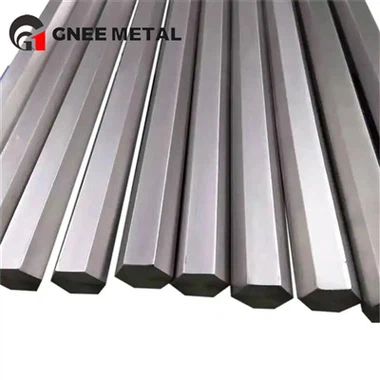

High-Quality Grade 1 Titanium for Industrial Applications
Apr 14, 2026
Key Features & Benefits
| Feature | Benefit |
|---|---|
| Superior Corrosion Resistance | Ideal for harsh environments such as chemical processing and marine applications |
| High Ductility | Easily formed and shaped, perfect for applications requiring intricate designs |
| Soft Strength | Balances strength with flexibility, suitable for a wide range of uses |
| Excellent Formability | Allows diverse applications from aerospace to medical devices |


Specifications of Titanium GR-1
| Property | Value |
|---|---|
| Purity | 99.5% Titanium |
| Density | 4.51 g/cm³ |
| Tensile Strength | 240 MPa |
| Yield Strength | 170 MPa |
| Elongation | 24% |
| Hardness (Rockwell B) | 70 |
| Melting Point | 1660°C |
| Maximum Operating Temperature | 300°C |
| Thermal Conductivity | 22 W/m-K |
Industrial Applications
Titanium GR-1 is a commercially pure titanium known for its excellent corrosion resistance and high ductility. Its superior properties make it a valuable material for various demanding industrial applications, including:
Chemical Processing – heat exchangers, reactors, piping systems
Aerospace – airframe components, hydraulic tubing
Medical – surgical instruments, implants
Marine – propeller blades, ballast tanks, seawater piping
Automotive – exhaust systems, connecting rods
Architecture – building cladding, monuments
Quality Advantages

Quality Control System – Each batch is tested with mill test certificates provided
100% Satisfaction Guarantee – Full commercial and logistical support from order to delivery
Highly Professional Staff – Technical assistance for material selection and fabrication
Accurate Testing Processes – Ultrasonic, eddy current, and hydrostatic testing available
FAQ
Q1: What is the difference between Titanium GR-1 and GR-2?
A: Titanium GR-1 has lower strength (tensile 240 MPa) but higher ductility (24% elongation), making it easier to form. Titanium GR-2 has higher strength (tensile 345 MPa) with similar corrosion resistance. Choose GR-1 for deep drawing and forming applications; choose GR-2 for structural applications requiring higher strength.
Q2: What are the equivalent grades to Titanium GR-1?
A: Titanium GR-1 is equivalent to UNS R50250 (ASTM), AMS 4900 (aerospace), DIN 3.7025 (German standard), and ISO 5832-2 Grade 1 (medical implants).
Q3: Can Titanium GR-1 be welded?
A: Yes, Titanium GR-1 has excellent weldability using GTAW (TIG) or GMAW (MIG) methods. However, strict argon shielding is required to prevent oxygen contamination and embrittlement of the weld zone.
Q4: What is the maximum working temperature for Titanium GR-1?
A: Titanium GR-1 can operate continuously at up to 300°C in air. For temperatures above 300°C, oxidation accelerates and mechanical properties may degrade. For higher temperature applications, consider Titanium GR-12 or other heat-resistant alloys.
Q5: Is Titanium GR-1 resistant to seawater corrosion?
A: Yes, Titanium GR-1 exhibits outstanding resistance to seawater corrosion, including resistance to crevice corrosion and pitting. It is widely used in marine applications such as propeller blades, ballast systems, and seawater heat exchangers.
Q6: What fabrication methods are suitable for Titanium GR-1?
A: Titanium GR-1 is ideal for cold forming, deep drawing, hydroforming, and bending. It has low springback compared to stainless steel. Hot forming (300-500°C) can be used for complex shapes, but cold forming is preferred to maintain surface quality.
Q7: Does Titanium GR-1 require heat treatment after welding?
A: Typically no. Titanium GR-1 is not hardenable by heat treatment. Post-weld heat treatment is generally not required unless the material has been heavily cold worked or if stress relieving is needed for dimensional stability. Stress relieving at 480-650°C for 30-60 minutes may be applied.
Q8: What is the difference between Titanium GR-1 and GR-5 (Ti-6Al-4V)?
A: Titanium GR-1 is commercially pure (99.5% Ti) with low strength (240 MPa) and high ductility, used for forming and corrosion resistance. Titanium GR-5 (Ti-6Al-4V) is an alpha-beta alloy with much higher strength (tensile 900-1000 MPa) but lower ductility and formability. GR-5 requires hot forming and is used for high-strength aerospace and medical structural applications.
Q9: Is Titanium GR-1 magnetic?
A: No, Titanium GR-1 is non-magnetic. This property makes it suitable for applications where magnetic interference must be avoided, such as in medical MRI rooms, electronic equipment housings, and sensitive instrumentation.
Q10: What surface finishes are available for Titanium GR-1?
A: Titanium GR-1 is available in mill finish (as-rolled), pickled (acid-cleaned to remove scale), polished (smooth reflective surface), and brushed (satin matte finish). Custom surface treatments such as anodizing (for color and wear resistance) or coating (e.g., TiN for hardness) can also be applied upon request.
Packaging
Our titanium products (tubes, plates, bars, wires, and strips) are carefully packed to ensure safe delivery. Each item is individually protected with anti-scratch materials such as foam or plastic film. For plates and strips, we use reinforced wooden crates with inner cushioning. Tubes and bars are packed in strong wooden cases or bundled with rust-proof straps, with plastic caps on both ends to prevent edge damage. Wires are wound on plastic or steel spools and wrapped with moisture-proof paper. All packages are secured with reinforced straps, clearly labeled with product specifications and quantity, and suitable for long-distance sea or air freight. Export-standard fumigated wooden packaging is used to comply with international shipping regulations.

Our Production Equipment:
Our factory is equipped with core processing machinery for titanium products. For melting and forming, we use vacuum arc remelting (VAR) furnaces and a 2,500-ton hydraulic press. The billet processing line includes a high-temperature rolling mill and a radial forging machine capable of producing bars and rods from 8mm to 300mm in diameter. For seamless titanium tubes, we operate three-roll piercing mills and cold pilger rolling mills (LG-60, LG-90). Titanium plates and strips are produced on a four-high cold rolling mill with an online annealing furnace. For wires, we have a continuous wire drawing line with in-line degreasing and spooling units. All key equipment is CNC-controlled, ensuring consistent dimensional accuracy and surface finish for tubes, plates, bars, wires, and strips.