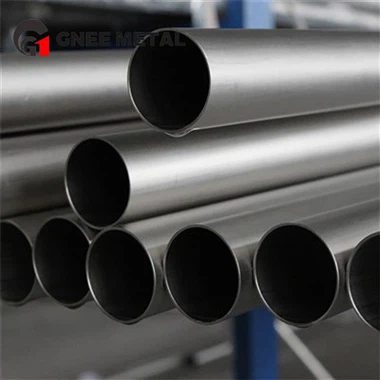
Titanium Grade 2 vs. Grade 5: A Comparison Guide
Jan 16, 2026
Sometimes not knowing which one to pick between Titanium Grade 2 and Grade 5 confuses professionals. This confusion not only wastes your resources but also increases programme timeline. In this article, we will cover their differences, advantages and disadvantages so you can determine the right titanium grade for your needs.
What is Titanium Grade 2?
Titanium Grade 2 is commercially pure titanium (CP) with minimum of 99% titanium. It's well known for its reasonable strength, good ductility and outstanding corrosion resistance. This grade is used in many industries like medical, chemical processing and aerospace because of its simple fabricability and good mechanical properties.
What is Titanium Grade 5?
Titanium Grade 5 also known as Ti-6Al-4V, is an alpha-beta titanium alloy which constitutes of titanium, vanadium and aluminum. This alloy is one of the most broadly used titanium grades because of its corrosion resistance, great strength and capability to tolerate high temperatures.
Titanium Grade 2 vs. Grade 5 – Top 5 Differences
1. Chemical Properties
Chemical Composition
| Element | Titanium Grade 2 (% weight) | Titanium Grade 5 (% weight) |
|---|---|---|
| Titanium | 99 | 90 |
| Aluminum | – | 6 |
| Vanadium | – | 4 |
| Oxygen | 0.25 | 0.2 |
| Iron | 0.3 | 0.3 |
| Carbon | 0.3 | 0.08 |
Corrosion Resistance
Titanium Grade 2 has better corrosion resistance than Titanium Grade 5. It forms a stable oxide layer that protects against neutral, oxidizing and mildly reducing conditions. Grade 5 also shows good corrosion resistance but is more prone to galvanic corrosion in particular conditions like high chloride concentrations or acidic environments.
2. Mechanical Properties
Yield Strength: Grade 5 has much greater yield strength of 880-1100 MPa than titanium's Grade 2 which has a yield strength of 275 MPa. So Grade 5 is better for operations that need better load bearing capacity and structural soundness.
Elongation: Titanium Grade 2 has elongation of 20-30% which is much better than titanium's Grade 5 elongation range of 10-15%. So Grade 2 is more ductile.
Hardness: Titanium Grade 5 is harder than Grade 2. Grade 5 has a hardness value of 379 Brinell and for Grade 2 is 250 Brinell.
Tensile Strength: Titanium Grade 2 has tensile strength of 352 MPa. So it is suitable for moderate strength applications. Grade 5, on the other side, has higher tensile strength of 1000-1190 MPa than grade 2 which is what is needed for high performance applications.


3. Thermal Properties
Thermal Conductivity
Titanium Grade 2, has a thermal conductivity of approximately 22 W/m·K, whereas Grade 5 has lower thermal conductivity, approximately 6.8 W/m.K
Coefficient of Thermal
Titanium Grade 2 has a coefficient of thermal expansion of approximately 9.0 µm/m·K and Grade 5 a slightly lower value of about 8.6 µm/m·K because of its microstructure.
Specific Heat Capacity
Capacity of Titanium Grade 2 is around 540 J/kg·K and Grade 5 has a greater specific heat capacity about 560 J/kg·K because of the alloying elements (aluminum and vanadium).
Melting Point
Melting point is about 1660°C for Titanium Grade 2 and about 1610°C for Grade 5.
4. Applications – Titanium Grade 2 vs. Grade 5
Medical Implants
Because of its biocompatibility, Titanium Grade 2 is broadly used for stents, surgical instruments and dental implants. Grade 5 is used for making heart valve components and orthopedic implants like joint replacements and bone plates.
Aerospace Components
In fuel tanks, aircraft frames, engine parts and aerospace components, Titanium Grade 5 is used due to its great strength to weight ratio. But Grade 2 is most of the time used for making less critical things like fasteners, brackets and airframe components where corrosion resistance is important.
Power Generation
Titanium Grade 2 is used in production of condenser tubes, pipework and heat exchangers while Grade 5 is suitable for turbine components, pressure vessels and compressor blades.
Chemical Processing
Titanium Grade 2 is used in manufacturing for tanks, reactors, pipework and heat exchangers.
But pressure vessels, pump components and valves in chemical processing units are normally made from Titanium Grade 5 for outstanding strength.
Marine Equipment
Titanium Grade 5 is used to produce components that need greater strength like turbine blades, structural supports and underwater fasteners.
Because of better corrosion resistance in seawater, Grade 2 is mostly used in marine equipment like seawater pumps, propeller shafts and boat hulls.
5. Cost Considerations
The prices of Titanium Grade 5 are usually higher because of the difficult manufacturing methods and the alloying elements and cost from $15 to $20 per kg. However Grade 2 is more affordable and the price falls between $10 to $12 per kg.
Titanium Grade 2 vs. Grade 5 – Which One You Should Choose?
The right option depends on your particular application needs. For formability and corrosion resistance in marine and chemical processing operations, Titanium Grade 2 would be the right choice. But for high strength applications like medical implants and aerospace where performance and longer life are more important, Titanium Grade 5 is better choice. You should also consider mechanical properties of both grades, environmental situations and cost, to make the correct decision.
Our factory
Our modern titanium material precision processing factory specializes in the R&D, customization, and production of titanium and titanium alloy products. We mainly supply high-precision products such as titanium tubes (seamless/welded), titanium plates/coils, titanium bars/wires, and titanium strips. Adhering to international standards (such as ASTM, ASME, DIN, etc.) and utilizing advanced smelting, forging, rolling, and precision machining technologies, combined with full-process quality control and non-destructive testing, we ensure that our products deliver excellent corrosion resistance, high strength, and lightweight properties for applications in aerospace, chemical and medical industries, marine engineering, and high-end manufacturing. With a focus on stable supply, technical support, and international trade services, we provide global customers with high-performance titanium material solutions.

Titanium product packaging
We understand the value of titanium products and the importance of shipping safety. Therefore, we have adopted professional and reliable customized packaging solutions. For products of various forms such as titanium tubes, plates, and bars, we employ multiple layers of protection-including anti-rust inner linings, sturdy wooden/steel crates, and waterproof wrapping films-to ensure the products are safeguarded against moisture, impact, and abrasion during long-distance sea transport and multiple transshipments. All packaging strictly complies with international export standards and features clear, complete labeling (such as marks, dimensions, weight, warning symbols, etc.).

Get Fast Quote & Logistics Plan