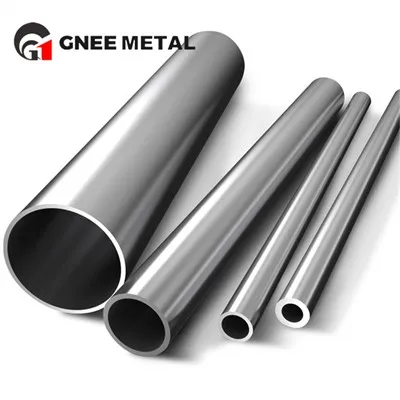
GR1 UNS R50250 Titanium Pipe
May 14, 2026
GR1 Titanium Pipe Specifications
| Parameter | Value |
|---|---|
| Standard | ASTM B338 (Pipe), ASTM B861 (Seamless Tube) |
| Grade | GR1 |
| Wall Thickness | Custom per requirement |
| Purity | 99.6% |
| Surface | No black spots, no burrs, no cracks |
| Condition | Annealed (M) or Cold Rolled (Y) |
| Titanium grade 1 density | 4.51 g/cm³ |
| Melting point | 1660°C |

GR1 Titanium Pipe vs Aluminum Alloy
GR1 titanium pipe has thermal strength several times higher than aluminum alloy. GR1 titanium tube can maintain required strength at medium temperatures and work at 450-500°C for long-term service.
| Material | High Temperature Capability | Specific Strength at 150-500°C |
|---|---|---|
| GR1 titanium pipe | Up to 500°C | Remains high |
| Aluminum alloy | Below 200°C | Significantly reduced above 150°C |
For GR1 titanium heat exchanger applications requiring elevated temperature service, GR1 titanium outperforms aluminum alloys by a wide margin.
Corrosion Resistance
GR1 titanium tube offers excellent corrosion resistance in specific environments:
| Environment | GR1 Titanium Pipe Performance |
|---|---|
| Humid atmosphere | Far better than stainless steel |
| Seawater medium | Far better than stainless steel |
| Pitting corrosion | Extremely resistant |
| Acid corrosion | Extremely resistant |
| Stress corrosion | Extremely resistant |
| Alkali, chloride, chlorine | Good resistance |
| Organic articles, nitrate acid, sulfuric acid | Good resistance |
Low Temperature Properties of GR1 Titanium Pipe
GR1 titanium pipe maintains mechanical properties at low and ultra-low temperatures. GR1 titanium tube with very low gap elements (O, N, H, C) can maintain certain plasticity even at -253°C.
GR1 titanium is therefore an important low-temperature structural material. GR1 titanium for deep drawing benefits from this low-temperature ductility.
A Key Consideration for Welding
GR1 titanium has high chemical activity. During how to weld GR1 titanium, it produces strong chemical reactions with:
| Element/Compound | Reaction with GR1 Titanium |
|---|---|
| O (Oxygen) | Forms hardened layer above 600°C |
| N (Nitrogen) | Forms TiN hard surface layer |
| H (Hydrogen) | Forms brittle layer |
| CO, CO₂, water vapor, ammonia | Strong chemical reactions |
When carbon content exceeds 0.2%, hard TiC forms in GR1 titanium pipe. The hard and brittle surface layer from gas absorption can reach 0.1-0.15 mm in depth, with hardening degree of 20-30%.
Thermal Conductivity and Elastic Modulus
GR1 titanium tube has low thermal conductivity and low elastic modulus:
| Property | GR1 Titanium | Comparison |
|---|---|---|
| Thermal conductivity | 15.24 W/(m·K) | 1/4 of nickel, 1/5 of iron, 1/14 of aluminum |
| Elastic modulus | ~1/2 of steel | Poor rigidity,容易变形 |
Various GR1 titanium alloys have thermal conductivity about 50% lower than pure GR1 titanium pipe. The low elastic modulus means GR1 titanium tube is not suitable for slender rods or thin wall applications where rigidity is critical.
Applications of GR1 Titanium Tube
| Industry | Application |
|---|---|
| Aerospace | Gas turbines, aircraft structural components |
| Chemical | GR1 titanium for chemical processing – corrosion-resistant piping |
| Shipbuilding | Marine components |
| Medical | Medical grade 1 titanium – bone implantation, precision accessories |
| Audio | High fidelity sound film applications (thin wall GR1 titanium tube for acoustic properties) |
| Low temperature | Cryogenic structural materials |
GR1 titanium heat exchanger tubes benefit from thermal strength and corrosion resistance.
FAQ
Q1: What is the thermal strength of GR1 titanium pipe compared to aluminum alloy?
A: GR1 titanium pipe has thermal strength several times higher than aluminum alloy. GR1 titanium tube can maintain required strength at medium temperatures and work at 450-500°C for long-term service. Aluminum alloy loses specific strength significantly above 150°C and cannot be used above 200°C.
Q2: What is the purity of GR1 titanium tube?
A: GR1 titanium tube has 99.6% purity. This high purity gives GR1 titanium its excellent corrosion resistance, formability, and biocompatibility. GR1 titanium pipe to ASTM B338 maintains this same purity requirement.
Q3: What is the UNS number for ASTM B861 grade 1 titanium tube?
A: The UNS number for ASTM B861 grade 1 titanium tube is R50250. ASTM B338 grade 1 titanium pipe also uses UNS R50250. Medical grade 1 titanium (ASTM F67 grade 1) uses the same UNS number.
Q4: What happens when GR1 titanium pipe absorbs gas during welding?
A: When GR1 titanium pipe absorbs gas during how to weld GR1 titanium, a hard and brittle surface layer forms. This layer can reach 0.1-0.15 mm in depth with hardening degree of 20-30%. Above 600°C, titanium absorbs oxygen and forms a hardened layer. With nitrogen, TiN hard surface forms. With hydrogen, a brittle layer forms. Proper argon shielding is critical.
Q5: What is the thermal conductivity of GR1 titanium tube?
A: The thermal conductivity of GR1 titanium tube is 15.24 W/(m·K). This is approximately 1/4 of nickel, 1/5 of iron, and 1/14 of aluminum. Various GR1 titanium alloys have thermal conductivity about 50% lower than pure GR1 titanium pipe.
Q6: What is the elastic modulus of GR1 titanium pipe?
A: The elastic modulus of GR1 titanium pipe is about 1/2 that of steel. This means GR1 titanium tube has poor rigidity and is prone to deformation. GR1 titanium is not suitable for slender rods or thin wall applications where rigidity is critical.
Q7: How does GR1 titanium machinability compare to stainless steel?
A: GR1 titanium machinability presents challenges. During machining, the processing surface springback is very large (about 2-3 times that of stainless steel). This results in severe friction, adhesion, and adhesive wear of the cutting tool. Use sharp carbide tools, low speeds, and abundant coolant.
Q8: Can GR1 titanium pipe be used for cryogenic applications?
A: Yes, GR1 titanium pipe maintains mechanical properties at low and ultra-low temperatures. GR1 titanium tube with very low gap elements (O, N, H, C) can maintain plasticity even at -253°C. GR1 titanium is an important low-temperature structural material.
Q9: What is the difference between GR1 and GR2 titanium tube?
A: The difference between pure titanium GR1 and GR2 is primarily oxygen content and purity. GR1 titanium tube has 99.6% purity with 0.20% oxygen max, while GR2 has 0.25% oxygen max. Titanium grade 1 vs grade 2 comparison shows GR1 has higher ductility and lower strength, making it more formable for GR1 titanium for deep drawing applications.
Q10: Is GR1 titanium pipe corrosion resistant to all chemicals?
A: No, GR1 titanium pipe has limitations. While GR1 titanium tube is extremely resistant to pitting, acid, and stress corrosion, and performs well in seawater, humid atmosphere, alkali, chloride, and chlorine, it has poor corrosion resistance to reducing oxygen and chromium salt medium. GR1 titanium for chemical processing should consider this limitation.
Q11: What is the maximum operating temperature for GR1 titanium heat exchanger tubes?
A: GR1 titanium heat exchanger tubes can operate at 450-500°C for long-term service. GR1 titanium maintains required strength at medium temperatures. For comparison, aluminum alloy cannot be used above 200°C. GR1 titanium pipe offers superior thermal strength for high-temperature applications.
Inspection
GR1 titanium pipe and GR1 titanium tube undergo rigorous quality control:
| Test | Purpose |
|---|---|
| Chemical analysis | Verify 99.6% purity and GR1 titanium chemical composition |
| Tensile testing | Confirm GR1 titanium yield strength, tensile strength, elongation |
| Hardness testing | Verify grade 1 titanium hardness |
| Surface inspection | Check for no black spots, no burrs, no cracks |
| Dimensional inspection | Verify length, diameter, wall thickness within ±0.50mm tolerance |
| Corrosion testing | Verify resistance in relevant environments |
| Ultrasonic testing | Detect internal flaws in GR1 titanium pipe |
| Eddy current testing | Surface defect detection on GR1 titanium tube |

Packaging
| Packaging Step | Description |
|---|---|
| 1. End protection | Plastic end caps on both ends of each GR1 titanium tube |
| 2. Inner wrapping | Plastic paper / VCI paper wrapped around GR1 titanium pipe |
| 3. Bundling | Steel straps securing bundles of GR1 titanium tube |
| 4. Wooden case | Suitable for long-distance transport by air or sea shipping |
| 5. Labeling | Grade (GR1), standard (ASTM B338/B861), dimensions, heat number |
| 6. Documentation pouch | Waterproof pouch with packing list and mill test certificate |

Factory Equipment
| Equipment | Function |
|---|---|
| VAR furnace | Vacuum Arc Remelting for high-purity titanium ingot (99.6%) |
| Extrusion press | Forms GR1 titanium pipe hollows from billet |
| Cold pilger mill | Reduces diameter and wall thickness of GR1 titanium tube |
| Cold rolling mill | Produces customized GR1 titanium tube with tight tolerances |
| Annealing furnace | Stress relief – supplies annealed (M) condition |
| Pickling line | Removes oxide scale from GR1 titanium surface |
| Straightening machine | Corrects bending of GR1 titanium pipe |
| Cutting machine | Precision length cutting |
| Surface inspection station | Verify no black spots, no burrs, no cracks |
| Ultrasonic tester | Non-destructive inspection of GR1 titanium tube |
| Eddy current tester | Surface defect detection |
| Hydrostatic tester | Pressure testing of each pipe length |
| Optical Emission Spectrometer | In-house chemical analysis |
| Universal tensile testing machine | Mechanical property verification |

Check Today's Stock & Lead Time