Titanium Wire: Properties, Applications and Future Prospects
Oct 12, 2024
In recent years, with the in-depth research and wide application of titanium materials, titanium wire, as an important titanium product, has shown its unique value and potential in many fields.
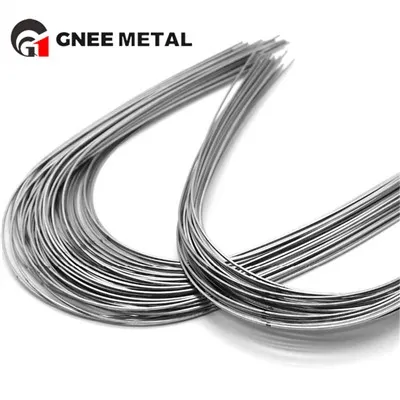
Titanium wire, usually referred to as titanium products supplied in the form of coiled round or straight wire, has different diameter sizes in different countries with different division standards. In China, according to the standard "GB3623-83", the diameter of titanium and titanium alloy wire is not more than 6mm. titanium wire can be classified into pure titanium wire, titanium alloy wire, pure titanium eyeglasses wire, titanium straight wire, titanium welding wire, titanium hanging wire, titanium coiled wire, titanium bright wire, titanium wire for medical use, and titanium-nickel alloy wire, and so on, according to the performance and the application requirements. Each type of titanium wire has its own specific use, such as pure titanium eyeglass wire is mainly used to make eyeglass holders, titanium hanging wire is used to hang heavy objects, and titanium nickel alloy wire is widely used because of its memory alloy properties.


In terms of specifications, titanium wire comes in a variety of sizes to meet different needs. For example, ordinary titanium wire is available in sizes ranging from φ0.8-φ6.0mm, while titanium wire for special eyeglasses and titanium wire for hanging gears are available in sizes ranging from φ1.0-φ6.0mm and φ0.2-φ8.0mm respectively. The main standards of titanium wires include GB/T, GJB, AWS, ASTM, AMS and JIS, etc., while the grades cover a variety of series from TA0 to TA10, TC1 to TC11 and GR1 to GR5. The states of titanium wire are usually categorized into annealed state (M), hot worked state (R) and cold worked state (Y), each of which has its own specific physical and chemical properties.
Titanium wires are widely used in many fields such as aerospace, chemical, and medical because of their excellent properties. In the aerospace field, titanium wire is the material of choice for key components due to its excellent corrosion resistance and low specific gravity. In the chemical industry, the corrosion resistance of titanium wire enables it to resist the erosion of various corrosive media, thus ensuring the long-term stable operation of equipment. In the medical field, titanium wire is widely used in dental implants and fracture repair due to its good biocompatibility and mechanical properties. In addition, titanium wire also has good anti-static properties, can be used to manufacture static electricity floor and anti-static clothing.
The production process of titanium wire involves a number of steps, including raw material preparation, production line testing, continuous production and packaging. Raw materials, mainly in the form of titanium ore, titanium scrap or titanium sponge, undergo rigorous testing before entering the production line to ensure that their purity and chemical composition meet production standards. During the continuous production process, a certain amount of raw material needs to be stocked to ensure the continuity and stability of production. Finally, the quality-tested titanium wire is properly packaged and labeled, and stored in a dry, designated finished product storage area for sale or further processing.
Looking ahead, the demand for titanium wire will continue to grow as technology advances and industry develops. To meet this demand, the production of titanium wire will become more sustainable and environmentally friendly. This may include the development of new production processes to reduce energy consumption and emissions, the use of recycled titanium raw materials to minimize resource wastage, and increased automation and intelligence in the production process to improve production efficiency and product quality. Meanwhile, with the application of new technologies such as artificial intelligence and big data, the production process of titanium wire is expected to achieve a higher level of intelligence and customization, so as to better meet the individual needs of customers.
Overall, titanium wire, as an important metal material, has demonstrated its unique value and potential in a variety of fields. Although the production process is complex and technically demanding, with the continuous progress of science and technology and the deepening of the concept of sustainable development, we have reason to believe that titanium wire will play a more important role in the future and make greater contributions to the development of human society.