


Grade 2 Titanium Prices October 8, 2026
Oct 08, 2026
Price Snapshot - October 8, 2026
| Product | Specification | Price | USD eq. | Pre-holiday | Reading |
|---|---|---|---|---|---|
| Sponge Ti Grade 0# | Published range high | ¥45,000 /t | $6.69 /kg | ¥43,000–45,000 | Recovered to top of range |
| Sponge Ti Grade 1# | Civil grade | ¥44,000 /t | $6.54 /kg | ¥42,000–44,000 | Back to range top |
| Sponge Ti Grade 2# | Lowest grade | ¥43,000 /t | $6.39 /kg | ¥41,000–43,000 | Back to range top |
| TA2 pure Ti ingot | Melting stock | ¥54 /kg | $8.02 /kg | ¥54 | Unchanged through break |
| TA1 pure Ti ingot | Melting stock | ¥55 /kg | $8.17 /kg | ¥55 | Unchanged |
| GR2 plate | 6.0 mm hot-rolled | ¥77 /kg | $11.44 /kg | ¥77 | Thick end of ladder |
| GR2 plate | 5.0 mm hot-rolled | ¥85 /kg | $12.63 /kg | - | Mid ladder |
| GR2 plate | 2.0 mm | ¥95 /kg | $14.12 /kg | - | Mid ladder |
| GR2 plate | 1.5 mm | ¥105 /kg | $15.60 /kg | - | Steepening |
| GR2 plate | 0.5 mm cold-rolled | ¥170 /kg | $25.26 /kg | - | Thin end of ladder |
| GR1 plate | 3.0 mm | ¥86 /kg | $12.78 /kg | - | Softest of the CP grades |
| GR2 strip / coil | 0.3 mm | ¥180 /kg | $26.75 /kg | - | Coil premium |
| GR2 welded tube | OD 6–114 mm | ¥105–110 /kg | $15.60–16.34 | ¥105–110 | Last assessed |
| GR2 bar | Φ 20–40 mm | ¥105–110 /kg | $15.60–16.34 | ¥105–110 | Last assessed |
| GR2 foil | 0.07 mm | ¥800 /kg | $118.87 /kg | - | Specialty end |
| High-Ti slag | 90-grade tender | ¥5,100 /t | - | ¥5,100 | Flat, low utilisation |
| Ferro-titanium | FeTi-70A | ¥26,750 /t | - | ¥26,750 | Flat |
| Titanium dioxide | Rutile, ex-works | ¥14,000 /t | - | ¥14,000 | Hike letter absorbed |
| Magnesium ingot | Reductant input | ¥15,750 /t | - | ¥15,750 | Cost floor input |
Compiled from published spot assessments for October 8, 2026, the first working day after the national holiday. CNY levels ex-works China. USD conversions use the prevailing weekly reference rate of approximately ¥6.73/USD. Foil and strip levels reflect small-volume specialty pricing and are not comparable with plate on a per-tonne basis.
The Millimetre That Costs More Than The Metal
Here is the fact that should change how you negotiate Grade 2, and it has nothing to do with the sponge price. Within a single grade - same chemistry, same mill, same standards - Grade 2 plate prices more than double between the thick end and the thin end of the range. Six millimetre hot-rolled plate is ¥77/kg. Half-millimetre cold-rolled plate is ¥170/kg. That is a 121% premium inside one grade, and it is larger than every other variable in the GR2 cost equation combined.
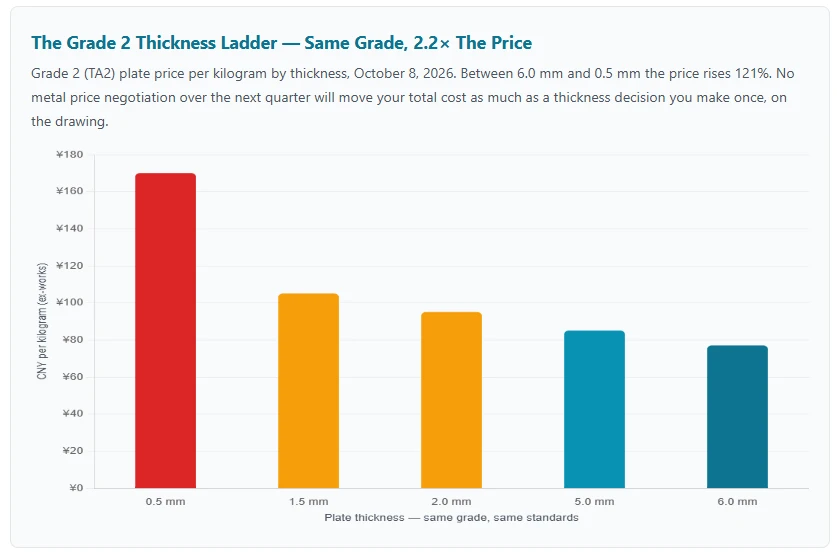
Two mechanisms produce this. The first is yield: rolling 6 mm down to 0.5 mm consumes more passes, more annealing cycles and more pickling, and each pass carries scrap and edge-trim loss. The second is capacity scarcity. Thin-gauge cold rolling lines are the constrained asset in the industry - fewer exist, they run slower, and everyone wants them for the thin end of every other product.
Practical consequence: if your drawing says 0.8 mm because that is what a previous supplier could hold flat, and the application only requires corrosion resistance and pressure containment, a 2 mm specification could cut your material cost by roughly 40% with no change in service performance. Re-examine thickness before you re-examine price.
Where The Money Goes Between Sponge And Thin Plate
The waterfall below is the same data viewed from the process side. Start with Grade 0# sponge at ¥45/kg. Melting to ingot adds ¥9. Hot rolling to 6 mm adds ¥23. Cold rolling, annealing and pickling to 0.5 mm adds ¥93 - more than the sponge and the ingot combined, and more than twice the entire upstream value of the metal.
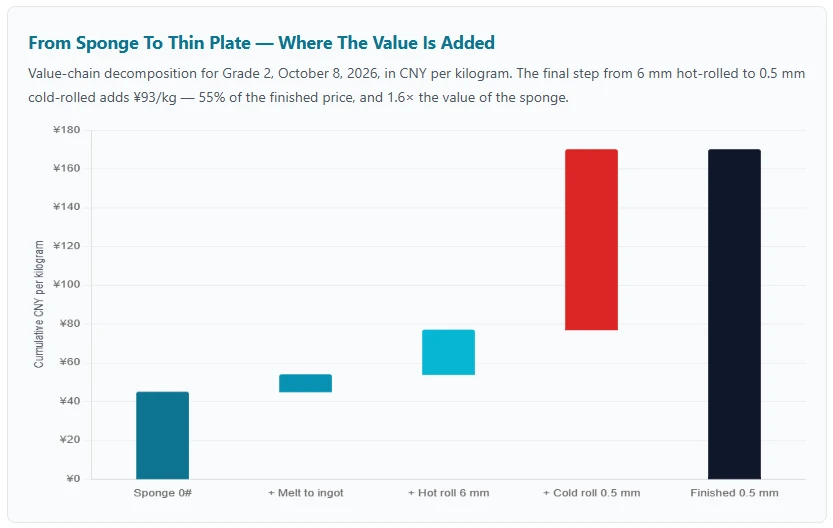
Read the chart from the buyer's side and it says something specific: pushing a supplier on thin-gauge Grade 2 means pushing on the one step in the chain with the least room. Thick plate is a different negotiation - the conversion margin there is ¥23/kg and the competitive field is wider. The same tactic produces very different results depending on which end of the ladder you buy from.
What Moved During The Break - Supply Side
Three developments from the holiday period that affect Grade 2 supply over the next four quarters.
New integrated capacity produced its first metal. A large vanadium-titanium project in the southwest began trial production in late September - roughly 13 tonnes of sponge meeting design specifications. It covers the full chain from high-titanium slag through titanium tetrachloride and sponge to ingot and high-purity powder, with an electron-beam melting furnace described as the largest single-ingot unit in the industry. Output and consistency still have to be proven. If it ramps as designed, the mid-market picture in twelve to eighteen months is materially different.
A thin-gauge specialist entered the market. A cold-rolled materials producer broke ground on a 100,000-tonne ultra-thin precision titanium alloy and metal composite strip project in late September, targeting electronics, medical and energy. It is the first significant new capacity aimed at the thin end of the ladder - where the ¥93/kg conversion premium lives. No metal for at least two years, but it shows where the industry sees the margin.
Grade 2 tube gained a new source. A specialty seamless-tube producer moved from trial to volume manufacturing of TA2 forged tube, adding supply in the chemical pressure-vessel segment - exactly the grade and form most exposed to civil demand weakness.
What Did Not Move - And Why It Matters More
The titanium dioxide chain remains stuck. September operating rates came in near 71%, roughly two points below the same month last year, with pigment producers holding price intentions they cannot make stick. A coordinated round of price notices lifted domestic levels by ¥700/tonne, yet new orders continued at previous levels. Inventory moved from producers to traders; it did not get consumed. The largest consumer of titanium feedstock is still not pulling.
One export tailwind: a regional customs union suspended its anti-dumping duty on Chinese titanium dioxide through 2027. The duty had been in the mid-teens range. Removing it lowers landed cost in that market and should support pigment export volumes, which in turn supports ore and slag demand. Slow-acting support, not a reversal.
Procurement Recommendations By Use Case
Chemical process equipment, plate and shell (ASTM B265). Buy at the thick end of the ladder wherever the stress calculation allows. Six millimetre hot-rolled at ¥77/kg is the value point in this market; each step down the ladder costs disproportionately. If the application is corrosion resistance and containment rather than structural, question any specification below 2 mm.
Heat exchanger and condenser tube (ASTM B338). Grade 2 welded tube at ¥105–110/kg is unchanged and the newly qualified domestic supply should improve lead times through Q4. Volume orders of 50 tonnes and above are worth negotiating as a package with a fixed-price component, because tube conversion margins have less room than plate conversion margins.
Thin-gauge sheet, strip and coil buyers. This is the segment with the least negotiating room and the longest lead times. If your programme for 2027 is known, reserve thin-gauge rolling capacity now rather than negotiating price later - the constraint is line availability, not price. Where a 0.5 mm specification is driven by habit rather than requirement, re-qualify upward.
Medical and certified Grade 2 (ISO 5832-2). Certification premium over commercial Grade 2 remains in the 30–50% range, with lead times of eight to twelve weeks from certified mills. Lock the audit trail and documentation package before discussing price.
Marine and desalination projects. Plate and tube are both flat at published levels and the new tube supply improves the negotiating position on project packages. Tender 50–500 tonne packages with a fixed-price element rather than buying against spot.
What Would Change This View
Three things to watch through October and November. First, whether the post-holiday quote recovery holds or fades once the deferred orders are filled - a fade within three weeks would confirm that the recovery was restocking, not demand. Second, whether civil casting-ingot operating rates climb back above 60%; they have been below 50% for two consecutive months, and that figure is the supply side of the floor. Third, whether pigment order intake follows the export duty suspension with real volume, or whether the inventory already sitting in channels absorbs it. Only the third would change the outlook for the upstream cost floor.
Grade 2 Product Specifications
| Form | Grades | Size range | Standards | Certification | Surface finish |
|---|---|---|---|---|---|
| Plate & sheet | GR1, GR2, GR3, GR4 | Thickness 0.3–100 mm; width up to 2,000 mm; length up to 6,000 mm | ASTM B265 / ASME SB-265 | EN 10204 3.1 mill cert | Hot-rolled, pickled; cold-rolled, bright annealed |
| Tube (welded) | GR1, GR2 | OD 6–114 mm; wall 0.5–3 mm | ASTM B338 / ASME SB-338 | EN 10204 3.1; hydrostatic test | Annealed, pickled; OD-polished optional |
| Tube (seamless) | GR1, GR2 | OD 6–114 mm; wall 0.5–6 mm | ASTM B338 / ASME SB-338 | EN 10204 3.1; ultrasonic + eddy current | Annealed, pickled; cold-worked optional |
| Bar & billet | GR1, GR2, GR3, GR4 | Φ 3–350 mm round; hex; square | ASTM B348 / ASME SB-348 | EN 10204 3.1 mill cert | Hot-rolled, turned, polished, centreless ground |
| Wire | GR1, GR2 | Φ 0.1–6.0 mm | ASTM B863 | Spool, coil, cut-length | Bright, annealed, electropolished for medical |
| Forgings | GR1, GR2, GR4 | Up to 500 kg single piece; ring, disk, sleeve, flange | ASTM B381 | EN 10204 3.1; ultrasonic + dimensional report | Machined to drawing; rough-turned stock |
| Fittings | GR1, GR2 | DN 15–600 (1/2″–24″) | ASTM B363 | Elbows, returns, caps, stub-ends, reducers | As-machined; pickled optional |
| Flanges | GR1, GR2 | DN 15–600; ASME B16.5 / EN 1092-1 | ASTM B381 + dimensional | SO, WN, BL, TH, LJ types | Machined, faced, drilled |
| Strip & foil | GR1, GR2, GR3 | Thickness 0.02–0.5 mm; width up to 600 mm | ASTM B265 / B863 | EN 10204 3.1; coil or cut length | Cold-rolled, annealed, degreased |
| Castings | C-2, C-3 | Up to 200 kg single piece | ASTM B367 | EN 10204 3.1; radiographic test | As-cast, blasted, machined |
| Powder (HDH) | GR2 | −100, −200, −325 mesh | ASTM B299 | PM feedstock; sintering service | Irregular morphology; purity ≥99.0% |
Send The Drawing, Not Just The Grade
Tell us the form, the thickness and the standard - we will quote the value point on the ladder and flag where a specification change would cut your cost. Fixed-price offers valid through October.


