


Grade 2 Titanium Prices September 28, 2026: The Workhorse Grade Quietly Sets A New Floor
Sep 28, 2026
Grade 2 Titanium Price Snapshot - September 28, 2026
| Product | Specification | Price (CNY) | USD equivalent | Week move | Reading |
|---|---|---|---|---|---|
| TA2 pure Ti ingot | Φ 200–500 mm | ¥54,000–55,000 /t | $7.20–7.33 /kg | Flat | Stable, civil demand soft |
| TA2 hot-rolled plate | 3–8 mm thickness | 64–68 RMB/kg | $9.50–10.10 /kg | Flat | Negotiable on volume |
| TA2 cold-rolled sheet | 0.5–3 mm | 72–82 RMB/kg | $10.70–12.18 /kg | Flat | Heat-exchanger grade premium |
| TA1/TA2 welded tube | OD 6–114 mm, wall 0.5–3 mm | 105–110 RMB/kg | $15.60–16.34 /kg | Flat | Civil soft, marine full |
| TA2 seamless tube | OD 6–114 mm | 130–145 RMB/kg | $19.31–21.54 /kg | Flat | Heat-exchanger premium |
| Pure Ti bar (GR2) | Φ 20–40 mm | 105–110 RMB/kg | $15.60–16.34 /kg | Flat | Stable |
| Pure Ti bar (GR2) | Φ 50–200 mm | 115–125 RMB/kg | $17.08–18.57 /kg | Flat | Forging stock premium |
| GR2 wire | Φ 0.1–6.0 mm | 140–160 RMB/kg | $20.80–23.77 /kg | Flat | Welding/medical premium |
| GR2 flange (ASTM B8) | DN 15–600 | 160–185 RMB/kg | $23.77–27.48 /kg | Flat | Machined, certified |
| GR2 powder (HDH) | −100 mesh | 320–380 RMB/kg | $47.55–56.46 /kg | Flat | PM feedstock premium |
| Mill products - Europe | Plate / bar / tube | $13.76–15.20 /kg | - | Flat | Premium unchanged |
| Mill products - North America | Plate / bar / tube | $6.17–6.81 /kg | - | Flat | Tight availability |
| Mill products - Northeast Asia | Plate / bar / tube | $6.93–7.65 /kg | - | Flat | Steady demand |
Compiled from published weekly spot assessments covering September 22–26, 2026. CNY levels ex-works China. USD conversions use the prevailing weekly reference rate. Imported feedstock on CIF basis.
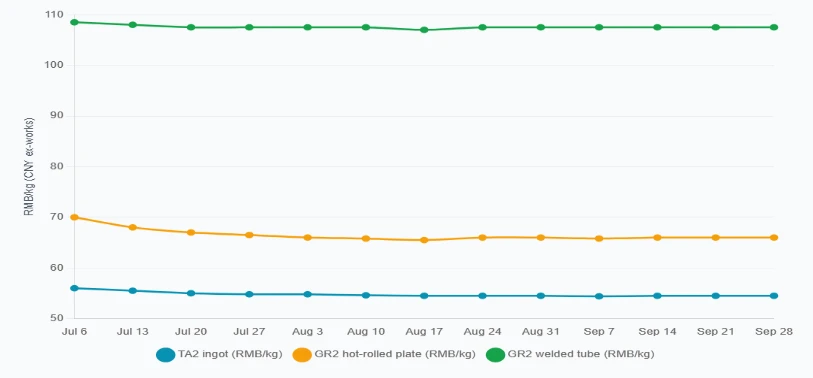
Five Weeks of Flat - The Chart That Quietly Sets A New Floor
Weekly average price of Grade 2 mill products, China domestic, July–September 2026. Three lines, one conclusion: the GR2 value chain stopped moving five weeks ago, and the spread between upstream sponge and downstream plate has not narrowed since.
Why Grade 2 Matters More Than The Headlines Suggest
Almost every story about titanium this year has been about TC4: aerospace lead times pushing 20 months, defence logistics stockpiling, jet-engine forgings. Grade 5 alloy grabs the attention because the units move in tonnes and the buyers are named in trade press. Grade 2 does not get the column inches, and yet the grade-2 family is what the industrial economy actually runs on. Industry estimates put commercially pure titanium at roughly half of global titanium mill-product consumption by volume, and Grade 2 is the most specified of the four CP grades by a wide margin.
The applications are unglamorous and durable. Chlor-alkali membrane cells run on Grade 2 anodes and cathodes. PTA (purified terephthalic acid) reactors are Grade 2-lined. Seawater-cooled heat exchangers in coastal power plants and LNG terminals are Grade 2 tube. Desalination trains in the Gulf, the Mediterranean, and the Pacific coast of the Americas are Grade 2. Hip and dental implants are Grade 2 or Grade 4 ELI. The grade is so pervasive that when its price moves, the move is felt across dozens of unrelated industries - not in headlines, but in cost-of-goods lines that nobody reads unless they are buying the parts.
Wins: Corrosion resistance in oxidising media (chlorides, nitric acid, seawater), formability, weldability, biocompatibility, cost-per-kilogram.
Loses: Reducing acids (HCl, H2SO4 at concentration), high-temperature creep, high-strength structural use. For those, Grade 7 (palladium-stabilised), Grade 12 (molybdenum-bearing), or Grade 5 (Ti-6Al-4V) is the right answer - not Grade 2.
The September 28 Read: Flat Means Flat, With One Foot Of Room Underneath
Grade 2 ingot and its mill products have now been unchanged for five consecutive weekly assessments. TA2 ingot sits at ¥54,000–55,000 per tonne; hot-rolled plate at 64–68 RMB/kg; welded tube at 105–110 RMB/kg. By every published spot survey this month, the value chain has stopped moving. This is unusual and worth saying out loud: GR2 is normally a price that follows upstream sponge with a two-to-four-week lag. Sponge Grade 0# lost its line in the first week of September. TA2 ingot did not move at all.
That tells you two things at once. First, conversion margins have absorbed the sponge dip. Producers cut their conversion fee rather than lower the mill-product quote, which is what always happens when finished-form inventories are tight relative to raw-material inventories. Second, Grade 2 demand is no longer what the spot surveys suggest it is. If civil demand were truly weak, the mill-product price would have followed sponge lower. It did not. Industrial buyers - particularly in chlor-alkali, desalination, and medical device fabrication - have been quietly accumulating stock at these levels, and the published range reflects only the marginal spot, not the volume-weighted average.
What Goes Into A Kilogram Of Grade 2 Plate
Cost-stack decomposition of GR2 hot-rolled plate at ¥66/kg (mid-range, September 28). Sponge at ¥44,500/t, conversion at ¥11,500/t, plus energy, labour, QC/certification, and producer margin. The sponge share is the smallest piece of the stack - this is why sponge prices can fall without plate prices falling in lockstep.

Grade 2 vs Grade 5
The most important comparison for procurement is not the absolute price of Grade 2 this week, but the gap between Grade 2 and Grade 5. TC4 alloy bar trades at 120–125 RMB/kg against pure titanium bar at 105–110 RMB/kg - a roughly 14% premium. For a structural part, the strength differential (TC4 is roughly twice as strong) easily justifies the premium. For a corrosion-resistant pressure vessel, a heat exchanger tube bank, or a medical implant, Grade 2 is the right answer and the Grade 5 premium would be wasted.
Practical rule: when the question is "corrosion resistance, formability, weldability", Grade 2 wins on cost. When the question is "strength-to-weight under fatigue", Grade 5 wins on engineering, and the price conversation is secondary.
For buyers who spec GR2 by default, this 14% gap means every time an engineer swaps GR2 for TC4 without a structural justification, the procurement team is paying a 14% premium for no engineering gain. The reverse is also true: when the engineering specification was TC4 because of legacy drawing notes but the application is really a corrosion-resistant shell, switching back to GR2 captures the 14% directly. Both directions need to be audited.
Standards And Specifications
Grade 2 is one of the most standardised materials in the metals catalogue. The specifications below cover 95% of mill-product procurement in the grade:
| Standard | Product | Note |
|---|---|---|
| ASTM B265 | Plate, sheet, strip | The most cited plate spec; GR2 thickness from 0.5 mm to 100+ mm. |
| ASTM B338 | Seamless and welded tube | Covers condenser and heat-exchanger service; GR2 is the default seawater/cooling grade. |
| ASTM B348 | Bar and billet | Hot-finished and cold-finished rounds, hexes, squares; forging stock covered. |
| ASTM B363 | Seamless and welded fittings | Stub-ends, elbows, returns, caps used in piping systems. |
| ASTM B381 | Forgings | Disk, ring, sleeve, flange shapes for pressure equipment. |
| ASTM B863 | Wire | Welding wire (ERTi-2), spring wire, medical wire. |
| ASTM B367 | Castings | C-Series castings for valve bodies, pump housings. |
| ASTM B493 | Bar and billet for reforging | Used when the buyer will forge in-house. |
| ASME SB-265 / SB-338 / SB-348 | Pressure-vessel code | Mandatory for ASME-stamped equipment; identical chemistry to ASTM. |
| ISO 5832-2 | Wrought Grade 2 for surgical implants | Medical-grade certification; tighter residuals than ASTM B348. |
| DIN 17850 / 17860 / 17862 | Plate, tube, bar (European) | Ti Grade 2 / Werkstoff 3.7035. |
| JIS H 4600 / H 4630 / H 4650 | Plate, tube, bar (Japanese) | TB340C / TTP340 / TB340. |
What The Five-Week Flatness Is Actually Telling Procurement Teams
Three readings, all consistent with the data. First, the worst of the GR2 price decline is behind us. Sponge has been at or near the published cost floor for five weeks; mill-product conversion margins have already absorbed the dip. The next ¥500/t move, if it comes, is more likely to be up than down. Second, demand for Grade 2 mill products is firmer than the published range suggests. The published range captures marginal spot deals. Industrial and medical volume is being transacted below the published level, which is why the range has not widened. Third, international availability is no longer uniform. North American buyers continue to face 6–8 week mill lead times on hot-rolled plate. European buyers pay a premium of roughly 2x the Asian benchmark. Northeast Asian buyers sit in between, with stable mill availability.
What Would Change The View
Three things to watch through October. (a) Civil casting-ingot operating rates: if the <50% utilisation figure rises back above 60% in the next two published surveys, sponge has stabilised and conversion fees will tighten. (b) Industrial order intake in chlor-alkali and PTA: these are the largest GR2 end-markets by tonnage; if order intake strengthens into Q4, the published plate range will move up. (c) Magnesium and TiCl4 costs: both are at or near multi-year highs, and a fall of 5%+ in either would reopen the conversation on sponge floor pricing.
Procurement Recommendations By Use Case
Heat-exchanger and condenser buyers (B338): welded tube at 105–110 RMB/kg is the right entry point for Q4 volumes. Lead time is currently 4–6 weeks ex-China. Long-term agreements (six-month fixed-price) are available from major mills and are worth negotiating against this published range.
Plate buyers for chemical process equipment (B265): hot-rolled 3–8 mm at 64–68 RMB/kg is the realistic negotiation target. Cold-rolled sheet carries a 12–20% premium over hot-rolled and is worth specifying only when surface finish matters. Forgings (B381) command a further premium and should be sourced from producers with audited forging capacity.
Medical device fabricators (ISO 5832-2): certification premium is roughly 30–50% over commercial Grade 2. Current ISO 5832-2 bar trades at ¥155–175/kg. Lead times from certified mills are 8–12 weeks. Lock certification and traceability documents before price negotiation - the audit trail is harder to switch than the supplier.
Marine and desalination project buyers: welded tube and plate are both flat at published range. Project volume (typically 50–500 tonnes per train) is best negotiated as a single package with a six-month fixed-price component. Spreads on marine-grade orders tend to be 5–8% below the published single-tonne range.
Grade 2 Product Specifications
| Form | Grades | Size range | Tolerances | Standards | Surface finish |
|---|---|---|---|---|---|
| Plate & sheet | GR1, GR2, GR3, GR4 | Thickness 0.3–100 mm; width up to 2,000 mm; length up to 6,000 mm | ASTM B265 / ASME SB-265 | EN 10204 3.1 mill cert | Hot-rolled, pickled; cold-rolled, bright annealed |
| Tube (welded) | GR1, GR2 | OD 6–114 mm; wall 0.5–3 mm | ASTM B338 / ASME SB-338 | EN 10204 3.1; hydrostatic test | Annealed, pickled; OD-polished optional |
| Tube (seamless) | GR1, GR2 | OD 6–114 mm; wall 0.5–6 mm | ASTM B338 / ASME SB-338 | EN 10204 3.1; ultrasonic + eddy current | Annealed, pickled; cold-worked optional |
| Bar & billet | GR1, GR2, GR3, GR4 | Φ 3–350 mm round; hex; square | ASTM B348 / ASME SB-348 | EN 10204 3.1 mill cert | Hot-rolled, turned, polished, centreless ground |
| Wire | GR1, GR2 | Φ 0.1–6.0 mm | ASTM B863 | Spool, coil, cut-length | Bright, annealed, electropolished for medical |
| Forgings | GR1, GR2, GR4 | Up to 500 kg single piece; ring, disk, sleeve, flange | ASTM B381 | EN 10204 3.1; ultrasonic + dimensional report | Machined to drawing; rough-turned stock |
| Fittings | GR1, GR2 | DN 15–600 (1/2″–24″) | ASTM B363 | Elbows, returns, caps, stub-ends, reducers | As-machined; pickled optional |
| Flanges | GR1, GR2 | DN 15–600; ASME B16.5 / EN 1092-1 | ASTM B381 + dimensional | SO, WN, BL, TH, LJ types | Machined, faced, drilled |
| Castings | C-2, C-3 | Up to 200 kg single piece | ASTM B367 | EN 10204 3.1; radiographic test | As-cast, blasted, machined |
| Powder (HDH) | GR2 | −100, −200, −325 mesh | ASTM B299 | PM feedstock; spare-parts; sintering | Irregular morphology; purity ≥99.0% |
Quote Your Grade 2 Order Today
Plate, sheet, bar, tube, wire, forgings - send your drawing or spec and receive a fixed-price offer valid through the end of October.


