


Grade 2 Titanium Prices October 26, 2026: Gr2 Plate At $22.16/kg
Oct 26, 2026
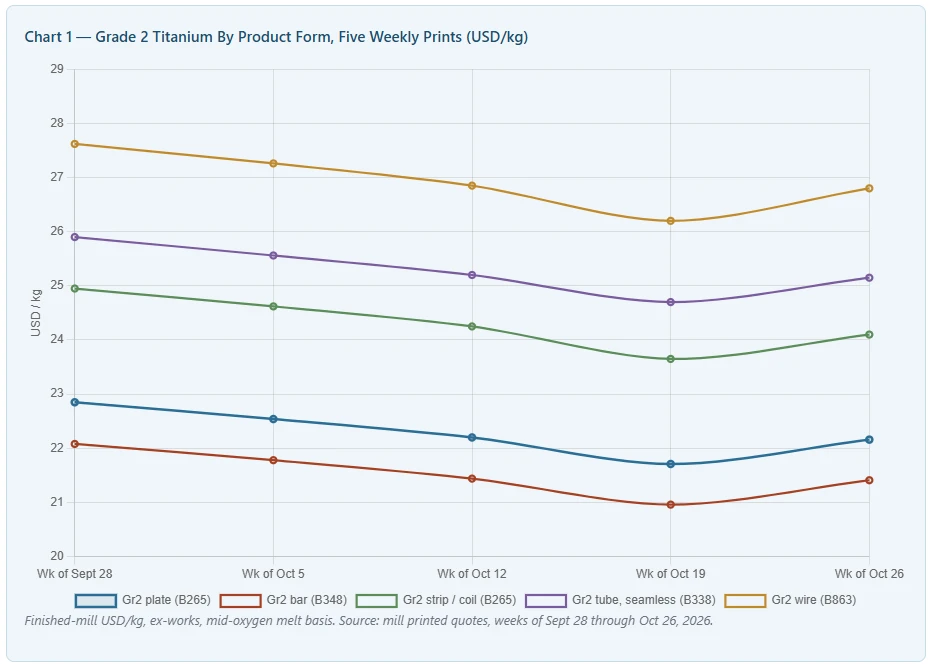
Grade 2 is the most-quoted titanium grade in the world and the least-specified one. This week Gr2 plate printed $22.16/kg, bar $21.41/kg, seamless tube $25.15/kg, wire $26.80/kg and strip or coil $24.10/kg - up 1.82% to 2.29% across the line, all USD, after titanium sponge turned up 2.53% to $7,291/tonne for its first weekly gain in five. That part is straightforward. What most RFQs get wrong is the second number. ASTM B265 allows oxygen anywhere from zero to 0.25% in Gr2, and that single line in the specification is worth $0.70/kg end to end this week. Low-oxygen melt (O 0.13–0.16%) now carries a $0.42/kg premium over mid-oxygen, up from $0.28/kg four weeks ago, while high-oxygen melt (O 0.21–0.25%) comes in $0.28/kg cheaper and gives up 7–8 points of elongation - enough to crack a deep-drawn shell or a tight U-bend. If your RFQ says "Gr2" and nothing else, you are not buying a defined metal. You are buying whatever oxygen level the mill has on the floor.
Price Snapshot - Grade 2 Titanium, Week of October 26, 2026
| Indicator | Reading | Unit | vs. October 19 | Direction |
|---|---|---|---|---|
| Titanium sponge (≥99.6%, ex-works) | 7,291 | USD / tonne | +180 / +2.53% | First weekly gain in five weeks |
| Magnesium ingot (99.9%, Kroll reductant) | 2,859 | USD / tonne | +120 / +4.37% | Largest input move |
| Gr2 ingot / billet (pre-conversion) | 19.20 | USD / kg | +0.40 / +2.13% | Melt leg - feeds every form below |
| Gr2 plate (ASTM B265, 3–50 mm) | 22.16 | USD / kg | +0.45 / +2.07% | Mid-oxygen melt basis |
| Gr2 bar (ASTM B348, round) | 21.41 | USD / kg | +0.45 / +2.14% | Lightest conversion leg |
| Gr2 tube (ASTM B338, seamless) | 25.15 | USD / kg | +0.45 / +1.82% | Smallest % move in the line |
| Gr2 wire (ASTM B863, Ø 0.5–6 mm) | 26.80 | USD / kg | +0.60 / +2.29% | Steepest move - capacity, not metal |
| Gr2 strip / coil (ASTM B265, 0.1–3 mm) | 24.10 | USD / kg | +0.45 / +1.90% | Cold-roll capacity tightening |
| Low-oxygen Gr2 surcharge (O 0.13–0.16%) | +0.42 | USD / kg | from +0.28 | Premium widened 50% in four weeks |
| High-oxygen Gr2 allowance (O 0.21–0.25%) | −0.28 | USD / kg | from −0.19 | Discount deepened as well |
| Gr1 plate (ASTM B265) | 22.68 | USD / kg | +0.48 / +2.16% | +$0.52/kg over Gr2 |
| Gr3 plate (ASTM B265) | 23.05 | USD / kg | +0.59 / +2.63% | +$0.89/kg over Gr2 - gap widened |
| Gr4 plate (ASTM B265) | 24.60 | USD / kg | +0.60 / +2.50% | +$2.44/kg over Gr2 |
| Gr5 / Ti-6Al-4V plate (ASTM B265) | 37.72 | USD / kg | +1.05 / +2.86% | Rose harder than Gr2 this week |
| Mill quote validity window | 7 | days | from 14 days | Halved |
| Discretionary mill discount on Gr2 | 0 | % off list | from 3–5% | Withdrawn |
Conversion reference: 1 kg = 2.205 lb. To convert USD/kg to USD/lb, divide by 2.205 - Gr2 plate at $22.16/kg is $10.05/lb. Sponge is quoted per tonne (1,000 kg). Product prices are finished-mill USD/kg, ex-works, mid-oxygen melt basis unless an oxygen band is named on the RFQ.
Sources: published sponge and magnesium assessments, mill printed quotes by product form (week ending Oct 23, 2026). Reference trading day: October 26, 2026.
Why Gr2 Rose Less Than Gr5
Gr2 plate moved +2.07% this week against +2.86% on Gr5 plate, and the gap is not noise. It comes out of the melt. Gr2 is commercially pure titanium: roughly 99.2% titanium with oxygen and iron as the only intentional residuals, and no aluminium or vanadium at all. Gr5 carries about 6% aluminium and 4% vanadium, and vanadium pentoxide turned up 3.22% this week to $11,048/tonne after four weeks of decline. Gr5 therefore has two cost legs pushing at once - sponge and alloy - while Gr2 has exactly one: sponge.
That is the useful part for a buyer. When Gr2 moves, you are reading the titanium feed cost almost undiluted, because there is no alloy leg to absorb or amplify it. Gr2 is the purest market signal in the whole titanium complex, and this week that signal says the four-week slide is over. The arithmetic behind it is simple and it does not reverse on soft demand: the Kroll process consumes roughly 1.5 tonnes of magnesium per tonne of sponge, and magnesium ingot rose 4.37% to $2,859/tonne - the largest single input move in the chain. Cost-push increases do not retreat just because order books thin out.
What should drive timing is the lag rather than the level. Sponge-to-mill pass-through on titanium runs two to three weeks, which is why the four-week slide took that long to appear in CP-Ti quotes and why this week's $7,291 sponge is only partly inside the $22.16/kg plate print. The full pass-through lands in the mid-November print, and on the current input trajectory that is another $0.30–0.55/kg on Gr2. In money: a 2-tonne Gr2 plate order booked this week lands roughly $600–1,100 USD below the same order booked after the mid-November repricing. Separately, the 3–5% discretionary discount that sat behind list quotes through the slide has been withdrawn, and quote validity halved from 14 days to 7 - so the real week-on-week change on a negotiated package is closer to 5–7%, not the 2% on the price sheet.
The Number Buyers Almost Never Quote: Oxygen Equivalent Splits Gr2 Into Three Different Metals
Here is the part of the Gr2 market that never shows up on a price sheet. ASTM B265 sets an oxygen ceiling of 0.25% for Grade 2 and a floor of nothing at all. In practice sponge and melt chemistry land in three bands, and mills price the top and bottom of that range against the middle:
| Oxygen band | O content | Price vs. mid-oxygen | Four weeks ago | UTS (MPa) | YS (MPa) | Elongation | Where it belongs |
|---|---|---|---|---|---|---|---|
| Low-oxygen Gr2 | 0.13–0.16% | +$0.42 / kg | +$0.28 / kg | 350–390 | 275–300 | 27–30% | Deep drawing, spinning, tight U-bends, explosion bonding, fine wire |
| Mid-oxygen Gr2 | 0.17–0.20% | baseline - $22.16/kg | baseline | 400–440 | 300–340 | 24–26% | General chemical process, heat exchanger, plate and bar work |
| High-oxygen Gr2 | 0.21–0.25% | −$0.28 / kg | −$0.19 / kg | 450–500 | 380–420 | 20–22% | Flat plate work, weldments with no forming, pressure vessels designed to strength |
Read that table as a trade, because that is what it is. Moving from mid-oxygen to high-oxygen saves $0.28/kg and costs you 7–8 points of elongation - and it moves tensile strength up toward the Gr3 floor at 450 MPa. If your part is a flat flue-gas duct liner, a tank shell with generous bend radii, or a weldment that never sees plastic deformation, high-oxygen Gr2 is genuinely the right buy and the discount is free money. If your part is a drawn housing, a spun head, a tight-radius tube bend or a fine wire that gets coiled, that same $0.28/kg buys you a crack. The failure rarely shows up at the mill or even at goods-in - it shows up on your press, and it gets booked as your scrap, not as a supplier claim, because the certificate was in spec.
The low-oxygen side has moved for a structural reason, not a speculative one. The low-oxygen premium widened 50% in four weeks, from $0.28/kg to $0.42/kg, because melt shops are allocating low-oxygen sponge to Gr1 and Gr23 orders first - medical implant stock and deep-drawing grades where oxygen is contractually capped much tighter than Gr2's 0.25%. Gr2 buyers who need low oxygen are now competing for the same melt slot as medical buyers. Expect low-oxygen Gr2 to carry a two-week lead-time penalty over standard melt for the rest of Q4.

Three Gr2 Sourcing Decisions Before The Second Wave Lands In Mid-November
Put an oxygen band on the RFQ, not just a grade. A line that reads "ASTM B265 Gr2, O ≤ 0.16%, Fe ≤ 0.20%, EN 10204 3.1 with O/N/H/Fe reported" costs about $0.42/kg more than an open-ended Gr2 enquiry and removes the single largest source of forming failure in CP-Ti fabrication. If your part does form, this is the cheapest insurance in the whole order. If it does not form, ask for the high-oxygen band explicitly and bank the $0.28/kg - but do not let it arrive by accident.
Book melt-driven forms now and capacity-driven forms first. The forms where metal dominates cost - plate at 13.4% conversion and bar at 10.3% - will move again in mid-November with the sponge pass-through, so locking them this week captures roughly $0.30–0.55/kg. The forms where capacity dominates - wire at 28.4% conversion and thin strip at 20.3% - are already past the price question: Gr2 strip and coil lead time stretched to 8–10 weeks from 6–8 weeks in late September, and fine wire drawing capacity is booked on annual frameworks. On those two forms, lead-time exposure now exceeds price exposure.
Do not downgrade Gr2 to Gr1 to save money this week unless the part is non-structural. Gr1 prints $0.52/kg above Gr2, not below it - the extra refining control to hold oxygen at 0.18% max costs more than the softer metal saves. Gr1 is the right call for explosive-clad plate, loose linings and deep-drawn shapes where you want the elongation, not the strength, and it is a specification decision, not a cost-down one.
Grade 2 Cost Breakdown By Product Form
All five Gr2 forms start from the same $19.20/kg melt leg this week. Everything above that is conversion, and the spread between the cheapest and most expensive conversion step is nearly four times.
| Product form | Standard | Total USD/kg | Melt leg | Conversion leg | Conversion share | Lead time | vs. late September |
|---|---|---|---|---|---|---|---|
| Gr2 bar & rod | ASTM B348 | 21.41 | 19.20 | 2.21 | 10.3% | 4–6 weeks | from 3–5 weeks |
| Gr2 plate & sheet | ASTM B265 | 22.16 | 19.20 | 2.96 | 13.4% | 4–6 weeks | from 3–5 weeks |
| Gr2 strip & coil | ASTM B265 | 24.10 | 19.20 | 4.90 | 20.3% | 8–10 weeks | from 6–8 weeks |
| Gr2 tube, seamless | ASTM B338 / B861 | 25.15 | 19.20 | 5.95 | 23.7% | 7–9 weeks | from 5–7 weeks |
| Gr2 wire | ASTM B863 | 26.80 | 19.20 | 7.60 | 28.4% | 6–8 weeks | from 5–7 weeks |
| Gr2 tube, welded | ASTM B862 | 23.40 | 19.20 | 4.20 | 17.9% | 5–7 weeks | from 4–6 weeks |
Two conclusions fall out of that table. First, the form you choose is worth more than the grade you choose - the $6.40/kg spread between Gr2 bar and Gr2 wire dwarfs the $0.89/kg spread between Gr2 and Gr3 plate. If a design can take welded B862 tube instead of seamless B338 at the same corrosion allowance, that is $1.75/kg back and two weeks of lead time, and for most chemical-process service the weld seam is not the limiting factor. Second, the two longest lead times in the line - strip at 8–10 weeks and seamless tube at 7–9 weeks - are also the two forms where the conversion leg is largest, which means capacity, not metal, will decide your delivery date. Price negotiation on those two forms buys very little; slot reservation buys everything.
What Gr1, Gr3 And Gr4 Actually Cost Against Gr2 This Week
Gr2 sits in the middle of a four-rung ladder, and the rungs are not evenly spaced. Gr2 to Gr3 costs $0.89/kg this week; Gr2 to Gr4 costs $2.44/kg; and Gr1 costs $0.52/kg more than Gr2 rather than less. The spacing matters because the strength steps are not proportional to the price steps.
| Grade | UNS | O max | Price USD/kg | vs. Gr2 | vs. Gr2 four weeks ago | UTS min (MPa) | YS min (MPa) | El min | Buy it when |
|---|---|---|---|---|---|---|---|---|---|
| Gr1 | R50250 | 0.18% | 22.68 | +$0.52 | +$0.49 | 240 | 170 | 24% | Maximum formability: deep draw, explosive cladding, loose linings |
| Gr2 | R50400 | 0.25% | 22.16 | baseline | baseline | 345 | 275 | 20% | Default CP-Ti: corrosion service, heat exchange, general fabrication |
| Gr3 | R50550 | 0.35% | 23.05 | +$0.89 | +$0.75 | 450 | 380 | 18% | Pressure boundary parts where wall thickness is driving cost |
| Gr4 | R50700 | 0.40% | 24.60 | +$2.44 | +$2.29 | 550 | 480 | 15% | Highest-strength CP-Ti; weld filler and hardware |
| Gr5 (ref.) | R56400 | 0.20% | 37.72 | +$15.56 | +$15.01 | 895 | 828 | 10% | Only when CP-Ti strength genuinely cannot close |
The one number in that table worth acting on is the Gr3 gap. The Gr3 premium over Gr2 widened by $0.14/kg this week to $0.89/kg, and Gr4's widened by $0.15/kg to $2.44/kg - the higher-oxygen grades rose faster than Gr2 because they sit closer to the top of the melt-chemistry window, where sponge quality costs more to hold. If your design carries 30% strength margin in a room-temperature, mildly corrosive duty, stepping from Gr3 down to Gr2 is $0.89/kg back with no change in corrosion performance - CP grades all form the same TiO₂ passive film, so corrosion resistance does not track strength across this ladder. The reverse move, Gr2 up to Gr3 to thin a wall, only pays if the wall reduction saves more than $0.89/kg of metal, and at these thicknesses it usually does not.

Fabrication Notes That Change Which Gr2 You Should Buy
Four practical points come up repeatedly on Gr2 orders, and each one moves money:
Oxygen sets your bend radius, not your grade name. ASTM B265 permits a 0.25% oxygen ceiling, and at the top of that band typical elongation sits at 20–22% against 27–30% at the bottom. A tight U-bend or a spun head quoted on unspecified Gr2 can pass incoming inspection and still crack on the tool. Name the band.
Hot work above roughly 540 °C grows an alpha case that must come off. Gr2 absorbs oxygen and nitrogen from air at temperature, producing a hard, brittle surface layer. Plan for chemical milling or machining removal on any hot-formed or hot-rolled Gr2 that will see fatigue or further forming - and specify alpha-case depth verification on the certificate if the part is cyclic.
Welding needs full inert shielding, front and back. Gr2 is readily weldable but the weld zone goes blue at inadequate purge and brittle beyond that. Trailing shields and back purge are not optional on tube and thin sheet, and weld discoloration is a reject criterion in most chemical-process specifications for good reason.
Gr2 machines like a gummy stainless, not like aluminium. Expect low cutting speeds, high feed, sharp tools and copious coolant; it work-hardens at the surface and has poor thermal conductivity, so heat goes into the tool. Never use chlorine-containing cutting fluids on titanium - halide residues are a stress-corrosion risk in service, particularly in hot chloride duty.
Where These Numbers Could Reverse
Three things would break the Gr2 setup, and all three are observable. Magnesium is the swing factor. It moved 4.37% this week and it is the largest single controllable cost in Kroll reduction; if magnesium ingot gives back even half of that move over the next two prints, sponge stops rising and the mid-November pass-through shrinks to nothing more than a rounding error. Watch the magnesium print, not the sponge print - magnesium leads it.
Second, the low-oxygen premium is a capacity phenomenon, not a scarcity one. It widened because melt slots are being allocated to tighter-oxygen grades first. If medical and deep-drawing order books ease into Q4 close, that $0.42/kg compresses quickly and the two-week lead-time penalty on low-oxygen Gr2 goes with it. Third, Gr2 is a demand-elastic grade - it is the default spec, so it is also the first one value-engineered out of a project. If chemical-process capex softens in Q4, Gr2 demand softens with it, and a demand-led decline would look exactly like the four-week slide that just ended. The distinction that matters: this week's move is cost-push and will not reverse on soft demand alone, but a genuine demand decline would still cap it.
Grade 2 Titanium Product Range And Specifications
Mill-direct Grade 2 / UNS R50400 lines across plate, bar, tube, wire and strip, with oxygen band and conversion route confirmed per order. Mill test certificates per EN 10204 3.1 are standard with oxygen, nitrogen, hydrogen and iron reported as actual values; 3.2, source inspection and full mechanical-property reports on request.
| Product | Standard | Grade coverage | Size envelope | Condition / temper | Tolerance band | Surface finish |
|---|---|---|---|---|---|---|
| Gr2 titanium plate & sheet | ASTM B265 / ASME SB-265 / AMS 4902 | Gr2 (UNS R50400); Gr1, Gr3, Gr4 also stocked | Plate 3–100 mm; sheet 0.5–3 mm; width up to 2,000 mm; length up to 6,000 mm | Hot-rolled, cold-rolled, annealed (M) | Thickness ±0.10 mm to ±1.5 mm; flatness ≤3 mm/m | Mill, pickled, polished, ground |
| Gr2 titanium bar & rod | ASTM B348 / ASME SB-348 / AMS 4921 | Gr2; Gr1, Gr3, Gr4, Gr5, Gr7, Gr9, Gr12, Gr23 | Round Ø 6–300 mm; square / hex 6–120 mm; length up to 4,000 mm | Hot-rolled, forged, turned, annealed | h9 / h11 or ±0.05 mm to ±1.0 mm by diameter | Turned, peeled, ground, polished |
| Gr2 titanium tube & pipe (seamless & welded) | ASTM B338 / B861 / B862 / ASME SB-338 | Gr2; Gr1, Gr3, Gr7, Gr9, Gr12, Gr5 | Seamless OD 6–114 mm, wall 0.5–8 mm; welded OD 6–114 mm, wall 0.5–4 mm; length up to 12,000 mm | Cold-drawn, annealed, stress-relieved | OD ±0.05 mm to ±0.30 mm; wall ±5% to ±10% | Bright annealed, pickled, polished |
| Gr2 titanium wire | ASTM B863 / AMS 4951 / AWS A5.16 ERTi-2 | Gr2; Gr1, Gr3, Gr4, Gr5, Gr7, Gr9, Gr23 | Ø 0.1–6 mm; coil, spool or cut-length; fine wire to 0.05 mm on request | Drawn (hard), annealed, bright annealed | ±0.005 mm (fine) to ±0.05 mm (heavy) | Bright, pickled, cleaned, spooled |
| Gr2 titanium strip & coil | ASTM B265 / ASME SB-265 | Gr2; Gr1, Gr3, Gr4, Gr5, Gr7, Gr9, Gr12, Gr23 | Thickness 0.05–3.0 mm; width 5–600 mm; coil ID 300 / 400 / 500 mm | Cold-rolled, annealed, bright annealed | Thickness ±0.01 mm to ±0.08 mm; width ±0.10 mm | Bright annealed, pickled, matte |
| Gr2 chemistry control | Oxygen band selectable on order: low 0.13–0.16% / mid 0.17–0.20% / high 0.21–0.25% · Fe ≤0.30% standard, ≤0.20% on request · N ≤0.03%, H ≤0.015%, C ≤0.08% · Oxygen equivalent (O + 2N + 0.75C) reported on request for deep-drawing and spinning orders | |||||
| Processing capabilities | Vacuum arc remelting · Ingot forging · Plate hot-rolling · Cold-rolling and foil rolling · Seamless tube extrusion and cold drawing · Tube welding (TIG / plasma) · Wire drawing with bright annealing · Vacuum annealing · Slitting · Precision cut-to-length · Machined finish (turning, milling, grinding) | |||||
| Surface finish options | Mill finish · Pickled · Bright annealed · Ground · Polished (mirror to satin) · Turned / peeled (bar) · Alpha-case removed and chemically milled on request | |||||
| Testing & certification | Mill test certificate per EN 10204 3.1 (3.2 on request) · Chemical composition by ICP / OES with actual O, N, H and Fe values reported · Mechanical properties (tensile, yield, elongation, hardness) · Ultrasonic testing per ASTM B594 on plate and billet · Eddy-current and hydrostatic test on tube per ASTM B338 · Bend, flattening and flare test · Grain size and microstructure per ASTM E112 · Alpha-case depth verification on request | |||||
| Quality systems | ISO 9001:2015 · SGS audited · BV audited · EN 10204 3.1 / 3.2 · ASTM B265 / B338 / B348 / B863 traceability · Heat-number traceability to plate, bundle, coil and spool level | |||||
| Lead time (Gr2) | In-stock Gr2 plate and bar: same-week shipment · Cut-to-length strip and coil: 8–10 weeks · Seamless tube production: 7–9 weeks · Welded tube: 5–7 weeks · Wire drawing: 6–8 weeks · Mill-run plate: 4–6 weeks · Low-oxygen melt: add 2 weeks across all forms · Rush service on request | |||||
| Trade terms | EXW, FOB, CIF, DDP available. All quotes USD-denominated; EUR / GBP settlement available. MOQ varies by form (typical 50 kg for stock items, 500 kg to 1 tonne for mill-run production). Quote validity 7 days on mill-run orders during the current repricing cycle. | |||||


