

Grade 2 Titanium Prices November 2, 2026
Nov 02, 2026
Price Snapshot - Grade 2 Titanium, Week Of November 2, 2026
| Indicator | Reading | Unit | vs. October 26 | Direction |
|---|---|---|---|---|
| Titanium sponge (≥99.6%, ex-works) | 7,516 | USD / tonne | +225 / +3.09% | Second consecutive gain |
| Titanium sponge (≥99.7%, ex-works) | 7,806 | USD / tonne | +275 / +3.65% | High-purity line leads - this is what low-O Gr2 needs |
| Magnesium ingot (99.9%) | 3,092 | USD / tonne | +233 / +8.15% | Second shock; Kroll reductant |
| Ferro-titanium (FeTi 30, foundry grade) | 1,742 | USD / tonne | +43 / +2.53% | Revert flow indicator |
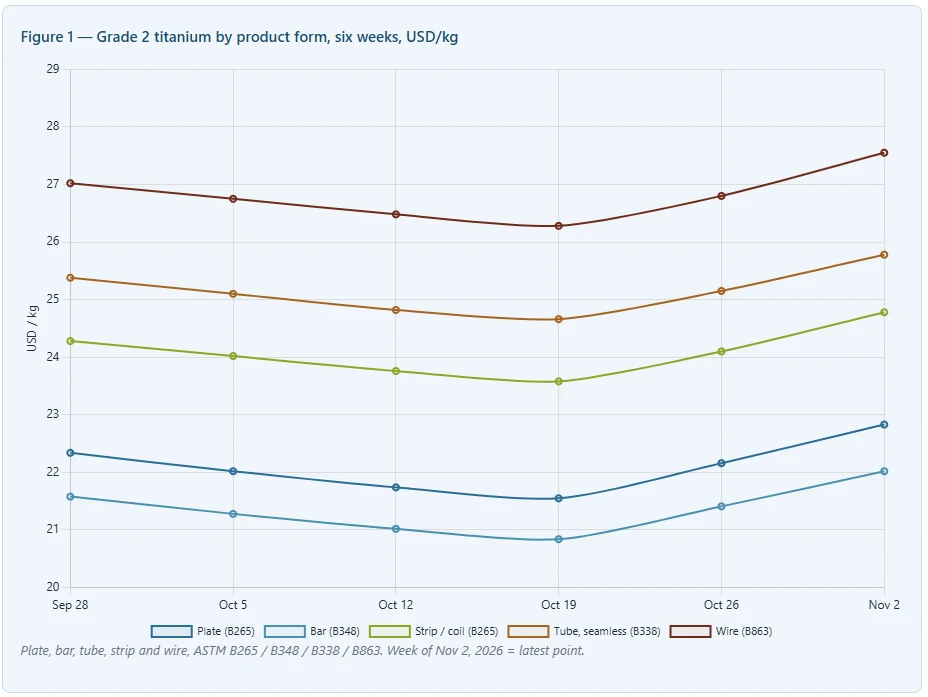
| Gr2 plate (ASTM B265, 3–50 mm) | 22.83 | USD / kg | +0.67 / +3.02% | Metal-led |
| Gr2 bar (ASTM B348, round) | 22.02 | USD / kg | +0.61 / +2.85% | Cheapest Gr2 form |
| Gr2 tube, seamless (ASTM B338) | 25.78 | USD / kg | +0.63 / +2.51% | Smallest Gr2 move |
| Gr2 strip / coil (ASTM B265, 0.1–3 mm) | 24.78 | USD / kg | +0.68 / +2.82% | Cold-roll book full |
| Gr2 wire (ASTM B863, Ø 0.5–6 mm) | 27.55 | USD / kg | +0.75 / +2.80% | Capacity-led |
| Gr2 wire, fine (Ø 0.1–1 mm) | 32.50 | USD / kg | +0.88 / +2.78% | Largest Gr2 percentage move |
| Gr2 tube, welded (ASTM B862) | 22.40 | USD / kg | +0.52 / +2.38% | Runs $3.38/kg under seamless |
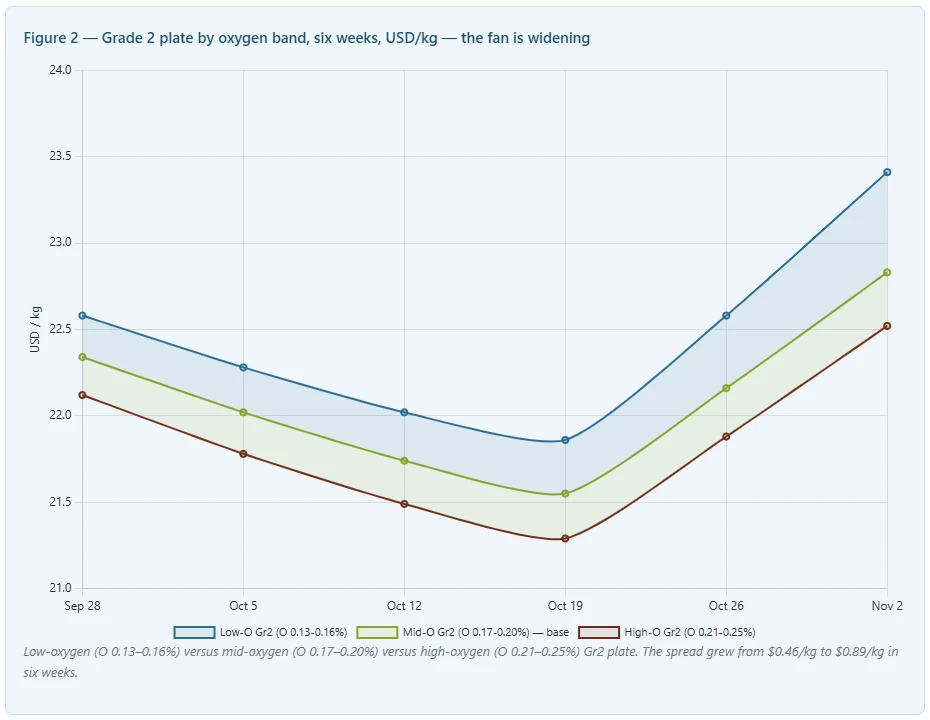
| Low-oxygen Gr2 premium (O 0.13–0.16%) | +0.58 | USD / kg | from +0.42 | +38% in one week |
| High-oxygen Gr2 discount (O 0.21–0.25%) | −0.31 | USD / kg | from −0.28 | Discount deepens |
| Oxygen swing inside one grade | 0.89 | USD / kg | from 0.70 | Widest in six weeks |
| Gr5 / Ti-6Al-4V plate (for substitution maths) | 39.24 | USD / kg | +1.52 / +4.03% | Gap over Gr2 widens to $16.41/kg |
| Mill quote validity | 5 | days | from 7 | Down from 14 days six weeks ago |
| Discretionary mill discount | 0 | % off list | unchanged | Still withdrawn |
| Low-oxygen Gr2 lead-time adder | +2–3 | weeks | from +2 | 99.7% sponge melt slot |
What Is Grade 2 Titanium?
Grade 2 (UNS R50400) is commercially pure titanium - the default grade of the entire CP family. It is not an alloy. Its strength comes almost entirely from interstitial elements held in solution, chiefly oxygen and iron, which is exactly why the specification window matters more here than it does for any alloy grade. Roughly half of all titanium mill product shipped worldwide is Grade 2, and the great majority of it goes into chemical process equipment, heat exchangers, marine hardware and architectural work - not aerospace.
| Element | Limit | What it actually does |
|---|---|---|
| Titanium | balance | - |
| Oxygen (O) | 0.25 max | No minimum. The single largest strength lever - roughly +1,000 MPa per 1.0% O, so 0.10% O is worth about 100 MPa |
| Iron (Fe) | 0.30 max | No minimum. Cheaper strengthener than oxygen; roughly +2 to 3 MPa per 0.01% Fe |
| Nitrogen (N) | 0.03 max | Potent strengthener and potent embrittler; counts double in oxygen equivalent |
| Carbon (C) | 0.08 max | Strength and weld-metal hardness |
| Hydrogen (H) | 0.015 max | Hydride former; the failure mechanism in hot reducing acid and over-pickled plate |
| Other, each / total | 0.10 / 0.40 | Residual control |
| Property | Value | Why a buyer should care |
|---|---|---|
| Tensile strength, min | 345 MPa | Comparable to annealed 304 stainless at half the weight |
| Yield strength, min | 275 MPa | - |
| Elongation, min | 20% | This is the property the Fe/O window quietly consumes |
| Density | 4.51 g/cm³ | 56% of steel |
| Elastic modulus | 105 GPa | Half of steel, and identical to Gr5. Stiffness is not a reason to upgrade grades |
| Thermal conductivity | 16.4 W/m·K | About one fifth of steel, one seventeenth of copper |
| Coefficient of thermal expansion | 8.6 µm/m·°C | Lower than austenitic stainless - matters in mixed-metal joints |
| Melting range | 1,668 °C | - |
| Max continuous service (air) | 300–350 °C | Oxidation and creep, not melting, set this ceiling |
| Electrical resistivity | 0.42 µΩ·m | Not a conductor - never a substitute for copper |
The Four Boundaries That Decide Whether Gr2 Is The Right Answer
Modulus is the trap. Gr2 is 105 GPa against steel's 200 GPa. An equal-section Gr2 replacement for a steel part deflects about twice as much. Titanium wins on specific strength, not absolute stiffness - and since Gr5 has the same 105 GPa, upgrading to Gr5 buys you strength, not stiffness.
The passive film needs oxygen and water to exist. The TiO2 film self-heals in any environment containing both. In dry chlorine, anhydrous methanol, and hot reducing acids it does not reform, and Gr2 corrodes quickly. Reducing acids - hydrochloric, sulphuric above roughly 10% and above roughly 60 °C - are outside the envelope regardless of grade.
Hydrogen is the silent failure. Above about 80 °C in reducing service, or under aggressive cathodic protection, Gr2 absorbs hydrogen and precipitates hydride platelets. Keep Fe low, never over-pickle, and never apply impressed-current protection without a potential limit.
Titanium galls. Dry titanium-on-titanium threads seize. Every threaded joint needs anti-seize or a dissimilar mating part. This is a design decision, not a lubrication footnote.
Grade 2 Equivalent Grades
| System | Designation | What it adds beyond "ASTM B265 Gr2" |
|---|---|---|
| UNS | R50400 | The universal key. Always put it on the RFQ |
| ASTM - plate, sheet, strip | B265 Gr2 | Product specification baseline |
| ASTM - bar, billet | B348 Gr2 | - |
| ASTM - seamless & welded tube | B338 / B861 / B862 Gr2 | B338 adds eddy-current or hydrostatic test |
| ASTM - wire | B863 Gr2 | - |
| ASTM - forgings | B381 Gr2 | - |
| ASTM - surgical implant | F67 Gr2 | Microstructure rating and tighter documentation. Typically +$1.80 to $3.20/kg over B265. Do not quote B265 to an implant RFQ |
| ASME | SB-265 / SB-348 / SB-338 Gr2 | Requires Section II documentation. An ASTM B265 certificate will not clear a coded vessel |
| EN / DIN | 3.7035, Ti2 | Nominally identical chemistry; EN 10204 3.1 certificate is the default deliverable |
| GB / China | TA2 (GB/T 3620.1) | Close, not identical - see trap 1 below |
| JIS | Class 2 (TR270C plate / TTH340 hot-rolled) | JIS classes are keyed to yield band, not to tensile minimum - see trap 3 |
| ISO - implant | ISO 5832-2 | Implant route outside ASTM territory |
| AMS | AMS 4902 (sheet/strip/plate), AMS 4921 (bar) | Aerospace adds surface condition, microstructure and in some forms ultrasonic inspection |
| AWS filler metal | ERTi-2 (AWS A5.16) | The only correct filler for welding Gr2 |
Two Heats, Both Certified Gr2: The Oxygen-And-Iron Substitution
This is the section that changes what you write on the RFQ. ASTM B265 gives the mill two independent strengthening knobs and a floor it only has to clear once: 345 MPa tensile and 20% elongation. Oxygen costs money to remove. Iron costs almost nothing to add. So the economic optimum for a mill is as much oxygen as the ceiling allows, topped up with iron, and the result passes every line of the specification.
| Heat | O % | Fe % | N % | Oe | UTS MPa | YS MPa | El % | USD/kg vs. base |
|---|---|---|---|---|---|---|---|---|
| A - low-O, low-Fe | 0.12 | 0.06 | 0.010 | 0.153 | 380 | 285 | 29 | +0.58 |
| B - mid-O, mid-Fe | 0.17 | 0.13 | 0.015 | 0.213 | 430 | 330 | 26 | base 22.83 |
| C - high-O, mid-Fe | 0.21 | 0.20 | 0.018 | 0.266 | 475 | 375 | 23 | −0.16 |
| D - high-O, high-Fe | 0.24 | 0.28 | 0.022 | 0.304 | 505 | 415 | 21 | −0.31 |
Why The Low-Oxygen Premium Widened 38% In One Week
The premium moved from $0.42/kg to $0.58/kg in seven days. Two mechanisms, and they add up exactly:
| Driver | USD / kg | Mechanism |
|---|---|---|
| Higher-purity sponge rose faster | +0.065 | 99.7% sponge gained 3.65% (+$275/t) against 3.09% (+$225/t) for 99.6% - a $50/t divergence. At roughly 1.3 kg of sponge per kg of mill product that is $0.065/kg |
| Allocation to Gr1 and Gr23 ELI | +0.095 | Melters fill medical and aerospace contracts first - longer terms, better margin. Gr2 gets the remainder, so low-O Gr2 competes for a shrinking pool |
| Total widening | +0.160 | $0.42 → $0.58/kg, +38% |
The practical consequence is a lead-time one. Low-oxygen Gr2 now carries a two-to-three week adder across every form, up from two weeks, because the melt has to wait for a 99.7% sponge lot rather than drawing from whatever is on hand. If your part needs formability and you have not specified oxygen yet, the specification decision and the melt slot are the same decision now - and the melt slot is the one that costs you calendar time.
Grade 2 Cost Benchmarks By Product Form
Numbers as a mill or converting house actually bills them, USD per kilogram of finished product, net for the week of November 2, 2026 with the discretionary discount still withdrawn at zero.
| Product form | Standard | Condition | USD / kg | Change on week |
|---|---|---|---|---|
| Plate (3–50 mm) | ASTM B265 / ASME SB-265 | Hot-rolled, annealed | 21.57–26.07 | +0.67 |
| Sheet (0.5–3 mm) | ASTM B265 | Cold-rolled, annealed | 23.30–27.90 | +0.70 |
| Strip / coil (0.1–3 mm) | ASTM B265 | Cold-rolled, annealed | 23.78–28.68 | +0.68 |
| Strip / foil (0.05–0.3 mm) | ASTM B265 | Cold-rolled, bright annealed | 29.20–35.40 | +0.80 |
| Bar, round (Ø 6–200 mm) | ASTM B348 / ASME SB-348 | Hot-rolled or turned, annealed | 20.81–25.21 | +0.61 |
| Tube, seamless (OD 6–114 mm) | ASTM B338 / ASME SB-338 | Cold-drawn, annealed | 24.83–30.23 | +0.63 |
| Tube, welded (OD 6–114 mm) | ASTM B338 / B862 | Welded, annealed | 21.95–26.65 | +0.52 |
| Heat-exchanger tube | ASTM B338 | Cold-drawn, bright annealed | 26.48–31.88 | +0.68 |
| Wire (Ø 0.5–6 mm) | ASTM B863 | Drawn, annealed or hard | 26.35–32.15 | +0.75 |
| Wire, fine (Ø 0.1–1 mm) | ASTM B863 / AMS 4951 | Drawn, bright annealed | 30.68–37.08 | +0.88 (largest % move) |
| Welding wire, coil / spool | ASTM B863 / AWS A5.16 (ERTi-2) | Drawn, cleaned, spooled | 32.50–43.90 | +1.10 |
| Forgings (disc, ring, block) | ASTM B381 | Forged, annealed | 27.40–34.60 | +0.72 |
The CP Ladder - What The Neighbouring Grades Cost Against Gr2
| Grade | USD/kg over Gr2 | What you are buying | When Gr2 is the wrong call |
|---|---|---|---|
| Gr1 | +0.54 | More ductility, lower strength - tighter refining control costs more, so Gr1 is not cheaper than Gr2 | Deep drawing beyond Gr2's limit, explosive cladding |
| Gr2 | base | The default | - |
| Gr3 | +0.93 | Higher strength from more oxygen; same corrosion behaviour | - |
| Gr4 | +2.50 | Highest CP strength | - |
| Gr12 (Ti-0.3Mo-0.8Ni) | +10.58 | Crevice-corrosion and hot-brine resistance | Hot chloride with gasketed or threaded joints |
| Gr5 / Ti-6Al-4V | +17.50 | Strength and temperature range | Strength-limited sections, above 350 °C |
| Gr7 (Ti-0.15Pd) | +23.16 | Reducing-acid resistance | Hot reducing acid |
| Gr23 / Ti-6Al-4V ELI | +30.83 | Implant and fracture-critical | - |
Two things follow. First, corrosion resistance does not improve as you climb the CP ladder - Gr1 through Gr4 share the same passive film and behave nearly identically in most media, so paying $0.93/kg extra for Gr3 buys strength that a stiffness-limited or corrosion-limited design does not use. Second, Gr12 at +$10.58/kg is the answer to hot-chloride crevice corrosion, and it costs $12.58/kg less than Gr7 - most specifications that reach for Gr7 on hot brine service do not need the palladium.
Where The Metal Leg Sits In Each Grade 2 Form
Sponge rose 3.09% this week. If Gr2 were priced off metal alone, every form would move by 3.09% of its metal leg. Splitting what actually happened tells you where a phone call still works.
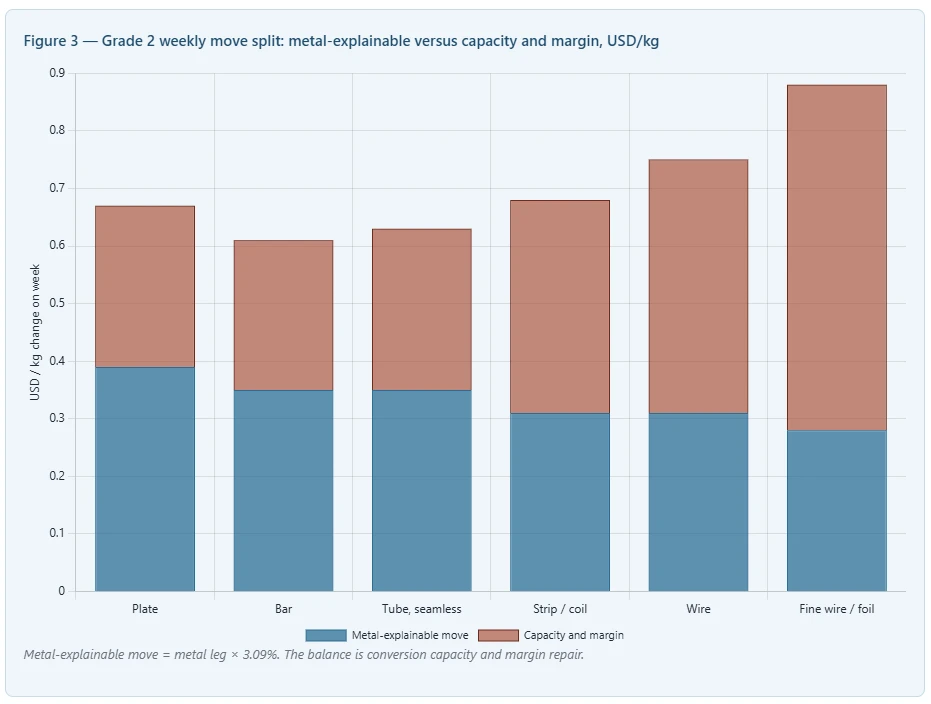
| Product form | Quote USD/kg | Metal share | Metal-explainable | Actual move | What that means for you |
|---|---|---|---|---|---|
| Plate | 22.83 | 55% | +0.39 | +0.67 | Metal-led - price negotiation still works |
| Bar | 22.02 | 52% | +0.35 | +0.61 | Metal-led - price negotiation still works |
| Tube, seamless | 25.78 | 44% | +0.35 | +0.63 | Mixed |
| Strip / coil | 24.78 | 40% | +0.31 | +0.68 | Capacity-led - book the rolling line |
| Wire | 27.55 | 36% | +0.31 | +0.75 | Capacity-led - book the drawing line |
| Fine wire / foil | 32.50 | 28% | +0.28 | +0.88 | Capacity-led - price talk is wasted time |
Only 58% of the plate increase is metal. On fine wire it is 32%. The thinner and more heavily processed the form, the larger the share of your increase that belongs to annealing and drawing capacity and to margin repair rather than to sponge. So negotiate plate and bar, and book capacity for strip, wire and foil - and note that welded tube at $3.38/kg under seamless is the single largest form-level saving available in Gr2 this week, provided the service allows a weld seam.
Three Grade 2 Decisions Worth Money This Week
1. If the part is stiffness-limited, Gr2 beats Gr5 by $16.41/kg and deflects identically
Gr2 and Gr5 have the same elastic modulus - 105 GPa. If your section is sized by deflection, by buckling, or by corrosion allowance rather than by allowable stress, then Gr5 buys you nothing except a thicker invoice. The gap is now $16.41/kg (Gr5 plate $39.24 against Gr2 $22.83), and it widened $0.85/kg this week because Gr5 rose 4.03% while Gr2 rose 3.02% - the fastest widening in six weeks. On a 500 kg release that is $8,205 saved, and a further $425 saved compared with last week.
The boundary is sharp. Stay on Gr5 where the section is strength-limited, where there is fatigue loading, where service exceeds 300 to 350 °C, or where the drawing carries an AMS callout. Switch to Gr2 where the design is stiffness-, weight- or corrosion-driven.
2. Put the oxygen and iron limits on before you put the quantity on
Low-oxygen Gr2 is +$0.58/kg today and carries a two-to-three week melt-slot adder. Both numbers are rising. If your part is deep-drawn, spun, hydroformed, tightly bent or welded with post-weld forming, specify O 0.16% max and Fe 0.15% max on the first RFQ - because a re-order placed after a formed part cracks costs you the part, not the premium. If the part is flat plate, unformed, and works at ambient temperature, take the generic heat and the $0.31/kg discount; you are not buying ductility you will not use.
3. Fix the commercial terms before you fix the price
Mill quote validity has fallen from 14 days to 5 days in six weeks and the discretionary discount is still zero. A five-day window is not enough time to run an internal approval, and every re-quote in a rising market is a price increase. Write these four lines in:
Ten-day validity in writing, not five. Mills are granting it when asked; they are not volunteering it.
A ceiling, not a fixed price. Fixed price is gone on orders beyond eight weeks, but price-at-shipment capped at +5% is still obtainable. Uncapped price-at-shipment on a ten-week tube order is an open exposure, not a price.
Split the release by lead time. Plate and bar at six to nine weeks, tube at eight to twelve, wire at six to ten, fine wire and foil at ten to fourteen. Ordering the whole bill to the longest item pays for the shortest items' metal risk.
Book third-party witness at purchase order, not at shipment. Witness adds two to three weeks unless it runs in parallel with production.
Grade 2 Titanium Product Range And Specifications
| Product | Standard | Size range | Condition / finish |
|---|---|---|---|
| Titanium plate | ASTM B265 / ASME SB-265 / AMS 4902 | Thickness 3–50 mm; width to 2,000 mm; length to 6,000 mm | Hot-rolled, annealed, pickled or ground |
| Titanium sheet | ASTM B265 / ASME SB-265 | Thickness 0.5–3 mm; width to 1,220 mm | Cold-rolled, annealed, pickled or bright |
| Titanium strip / coil | ASTM B265 | Thickness 0.05–3 mm; width 10–600 mm; coil ID 300 / 400 / 500 mm | Cold-rolled, annealed or bright annealed; slit edge or deburred |
| Titanium bar / rod | ASTM B348 / ASME SB-348 / AMS 4921 | Ø 6–200 mm round; hex and square on request; length to 6,000 mm | Hot-rolled, turned, peeled or centreless ground; annealed |
| Titanium tube, seamless | ASTM B338 / B861 / ASME SB-338 | OD 6–114 mm; wall 0.5–8 mm; length to 12,000 mm | Cold-drawn, annealed; bright annealed for heat-exchanger duty |
| Titanium tube, welded | ASTM B338 / B862 | OD 6–114 mm; wall 0.5–4 mm | Welded, annealed; weld seam bead-rolled or flush |
| Titanium wire | ASTM B863 / AMS 4951 / AWS A5.16 | Ø 0.1–6 mm; coil or spool | Drawn, annealed or hard drawn; bright annealed; cleaned and spooled for welding |
| Forgings and rings | ASTM B381 | Disc, ring, block, to drawing | Forged, annealed, rough or finish machined |
| Category | Detail |
|---|---|
| Grades supplied | Gr1, Gr2, Gr3, Gr4, Gr5 / Ti-6Al-4V, Gr7, Gr9, Gr12, Gr23 ELI - plus GB TA1, TA2, TA4, TC4 |
| Oxygen band options | Low-O 0.13–0.16% (+$0.58/kg), mid-O 0.17–0.20% (base), high-O 0.21–0.25% (−$0.31/kg). Custom caps on O and Fe available |
| Melting | VAR double or triple melt; EB melt on request; full heat traceability to the sponge lot |
| Processing | Hot rolling, cold rolling, forging, extrusion, drawing, vacuum annealing, pickling, precision slitting, cut-to-length, water-jet and plasma cutting |
| Surface | Pickled (nitric-hydrofluoric), ground, polished to Ra 0.4 µm, bright annealed, bead blasted. Alpha case removed as standard on hot-worked product |
| Testing | Tensile and hardness, full interstitial report (O, N, H, Fe, C actual values), ultrasonic per ASTM B594, eddy current and hydrostatic per ASTM B338, bend test, flattening and flare, grain-size and microstructure per ASTM F67 where specified, dimensional inspection |
| Certification | EN 10204 3.1 standard; 3.2 with third-party witness available (adds 2–3 weeks unless booked at PO). ASME SB- forms supplied with Section II documentation |
| Lead time | Plate and sheet 6–9 weeks (stock sizes 2–4); bar 5–8; seamless tube 8–12; welded tube 5–7; strip and coil 6–9; foil 10–14; wire 6–10; fine wire 10–14. Low-oxygen specification adds 2–3 weeks; third-party witness adds 2–3 weeks |
| Packing | Interleaved or sleeved, VCI paper, sealed plywood crate with steel banding, sealed end caps on tube, moisture indicator, ISPM 15 heat-treated timber |
| Trade terms | EXW, FCA, FOB, CFR, CIF, DAP, DDP. Scrap credit on returned sorted swarf: CP grades $1.80–$2.60/kg |


