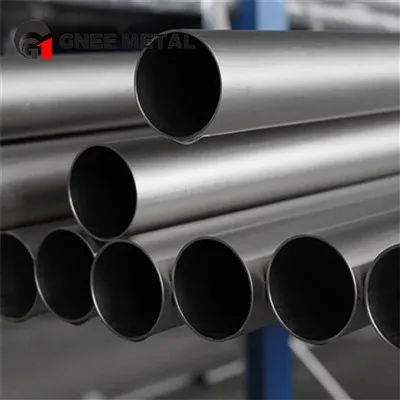

ASTM B338 Titanium Grade 1 Tube: Specifications and Applications
Apr 14, 2026
ASTM B338 is the governing standard for seamless and welded titanium tubes used in condensers and heat exchangers, and Grade 1 is the softest, most ductile grade it covers. Designated UNS R50250, Grade 1 tube combines a tensile strength of 240 MPa minimum with elongation of 24% minimum, making it the easiest titanium tube to bend, flare, and cold form. Because it is commercially pure titanium, it forms a self-healing oxide film that gives outstanding resistance to seawater, chlorides, and oxidizing media. This combination explains its widespread use in heat exchanger bundles, marine cooling lines, and high-purity process piping.
Equivalent Designations
| Standard | Designation |
|---|---|
| ASTM B338 | Grade 1 (titanium tube) |
| UNS | R50250 |
| DIN / W-Nr. | 3.7025 |
| ISO 5832-2 | Grade 1 (surgical implant material) |
| ASTM B265 / ASME SB265 | Grade 1 (plate, sheet, strip) |
Chemical Composition per ASTM B338
The composition limits are titanium balance, iron 0.20% maximum, oxygen 0.18% maximum, carbon 0.08% maximum, nitrogen 0.03% maximum, and hydrogen 0.015% maximum. The low oxygen limit, 0.18%, is what gives Grade 1 its exceptional ductility and formability compared with Grade 2, which allows 0.25% oxygen.
Mechanical and Physical Properties
| Property | Value |
|---|---|
| Tensile strength | 240 MPa minimum |
| Yield strength (0.2% offset) | 138-310 MPa |
| Elongation | 24% minimum |
| Density | 4.51 g/cm³ |
| Melting point | about 1670°C |
| Beta transus | 888 ± 4°C |
| Thermal conductivity at 20°C | about 16 W/m·K |
At 4.51 g/cm³, Grade 1 tube is about half the weight of nickel-based alloy tube of the same dimensions, which is a decisive factor in large exchanger bundles and offshore structures.
Typical Applications
Chemical processing: heat exchanger and condenser tubing, reactor coils, and piping for chloride-bearing and oxidizing media
Marine engineering: seawater cooling lines, ballast system tubing, and desalination tube bundles
Pharmaceutical industry: high-purity water and fluid transfer lines
Medical technology: surgical instrument tubing and device components per ASTM F67
Power generation: steam condenser tubes where seawater is the cooling medium
Fabrication Guidance
Grade 1 tube can be cold bent, flared, and flanged with low springback; mandrel bending is recommended for tight radii to prevent kinking. Welding by GTAW or GMAW is straightforward, but the weld zone and root side must be shielded with argon because titanium absorbs oxygen and nitrogen above about 400°C, which embrittles the joint. For maximum ductility after welding, a post-weld anneal at 650-700°C followed by air cooling is used. Non-destructive examination options include ultrasonic, eddy current, and hydrostatic testing per ASTM B338.
Quality and Certification
Material supplied to ASTM B338 should carry a mill test certificate per EN 10204 Type 3.1, traceable to the heat number, with chemical analysis and tensile results. For welded tube, verify that the weld zone meets the flattening and flaring tests of the standard, and confirm the exact delivery condition, normally annealed or cold-worked stress-relieved.
FAQ
What is the difference between Grade 1 and Grade 2 tube per ASTM B338?
Grade 1 has a 240 MPa minimum tensile strength and 24% elongation, while Grade 2 offers 345 MPa and 20%. Grade 1 is easier to cold form and bend; Grade 2 suits pressure-bearing components where a little more strength is needed.
What is UNS R50250 equivalent to?
UNS R50250 is equivalent to ASTM B338 Grade 1, DIN 3.7025, ISO 5832-2 Grade 1 for implants, and ASTM B265 Grade 1 for plate and sheet. All refer to CP titanium with 0.18% maximum oxygen.
Can Grade 1 titanium tube be used in seawater?
Yes. It is one of the most seawater-tolerant engineering alloys, with negligible general corrosion and strong resistance to pitting and crevice attack in ambient-temperature chloride service.
What is the maximum service temperature for Grade 1 tube?
Continuous service up to about 300°C is practical in seawater and oxidizing media. Above that, oxidation accelerates and creep strength becomes limiting; higher-strength grades or alloys are then specified.
Is Grade 1 tube suitable for pharmaceutical water systems?
Yes. Its corrosion resistance, non-toxicity, and non-magnetic behavior meet the requirements of high-purity water systems, and it satisfies the purity requirements of ISO 5832-2.
What wall thickness tolerance applies to welded Grade 1 tube?
ASTM B338 wall thickness tolerances do not apply at the weld seam of welded tube; the weld area is evaluated by flattening, flaring, and non-destructive testing instead. Dimensional tolerances for the rest of the tube follow the standard tables.