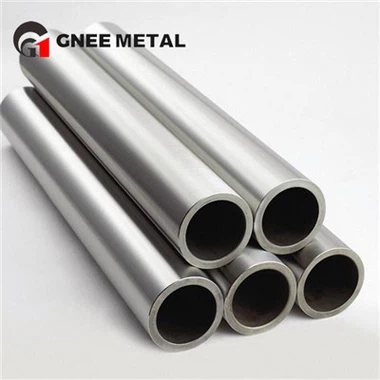
Tantalum Metal: Properties, ASTM B708 Grades and Industrial Applications
Mar 07, 2024
Tantalum: Element Overview
Tantalum is a refractory transition metal with the chemical symbol Ta and atomic number 73, placed in group 5 and period 6 of the periodic table. Its standard atomic weight is 180.94788, it crystallises in a body-centred cubic lattice, and it is a steel-grey, lustrous solid in its elemental form. Tantalum belongs to the same group as vanadium and niobium and shares with niobium the property of being found together in mixed oxide ores, which is the origin of most supply and refining complexity.
Two characteristics define the engineering value of the metal. First, it is ductile and workable at room temperature, so it can be rolled to foil, drawn to fine wire and bent without cracking. Second, it forms a stable, self-healing passive oxide film that resists a broad range of aggressive chemical media, which makes it a standard material for chemical process equipment.
Physical and Mechanical Properties
| Property | Value |
|---|---|
| Chemical symbol / atomic number | Ta / 73 |
| Atomic weight | 180.94788 |
| Crystal structure | Body-centred cubic |
| Density | 16.65 g/cm3 |
| Melting point | 3017 C |
| Boiling point | 5458 C |
| Elastic modulus | 186 GPa |
| Thermal conductivity | 57.5 W/m-K |
| Coefficient of thermal expansion | 6.3 um/m-K (20 to 100 C) |
| Electrical resistivity | 131 nOhm-m (0.131 uOhm-m) |
| Annealed hardness | Typically 60 to 125 HV, purity dependent |
| Recrystallisation temperature | Typically 1000 to 1300 C, purity and cold work dependent |
Reported tensile strengths for annealed unalloyed tantalum sheet sit in the region of 200 to 350 MPa with elongation above 20 percent, and values rise substantially after cold work. Because properties depend strongly on interstitial content, mill product should always be purchased against a recognised specification such as ASTM B708 for plate, sheet and strip, ASTM B521 for seamless and welded tube, or ASTM F560 for unalloyed tantalum intended for surgical implants. Those specifications limit carbon, oxygen, nitrogen and hydrogen, and the hydrogen limit is normally 0.015 percent maximum because hydrogen embrittlement is the principal failure mode of tantalum in service.
Ores, Extraction and Supply Chain
Tantalum is recovered from the columbite-tantalite mineral group, commonly called coltan, in which tantalum and niobium oxides occur in solid solution. Economically important deposits are found in granitic pegmatites and in weathered placer deposits in central Africa, Brazil and Australia. Because of the chemical similarity of niobium and tantalum, separation is the difficult step: the ore concentrate is dissolved in a fluoride-containing acid medium, and tantalum is separated by solvent extraction or ion exchange before being converted to potassium heptafluorotantalate, K2TaF7.
Metallic tantalum is then produced by sodium reduction of K2TaF7, or by molten-salt electrolysis, giving a powder that is either consolidated by vacuum sintering or melted into ingot by vacuum arc or electron-beam melting. Capacitor-grade tantalum powder is a separate product stream with tightly controlled particle morphology and purity. The overall chain is long and concentrated, and the concentration of both mining and refining is a well-documented supply risk for capacitor and superalloy users.
Corrosion Behaviour: Strengths and Limits
The passive film on tantalum makes it resistant to hydrochloric acid, nitric acid, and even aqua regia at ambient conditions, and to sulphuric acid up to roughly 150 C. This is why tantalum is used for thermowells, bayonet heaters, heat exchanger tubing and vessel linings in chemical plants handling strong mineral acids.
The limits of that resistance must be stated just as clearly, because the common misconception that tantalum is chemically inert is wrong and expensive:
Fluoride media: hydrofluoric acid, fluoride salts and any acid mixture containing fluoride ions attack tantalum rapidly by destroying the passive film. Tantalum equipment must never be used with fluoride-containing fluids.
Hot concentrated alkalis: sodium and potassium hydroxide at elevated temperature cause general corrosion.
Fuming sulphuric acid (oleum): attack becomes significant at elevated temperature.
High-temperature air: tantalum oxidises rapidly in air above roughly 300 C and becomes embrittled by oxygen uptake, so it is not a structural material for hot air or oxidising furnace atmospheres. Vacuum or high-purity inert atmospheres are required.
Hydrogen: hydrogen dissolves in tantalum and forms brittle hydrides, so hydrogen content is specified at 0.015 percent maximum and hydrogen-rich or hydrogen-sulphide service is excluded.
Where Tantalum Is Used
Electrolytic capacitors: sintered tantalum powder anodes with a tantalum pentoxide dielectric deliver very high capacitance per unit volume, and this remains the largest single application of the metal.
Chemical process equipment: heat exchangers, columns, thermowells and linings built from tantalum tube and sheet to ASTM B521 and ASTM B708.
Medical implants: unalloyed tantalum to ASTM F560 is biocompatible and radiopaque, and porous tantalum structures are used for bone ingrowth in orthopaedic and spinal devices.
Aerospace and defence electronics: high-temperature components and sputtering targets for thin films with a high refractive index and excellent thermal stability.
Superalloys and hardmetals: tantalum is added to nickel-base superalloys and as tantalum carbide in cemented carbides, where it inhibits grain growth during sintering.
Corrosion-resistant fasteners and lab ware: small parts exposed to strong acids in analytical and process environments.
Working, Machining and Joining
Tantalum cold works in a manner closer to soft copper than to steel: it galls against tooling, produces continuous stringy chips, and work hardens, so sharp high-positive-rake tools, generous cutting fluid flow and light finishing passes are used. Interstage annealing is performed in high vacuum or high-purity inert gas to prevent oxygen and hydrogen pickup, and the vacuum level must be verified before each cycle because residual water vapour is itself a hydrogen source. Tantalum sheet and tube are joined by gas tungsten arc welding or electron-beam welding under inert shielding, with the same cleanliness discipline applied to titanium: degreased surfaces, no iron contamination, and controlled shielding gas purity. Cold-worked parts are usually stress relieved before welding to avoid cracking in the heat-affected zone.
FAQ
Q: Is tantalum the same as coltan?
Coltan is the informal name of the columbite-tantalite ore group that contains both tantalum and niobium; tantalum is the refined metal obtained from that ore.
Q: Why is tantalum used in capacitors?
Its anodised pentoxide film is extremely thin and stable, which yields high capacitance per unit volume and volume-efficient capacitors for electronics.
Q: Can tantalum be used with hydrochloric acid?
Yes, hydrochloric acid at ambient and moderate temperature is a standard tantalum service, provided the medium contains no fluoride ions and no hydrogen-generating conditions.
Q: Does tantalum resist low or high temperature better?
It is excellent at low temperature, remaining ductile, and has a 3017 C melting point, but in oxidising atmospheres above roughly 300 C it embrittles through oxygen pickup, so high-temperature use requires vacuum or inert gas.
Q: What is the normal hydrogen limit for tantalum?
Common mill specifications cap hydrogen at 0.015 percent maximum, because absorbed hydrogen forms brittle hydrides.
Q: Is tantalum magnetic?
No. Tantalum is paramagnetic, with only a very weak response, which is one reason it is compatible with magnetic resonance imaging environments.