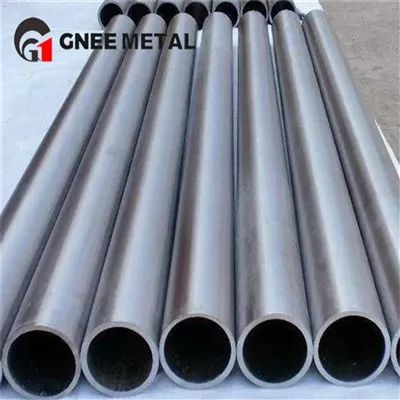

Can Gr5 Titanium Welded Pipe Be Used at Low Temperatures?
Apr 02, 2024
The short answer is yes, with qualifications that matter. Grade 5, the Ti-6Al-4V alloy, retains useful toughness at low temperature because titanium has a hexagonal close packed structure and does not show the sharp ductile to brittle transition that ferritic steels do. What limits welded Grade 5 pipe in cold service is not the parent metal but the weld and the interstitial content around it.
What Low Temperature Does to Titanium
As temperature falls, titanium gains strength and stiffness while losing some ductility. Tensile strength at liquid nitrogen temperature is roughly half again the room temperature value, and the increase is smooth rather than abrupt. There is no equivalent of the Charpy transition temperature that governs carbon and low alloy steel selection, so a designer does not need to look for a transition curve. The practical concerns instead are notch sensitivity, thermal contraction mismatched against adjacent steel components, and heat transfer behaviour in cryogenic service.
Why the Weld Governs the Limit
A welded pipe carries a fusion zone and a heat affected zone whose structure differs from the parent metal. In Ti-6Al-4V the weld cools into a coarse transformed structure, and because the weld pool is molten in air, it is also the place where oxygen and nitrogen pick-up is most likely. Both effects lower toughness. At ambient temperature the reduction can be tolerated in many duties; at low temperature, where ductility reserve is already smaller, it becomes the governing factor. This is why welded pipe intended for cold service is normally specified with a qualified welding procedure, full shielding and, above room temperature oxygen limits, a check on the weld rather than the plate.
Chemistry and Property Limits to ASTM B338
| Element or property | Grade 5 limit to ASTM B338 |
|---|---|
| Aluminium | 5.5 to 6.75 % |
| Vanadium | 3.5 to 4.5 % |
| Oxygen | 0.20 % max |
| Nitrogen | 0.03 % max |
| Carbon | 0.08 % max |
| Hydrogen | 0.015 % max |
| Iron | 0.30 % max |
| Tensile strength, min | 895 MPa (130 ksi) |
| Yield strength, 0.2 % offset, min | 828 MPa (120 ksi) |
| Elongation, min | 10 % |
Those minima apply at room temperature, as all standard specification values do. They are the right basis for ordering, but they are not a guarantee of low temperature behaviour, which has to be established separately.
Interstitials, Hydrogen and Ductility at Low Temperature
| Element | Effect | Action for cold service |
|---|---|---|
| Oxygen | Raises strength and lowers toughness; the strongest single influence on low temperature ductility | Order the lowest oxygen content the grade allows and check it on the certificate |
| Nitrogen | Strong interstitial strengthener with a disproportionate embrittling effect if picked up in welding | Full inert gas shielding during welding and a weld colour check |
| Hydrogen | Forms brittle hydride once the solid solubility limit is exceeded | Keep to the 0.015 % maximum and avoid acid cleaning that promotes pick-up |
| Iron | Beta stabiliser that shifts the phase balance at higher content | Control as a specification limit rather than treat as a trace element |
Where the coldest duty is expected, the extra low interstitial version of the alloy is normally selected. Cutting oxygen from 0.20 % to a much lower level markedly improves toughness at temperature, and that is exactly the logic behind the ELI grades used for cryogenic and medical work.
Comparing Grades for Cold Service
| Grade | Chemistry basis | Cold service behaviour |
|---|---|---|
| Grade 1 | Unalloyed titanium, 0.18 % max oxygen | Excellent ductility at low temperature, low strength |
| Grade 2 | Unalloyed titanium, 0.25 % max oxygen | Good ductility, the general purpose unalloyed choice |
| Grade 5 | Ti-6Al-4V, 0.20 % max oxygen | High strength with retained toughness; weld behaviour must be qualified |
| Grade 5 ELI | Ti-6Al-4V with extra low interstitials | Best combination of strength and toughness at low temperature |
| Grade 12 | Titanium with 0.3 % molybdenum and 0.8 % nickel | Improved corrosion resistance at moderate temperature, used where reducing media are involved |
What to Verify Before Using Welded Grade 5 Pipe Below Zero
Confirm the delivered interstitial content against the certificate, obtain the welding procedure qualification and the weld colour acceptance record, and check whether the drawing requires a post-weld anneal or stress relief. Review the support spacing and any steel components that will contract differently from the titanium line. Finally, be explicit about the design temperature and whether the low temperature duty is continuous or only a startup and shutdown transient, because the two cases justify different levels of qualification.
Frequently Asked Questions
Q: Can welded Grade 5 titanium pipe be used at low temperatures?
A: Yes, in many duties. Ti-6Al-4V retains useful toughness because titanium does not exhibit a sharp ductile to brittle transition, but the weld zone and the interstitial content must be controlled and the application qualified.
Q: Does titanium become brittle at low temperature like carbon steel?
A: No. The hexagonal close packed structure means there is no abrupt transition, so strength rises smoothly as temperature falls while ductility decreases gradually.
Q: What is the weakest point of a welded Gr5 pipe at low temperature?
A: The fusion zone and heat affected zone, which have a coarser structure and any oxygen or nitrogen picked up during welding; toughness there is lower than in the parent metal.
Q: Which grade is preferred for the coldest service?
A: An extra low interstitial grade of the same alloy, because lowering oxygen markedly improves toughness at low temperature while preserving the strength advantage over unalloyed titanium.
Q: What should be checked on the mill certificate?
A: Oxygen, nitrogen, hydrogen and iron content, the heat treatment condition of the finished pipe, and the welding procedure qualification together with the weld colour acceptance record.