Characteristics and Patterns of Crevice Corrosion in Titanium
Aug 12, 2025
Crevice corrosion is a localized corrosion phenomenon that occurs in tight crevices. Crevices can be structural (such as flange or gasket surfaces, tube-to-tube sheet expansion joints, and bolt or rivet joints), or they can be caused by scale or deposits and the underlying surface. Initially, it was believed that titanium would not undergo crevice corrosion in seawater or salt spray. However, crevice corrosion damage has subsequently occurred in high-temperature chloride media (such as seawater heat exchangers), wet chlorine gas (such as wet chlorine shell-and-tube condensers), oxidant-inhibited hydrochloric acid solutions, and formic and oxalic acid solutions.
Crevice corrosion in titanium is dependent on many factors, including ambient temperature, chloride type and concentration, pH, and crevice size and geometry. Furthermore, crevices between titanium and non-metallic materials, such as polytetrafluoroethylene and asbestos, are more susceptible to crevice corrosion than between titanium and titanium.
Based on research and industrial practice both domestically and internationally, crevice corrosion in titanium exhibits the following characteristics and patterns. ① Crevice corrosion has an incubation period, the length of which is dependent on many factors, such as ambient temperature, chloride type and concentration, oxidant concentration, materials in contact with titanium, solution pH, and crevice size and geometry. For titanium in sodium chloride solution, the higher the chloride ion concentration, the higher the temperature, and the lower the pH, the shorter the incubation period, indicating a greater susceptibility to crevice corrosion.
② The solution composition and pH in the crevice are completely different from those in the bulk solution. Generally speaking, when the oxygen concentration in the crevice is low and the chloride and hydrogen ion concentrations are high (the pH is lower than that of the bulk solution), the pH in the crevice can drop to <1, causing the electrode potential in the crevice to become more negative, thus making the titanium in the crevice active. Laboratory electrochemical measurements show that the crevice corrosion potentials of various halide ions follow the order: Cl- < Br- < I-. This indicates that titanium is most susceptible to crevice corrosion in chloride solutions, which is the opposite of titanium's sensitivity to pitting corrosion. ③ Crevice corrosion in titanium typically occurs locally within the crevice surface and generally does not occur throughout the entire crevice surface. After the incubation period, once nucleation has occurred, corrosion rapidly progresses due to autocatalytic mechanisms, ultimately leading to localized perforation and destruction.

④ Crevice corrosion in titanium is often accompanied by hydrogen absorption, and even needle-shaped hydrides can be observed within the material using a metallographic microscope. As hydrogen absorption increases, the surface hydride accumulation continues, accelerating overall corrosion. Simultaneously, hydrogen continuously penetrates into the metal interior, and internal hydride precipitation can become a source of stress corrosion cracking, causing cracking under external stress.
⑤ After years of research, the physical picture of the crevice corrosion process in titanium has become relatively clear. Simply put, it consists of two stages: the incubation period and the active dissolution period.
In the initial incubation period, the same reaction occurs both inside and outside the crevice. The cathodic reaction consumes oxygen in the crevice solution. When the crevice becomes oxygen-depleted, the cathodic reaction occurs only outside the crevice, while the anodic reaction-the anodic dissolution of titanium-dominates within the crevice. As the number of titanium ions within the crevice increases, chloride ions continuously migrate into the crevice to maintain the charge balance between positive and negative ions. Simultaneously, the titanium ions accumulate in the crevice and undergo hydrolysis, producing a white corrosion product, titanium hydroxide. The dehydrated white corrosion product has been identified as TiO2. The hydrolysis reaction lowers the pH within the crevice, further disrupting the titanium's passivation. Therefore, once the incubation period for crevice corrosion ends, its progression is extremely rapid, a phenomenon known as "autocatalysis."
⑥ The "geometric factors" of crevice corrosion in titanium include factors such as crevice length, crevice width, and the ratio of the area inside and outside the crevice. These values generally require experimental determination of specific systems and cannot be theoretically predicted. Experiments have shown that narrow crevice corrosion is much more susceptible than wide crevice corrosion, with crevice widths typically below 0.5 mm. ⑦ To improve titanium's corrosion resistance in reducing inorganic acids and reduce its sensitivity to crevice corrosion, titanium alloys are generally used. These alloys, such as Ti-Pd and Ti-Ni-Mo, offer superior performance compared to commercially pure titanium, particularly Ti-Pd. Surface treatments such as palladium plating, thermal oxidation, or anodizing can improve titanium's resistance to crevice corrosion.
The company boasts leading domestic titanium processing production lines, including:
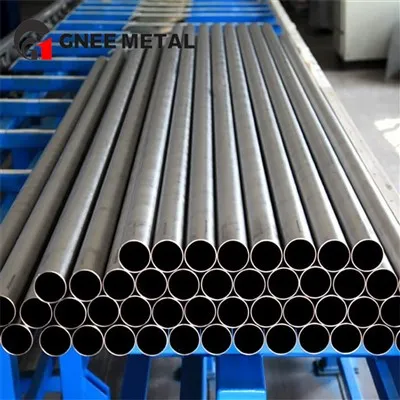
German-imported precision titanium tube production line (annual production capacity: 30,000 tons);
Japanese-technology titanium foil rolling line (thinnest to 6μm);
Fully automated titanium rod continuous extrusion line;
Intelligent titanium plate and strip finishing mill;
The MES system enables digital control and management of the entire production process, achieving product dimensional accuracy of ±0.01μm.