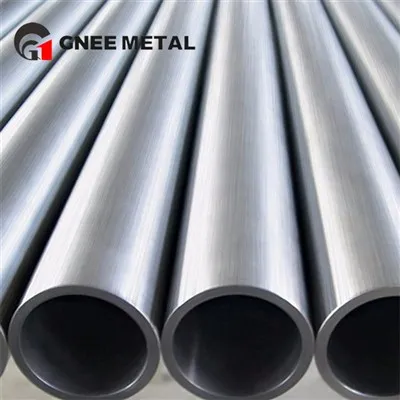

GR1 Titanium for Heat Exchangers
May 20, 2026
Why is GR1 used for heat exchanger tubes?
Two reasons: formability and corrosion resistance.
GR1 titanium has the lowest oxygen content of any commercial pure titanium grade. That makes it soft and ductile. Heat exchanger tubes are often bent into U-shapes. A U-bend requires the tube to stretch on the outside of the bend and compress on the inside. If the material is too hard, it cracks.
GR2 is stronger but less ductile. GR5 (Ti-6Al-4V) is even stronger but very difficult to bend. For U-bend tubes, GR1 is the right choice.
The second reason is corrosion resistance. Titanium resists:
Seawater and brine
Chlorides (including high temperature chlorides)
Acetic acid
Formic acid
Wet chlorine gas
Hypochlorite solutions
In a heat exchanger, the tube side often carries aggressive media. Stainless steel pits. Copper alloys corrode. GR1 titanium does not.

What ASTM spec covers GR1 heat exchanger tubes?
ASTM B338 grade 1.
This is the specification for seamless and welded titanium tubes for surface condensers, heat exchangers, and similar applications.
ASTM B338 grade 1 includes specific requirements that matter for heat exchanger service:
| Requirement | What it tests |
|---|---|
| Flattening test | Ductility of the tube wall |
| Flaring test | Ability to expand the tube into tubesheets |
| Reverse flattening test | Weld seam quality (for welded tube) |
| Eddy current or hydrostatic test | Leak tightness |
| Tight wall tolerances | Consistent heat transfer |
Do not use ASTM B861 seamless pipe for heat exchanger tubes. B861 does not require flattening or flaring tests. Your U-bends may crack. Your tube expansion may fail.
Seamless or welded? Which one should you choose?
Both are allowed under ASTM B338. The choice depends on your application.
Seamless B338 grade 1 tube:
No weld seam to worry about
Better for high vibration services
More expensive than welded
Longer lead times for custom sizes
Welded B338 grade 1 tube:
Lower cost than seamless
Weld seam is fully annealed
Must pass reverse flattening test
Acceptable for most heat exchanger applications
Most heat exchanger tubes are welded. The cost savings are significant. As long as the weld seam is placed on the neutral axis of the U-bend, cracking is rare.
If your specification calls for seamless only, follow the spec. Otherwise, welded tube is fine for the majority of shell-and-tube heat exchangers.
What are the typical dimensions for GR1 heat exchanger tubes?
Standard sizes for ASTM B338 grade 1 tubes:
| Outside diameter (mm) | Wall thickness (mm) | Typical application |
|---|---|---|
| 12.7 | 0.7 to 1.2 | Small condensers |
| 15.9 | 0.9 to 1.2 | Standard industrial |
| 19.1 | 1.0 to 1.6 | Most common size |
| 25.4 | 1.2 to 2.1 | Large exchangers |
| 31.8 | 1.2 to 2.5 | High pressure |
Lengths are typically 6 to 30 meters. Longer tubes reduce the number of U-bends but require larger bending machines.
Wall thickness tolerance for B338 is tighter than B861. For a 1.2mm wall, B338 allows plus or minus 0.1mm. B861 allows plus or minus 0.15mm. That difference matters when you are rolling tubes into a tubesheet.
How are GR1 heat exchanger tubes bent into U-shapes?
U-bending is the most critical step in making a titanium heat exchanger.
Titanium work-hardens. If you bend it too fast or with too small a radius, it cracks.
Minimum bend radius for GR1 titanium tube:
For tube OD up to 25mm: 1.5 to 2 times the OD
For tube OD above 25mm: 2 to 2.5 times the OD
Practices for bending GR1 tubes:
Use a mandrel inside the tube to prevent ovality
Use a wiper die to prevent wrinkling on the inside radius
Bend slowly (titanium does not like high strain rates)
No heat required. Cold bending is standard.
Check for cracking after bending. A simple visual inspection is not enough. Use dye penetrant testing on critical bends.
How do you expand GR1 tubes into a tubesheet?
Tube expansion is how you seal the tube to the tubesheet. Titanium is softer than steel, so expansion parameters are different.
Two methods:
Roller expansion: A rotating mandrel expands the tube into the tubesheet. Titanium work-hardens quickly, so you need more passes than with steel. Use titanium-compatible lubricant to prevent galling.
Hydraulic expansion: A rubber bladder or liquid pressure expands the tube. This is gentler on titanium and produces more uniform expansion. Recommended for thin wall tubes below 1.2mm.
What is the difference between GR1 and GR2 for heat exchangers?
| Component | Recommended grade | Why |
|---|---|---|
| U-bend tubes | GR1 | Needs formability for bending |
| Straight tubes (no bends) | GR1 or GR2 | GR2 works but GR1 is safer |
| Tubesheet | GR1 or GR2 | Clad or solid, both work |
| Shell (pipe) | GR2 or GR1 | No forming required, GR2 is cheaper |
| Channel | GR2 or GR1 | No forming required |
Do not use GR2 for U-bend tubes. The higher oxygen content reduces ductility. Cracking rates go up significantly.
Do not use GR5 for heat exchanger tubes. GR5 is too hard to bend and costs much more. GR5 is for structural components, not tubes.
How much does GR1 heat exchanger tube cost?
GR1 tube costs more than GR2 tube. But the difference is small compared to the cost of replacing a failed heat exchanger.
Price factors:
| Factor | Impact on price |
|---|---|
| Seamless vs welded | Welded is 15 to 25 percent cheaper |
| Quantity | Volume discounts available |
| Wall thickness | Thinner walls cost less |
| Length | Longer lengths may cost more to ship |
| Certification | Third party inspection adds cost |
Current gr1 titanium price per kg varies with raw material costs. Contact us for a quote based on your size and quantity.
For wholesale grade 1 titanium tubing, ask about our stock program. Common sizes in 19.1mm and 25.4mm OD ship within 48 hours.
FAQ
1. Why is GR1 titanium used for heat exchangers instead of stainless steel?
Corrosion resistance. Stainless steel pitts in seawater and chlorides. Titanium does not. GR1 heat exchanger tubes last 20 to 30 years in marine service. Stainless may fail in 2 to 5 years.
2. Can I use GR2 titanium for U-bend tubes?
Not recommended. GR2 has higher oxygen content and lower ductility. Cracking rates increase significantly. Test a sample before committing to GR2 for U-bends.
3. What is the minimum bend radius for GR1 titanium tube?
1.5 to 2 times the outside diameter. For a 19.1mm OD tube, minimum bend radius is 28.6mm to 38.2mm. Below 1.5 times OD, test first.
4. Does GR1 titanium require heat treating after bending?
No. GR1 does not require post-bend annealing. The material is already soft and ductile. GR2 and GR5 may require stress relief, but GR1 is fine as-bent.
5. What is ASTM B338 grade 1?
The specification for titanium heat exchanger tubes. It covers seamless and welded tube, with flattening, flaring, and hydrostatic or eddy current testing.
6. What is the difference between B338 and B861?
B338 is for heat exchanger tubes. B861 is for general service seamless pipe. B338 has tighter tolerances and requires flattening and flaring tests. B861 does not. They are not interchangeable.
7. Can welded tube be used for heat exchanger U-bends?
Yes. ASTM B338 allows welded tube. The weld seam must be placed on the neutral axis of the bend. Most heat exchanger tubes are welded, not seamless.
8. How do you test GR1 tube for cracking after bending?
Dye penetrant testing. Apply penetrant, wait, wipe off, apply developer. Cracks show as red lines. Visual inspection alone is not enough.
9. What is the corrosion resistance of GR1 titanium?
Excellent in seawater, chlorides, acetic acid, formic acid, and wet chlorine. Not recommended for hydrofluoric acid or concentrated sulfuric acid.
10. Can I roll GR1 tubes into a steel tubesheet?
Yes. Use roller expansion or hydraulic expansion. Titanium is softer than steel, so adjust rolling parameters. Do not over-expand. Test a sample first.
11. What filler metal should I use to weld GR1 titanium?
ERTi-1 or ERTi-2. ERTi-1 matches GR1 chemistry. ERTi-2 is slightly stronger and more common. Both work.
12. How do I clean GR1 titanium tubes before installation?
Use acetone or isopropyl alcohol. Do not use chlorinated solvents. Do not use steel wool or wire brushes that have been used on other metals. Cross-contamination causes corrosion.
13. What is the typical wall thickness for GR1 heat exchanger tubes?
0.9mm to 1.6mm. Thinner walls reduce cost but are harder to bend and roll. Thicker walls increase strength but reduce heat transfer.
14. How long do GR1 titanium heat exchanger tubes last?
20 to 30 years or more in seawater service. Titanium does not corrode in marine environments. The limiting factor is usually mechanical damage, not corrosion.
Testing
Every order of ASTM B338 grade 1 tubes goes through these tests:
Chemical analysis. We verify oxygen below 0.18 percent and other elements within titanium grade 1 composition limits.
Tensile testing. We confirm yield strength, tensile strength, and elongation.
Flattening test. We flatten a sample to check for cracking.
Flaring test. We flare a sample to check expansion ductility.
For welded tube only: Reverse flattening test. We flatten the tube with the weld seam at 90 degrees to the compression direction.
Eddy current or hydrostatic test. Every tube is tested for leaks.
Hardness test. Performed when specified.
PMI (Positive Material Identification). 100 percent of tubes are verified before packing.
Third party inspection available. SGS, Bureau Veritas, TUV, or your chosen agency.
Full traceability from raw ingot to finished tube. Every tube has a heat number. Every mill certificate matches.

Packaging
Individual wrapping. Each tube in VCI paper or plastic film.
End caps. Plastic caps on both ends.
Layer separation. Wood or plastic spacers between layers.
Bundling. Steel straps with edge protectors.
Waterproofing. Shrink wrap for sea freight.
Labeling. Heat number, size, grade, quantity, and ASTM spec on each bundle.
For export: plywood crates meeting ISPM-15 standards. Containers loaded with dunnage to prevent shifting.

Factory Equipment
Melting:
3 ton VAR furnace
6 ton VAR furnace
Plasma cold hearth melting
Tube production:
Piercing mill for seamless up to 325mm OD
3 roll continuous mill
Pilger mill for heavy wall
Tube reducer
Welded tube mill for B338 welded
Heat treatment furnace
Finishing and inspection:
7 roll and 11 roll straighteners
Cutting and chamfering lines
Ultrasonic testing
Eddy current testing
Hydrostatic tester
Hardness tester
Optical emission spectrometer