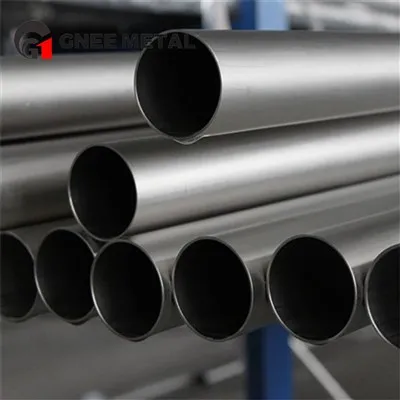
GR1 Titanium Pipe – CP Grade
May 18, 2026
CP Titanium
Commercially Pure (CP) titanium grades one through four: the grade number goes up incrementally as strength increases and ductility decreases. CP titanium grades are categorized by varying proportions of interstitial elements (nitrogen, carbon, iron, and oxygen), which impact ductility and strength.
| Grade | Key Characteristic | Ductility | Strength |
|---|---|---|---|
| GR1 | Softest, highest ductility | Highest | Lowest |
| GR2 | Moderate strength, excellent cold forming | High | Moderate |
| GR3 | Stronger than GR1/GR2, less formable | Medium | Higher |
| GR4 | Strongest CP grade, lower ductility | Lower | Highest |

GR1 Titanium Pipe Applications
GR1 titanium pipe is used in the following industries:
| Industry | Application |
|---|---|
| Architecture | Structural and decorative components |
| Automotive | Exhaust systems, lightweight components |
| Desalination | GR1 titanium heat exchanger tubes, seawater piping |
| Dimensional Stable Anodes (DSA) | Grade 1 titanium anode/cathode substrates |
| Medical | Medical grade 1 titanium – ASTM F67 grade 1 implants and instruments |
| Marine | Shipbuilding, offshore platforms, seawater systems |
| Processing & Chlorate Manufacturing | GR1 titanium for chemical processing – piping, reactors |
GR1 Titanium Pipe Standards
| Standard | Product Form |
|---|---|
| ASME SB-338 / ASTM B338 | Seamless and welded GR1 titanium heat exchanger tubes |
| ASME SB-337 / ASTM B337 | GR1 titanium pipe (general) |
| ASME SB-265 / ASTM B265 | Sheet and plate (reference) |
| ASME SB-348 / ASTM B348 | Bar |
| ASME SB-363 | Pipe fittings |
| ASME SB-381 | Forgings |
| ASTM F-67 | Medical grade 1 titanium – surgical implants |
GR1 titanium tube in seamless form (ASTM B861) and welded form (ASTM B862) are also common commercial specifications.
Available Forms for GR1 Titanium
| Form | Availability |
|---|---|
| GR1 titanium seamless pipe | Yes |
| GR1 titanium seamless tube | Yes |
| GR1 titanium welded pipe | Yes |
| GR1 titanium welded tube | Yes |
| Bar | Yes |
| Plate | Yes |
| Sheet | Yes |
| Strip and coil | Yes |
| Wire | Yes |
| Forgings | Yes |
GR1 vs Other CP Grades Comparison
| Property | GR1 | GR2 | GR3 | GR4 |
|---|---|---|---|---|
| Ductility | Highest | High | Medium | Lower |
| Strength | Lowest | Moderate | Higher | Highest |
| Cold formability | Excellent | Excellent | Good | Fair |
| Corrosion resistance | Excellent | Excellent | Excellent | Excellent |
| Weldability | Excellent | Excellent | Good | Good |
| Impact toughness | High | High | Moderate | Moderate |
Difference between pure titanium GR1 and GR2: GR1 has higher ductility and lower strength. GR2 is stronger and more widely used. Titanium grade 1 vs grade 2 selection depends on whether formability (GR1) or balanced strength (GR2) is the priority.
Key Properties of GR1 Titanium Pipe
| Property | Value |
|---|---|
| Titanium grade 1 density | 4.51 g/cm³ |
| GR1 titanium yield strength | ~170-310 MPa |
| Tensile strength | ~240 MPa |
| Elongation | ≥24% |
| Grade 1 titanium hardness | ~70 HRB / 100-150 HV |
How to Weld GR1 Titanium Pipe
| Parameter | Recommendation |
|---|---|
| How to weld GR1 titanium | GTAW (TIG) with ERTi-1 filler metal |
| Argon shielding | Required on both sides |
| Preheat | Not required |
| Post-weld heat treatment | Not required |
| Key advantage | Excellent welding properties |
FAQ
Q1: What is GR1 titanium pipe?
A: GR1 titanium pipe is the softest commercially pure titanium grade with the highest ductility. It has good cold-forming characteristics, excellent corrosion resistance, excellent welding properties, and high-impact toughness. GR1 titanium is available in seamless pipe, seamless tube, welded pipe, and welded tube forms.
Q2: What is the UNS number for ASTM B861 grade 1 titanium tube?
A: The UNS number for ASTM B861 grade 1 titanium tube is R50250. ASTM B338 grade 1 titanium pipe also uses UNS R50250. For medical applications, ASTM F67 grade 1 applies with the same UNS number.
Q3: What are the applications of GR1 titanium pipe?
A: GR1 titanium pipe is used in architecture, automotive, desalination, dimensional stable anodes (DSA), medical, marine, and chemical processing industries. Specific applications include GR1 titanium heat exchanger tubes, seawater piping, GR1 titanium reactor components, and medical grade 1 titanium implants.
Q4: What standards apply to GR1 titanium pipe?
A: GR1 titanium pipe and tube conform to ASME SB-338, ASME SB-337, ASTM B338 (heat exchanger tube), ASTM B861 (seamless tube), and ASTM B862 (welded tube). For medical applications, ASTM F-67 applies. Other relevant standards include ASME SB-265 (sheet/plate), SB-348 (bar), and SB-363 (fittings).
Q5: What forms of GR1 titanium are available?
A: GR1 titanium is available as seamless pipe, seamless tube, welded pipe, welded tube, bar, plate, sheet, strip, coil, wire, and forgings.
Q6: How does GR1 compare to other CP titanium grades?
A: GR1 has the highest ductility and lowest strength among CP grades (GR1-GR4). As grade number increases, strength increases and ductility decreases. GR1 titanium for deep drawing is preferred over GR2, GR3, or GR4 due to its superior formability.
Q7: Is GR1 titanium pipe suitable for medical applications?
A: Yes, medical grade 1 titanium conforming to ASTM F67 grade 1 is used for surgical implants and medical instruments. GR1 titanium offers excellent biocompatibility and corrosion resistance. GR1 titanium forming/bending allows complex shapes for medical devices.
Q8: What is the density of titanium grade 1 pipe?
A: Titanium grade 1 density is 4.51 g/cm³. GR1 titanium pipe offers good cold-forming characteristics and high-impact toughness combined with low density.
Q9: Is GR1 titanium pipe suitable for heat exchangers?
A: Yes, GR1 titanium heat exchanger tubes are specifically covered under ASTM B338 and ASME SB-338. GR1 titanium provides excellent corrosion resistance in seawater and chemical environments, making it ideal for desalination and chemical processing heat exchangers.
Q10: What is the difference between GR1 and GR2 titanium pipe?
A: The difference between pure titanium GR1 and GR2 is primarily oxygen content. GR1 has 0.18% oxygen max, GR2 has 0.25% oxygen max. GR1 has higher ductility (≥24% vs ≥20% elongation) and lower strength. Titanium grade 1 vs grade 2 selection depends on whether formability (GR1) or higher strength (GR2) is required.
Q11: Can GR1 titanium pipe be used for anodes?
A: Yes, grade 1 titanium anode/cathode applications include dimensional stable anodes (DSA) and GR1 titanium MMO anode (mixed metal oxide coated) substrates. GR1 titanium offers excellent electrical conductivity and corrosion resistance for electrochemical applications.
Q12: How to weld GR1 titanium pipe?
A: How to weld GR1 titanium – GR1 titanium has excellent welding properties. Use GTAW (TIG) with ERTi-1 filler metal. Proper argon shielding on both sides is critical. No preheat or post-weld heat treatment is required for most applications.
Q13: What is the yield strength of GR1 titanium pipe?
A: GR1 titanium yield strength is approximately 170-310 MPa. Tensile strength is approximately 240 MPa minimum. Elongation is 24% minimum. GR1 titanium has the lowest strength among CP grades, which directly enables its excellent formability.
Q14: Is GR1 titanium pipe suitable for desalination?
A: Yes, GR1 titanium pipe is widely used in desalination plants. Applications include GR1 titanium heat exchanger tubes and seawater piping systems. GR1 titanium offers excellent corrosion resistance in chloride-rich environments.
Q15: What is the hardness of GR1 titanium tube?
A: Grade 1 titanium hardness is approximately 70 HRB or 100-150 HV depending on measurement scale. This low hardness contributes to the excellent machinability and formability of GR1 titanium tube.