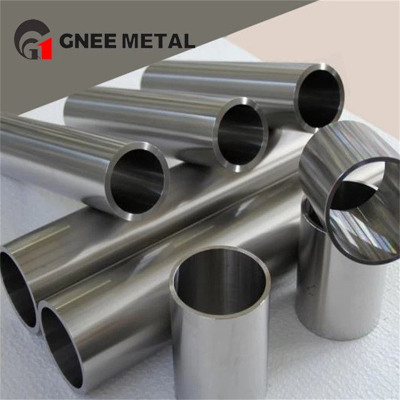
Titanium Grade 1 Pipe Supplier
May 14, 2026
What Is Titanium Grade 1 Pipe?
Titanium Grade 1 pipe has properties and chemical composition very similar to Grade 2, but with tighter controls on O (oxygen), Fe (iron), and H (hydrogen) contents. GR1 titanium tube is one of the softer and more ductile grades of pure titanium.
GR1 titanium pipe offers good strength-to-weight ratio, corrosion resistance in oxidizing and mildly reducing environments, and good formability. ASTM B338 grade 1 pipe is available in seamless and welded forms.

Chemical Composition of GR1 Titanium Tube
GR1 titanium chemical composition has tighter controls on oxygen, iron, and hydrogen compared to Grade 2:
| Element | Min % | Max % |
|---|---|---|
| N | – | 0.03 |
| C | – | 0.08 |
| H | – | 0.01 |
| Fe | – | 0.20 |
| O | – | 0.18 |
| Residuals | – | 0.40 |
| Ti | bal | – |
Specifications and Designations for GR1 Titanium Pipe
| Standard | Designation |
|---|---|
| ASTM B338 (Pipe) | Grade 1 |
| ASTM B861 (Seamless Tube) | Grade 1 |
| UNS | R50250 |
| Werkstoff NR. | 3.7025 |
| AWS | 150 |
| Medical | ASTM F67 Grade 1 |
ASTM B861 grade 1 titanium tube and ASTM B338 grade 1 titanium pipe share the same chemical and mechanical requirements. Medical grade 1 titanium conforms to ASTM F67.
Physical Properties of Titanium Grade 1 Pipe
| Property | Value (Metric) | Value (Imperial) |
|---|---|---|
| Titanium grade 1 density | 4.51 g/cm³ | 0.163 lb/in³ |
| Melting point | 1670°C | 3040°F |
| Coefficient of expansion | 8.6 μm/m°C (20-100°C) | 4.8 x 10⁻⁶ in/in°F (70-212°F) |
| Modulus of rigidity | 40-45 kN/mm² | 5800-6530 ksi |
| Modulus of elasticity | 105-120 kN/mm² | 15230-17400 ksi |
Mechanical Properties of GR1 Titanium Tube
| Condition | Tensile Strength (N/mm²) | Tensile Strength (ksi) | Operating Temperature (°C) | Operating Temperature (°F) |
|---|---|---|---|---|
| Annealed | 300-400 | 44-58 | -200 to +400 | -330 to +750 |
| Spring Temper (if applicable) | 550-850 | 80-123 | -200 to +400 | -330 to +750 |
Heat Treatment of GR1 Titanium Pipe
| Condition as Supplied | Type | Temperature (°C) | Temperature (°F) | Time (Hr) | Cooling |
|---|---|---|---|---|---|
| Annealed | Stress Relieve | 480 | 900 | 0.5-2 | Air |
| Spring Temper | Stress Relieve | 250 | 480 | 0.5 | Air |
How to weld GR1 titanium does not typically require post-weld heat treatment. Stress relieving at 480°C may be performed to reduce residual stresses after cold forming or welding.
Key Features of GR1 Titanium Pipe
| Feature | Description |
|---|---|
| Ductility | One of the softer and more ductile grades of pure titanium |
| Strength-to-weight ratio | Good |
| Corrosion resistance | Excellent in oxidizing and mildly reducing environments |
| Formability | Good – suitable for GR1 titanium forming/bending and GR1 titanium for deep drawing |
| Weldability | Excellent – how to weld GR1 titanium is well established |
Applications of GR1 Titanium Tube
| Industry | Typical Use |
|---|---|
| Aerospace | Airframe components, engine accessories |
| Automotive | Lightweight exhaust and structural tubing |
| Chemical Processing | GR1 titanium for chemical processing – heat exchangers, reactors, piping |
| Medical | Medical grade 1 titanium – ASTM F67 grade 1 surgical instruments and implants |
GR1 titanium heat exchanger tubes are common in chemical and marine applications. GR1 titanium reactor components benefit from the material's corrosion resistance and fabricability.
Grade Comparison: GR1 vs GR2 vs GR5
| Property | GR1 Titanium Pipe | GR2 | GR5 (Ti-6Al-4V) |
|---|---|---|---|
| Oxygen max (%) | 0.18 | 0.25 | 0.20 |
| Yield strength (MPa) | 138-170 | 275 | 827 |
| Tensile strength (MPa) | 240-400 | 345 | 896 |
| Elongation (%) | 24-27 | 20 | 10 |
| Ductility | Highest | Moderate | Low |
| Formability | Best | Good | Poor |
| Corrosion resistance | Excellent | Excellent | Good |
FAQ
Q1: What is the difference between GR1 and GR2 titanium pipe?
A: The difference between pure titanium GR1 and GR2 is primarily oxygen content and impurity controls. GR1 titanium pipe has tighter controls on O (0.18% max), Fe (0.20% max), and H (0.01% max) compared to GR2. This gives GR1 titanium higher ductility and lower strength, making it more formable for GR1 titanium for deep drawing applications.
Q2: What is the UNS number for ASTM B861 grade 1 titanium tube?
A: The UNS number for ASTM B861 grade 1 titanium tube is R50250. ASTM B338 grade 1 titanium pipe also uses UNS R50250. The Werkstoff NR. equivalent is 3.7025.
Q3: What is the density of titanium grade 1 pipe?
A: Titanium grade 1 density is 4.51 g/cm³ (0.163 lb/in³). This low density gives GR1 titanium pipe a good strength-to-weight ratio, approximately 44% lighter than stainless steel pipe of the same dimensions.
Q4: What is the melting point of GR1 titanium tube?
A: The melting point of GR1 titanium tube is 1670°C (3040°F). However, the maximum operating temperature for GR1 titanium pipe is approximately 400°C (750°F) due to oxidation concerns above this temperature.
Q5: What is the tensile strength of ASTM B338 grade 1 titanium pipe?
A: The tensile strength of ASTM B338 grade 1 titanium pipe in annealed condition is 300-400 N/mm² (44-58 ksi). GR1 titanium yield strength is not specified in this source but is typically 138-170 MPa minimum.
Q6: What is the recommended heat treatment for GR1 titanium tube after welding?
A: How to weld GR1 titanium typically does not require post-weld heat treatment. If stress relieving is desired after cold forming or welding, GR1 titanium tube should be heated to 480°C (900°F) for 0.5-2 hours and cooled in air.
Q7: Is GR1 titanium pipe suitable for cryogenic applications?
A: Yes, GR1 titanium pipe has an operating temperature range down to -200°C (-330°F). GR1 titanium tube maintains good ductility and toughness at cryogenic temperatures, making it suitable for low-temperature service.
Q8: What is the modulus of elasticity for GR1 titanium tube?
A: The modulus of elasticity for GR1 titanium tube is 105-120 kN/mm² (15230-17400 ksi). This is approximately half that of steel, meaning GR1 titanium pipe is more flexible under load.
Q9: Can GR1 titanium pipe be used for chemical processing applications?
A: Yes, GR1 titanium for chemical processing is a common application. GR1 titanium pipe offers excellent corrosion resistance in oxidizing and mildly reducing environments. GR1 titanium heat exchanger tubes and GR1 titanium reactor components are widely used in the chemical industry.
Q10: What is the coefficient of thermal expansion for GR1 titanium tube?
A: The coefficient of thermal expansion for GR1 titanium tube is 8.6 μm/m°C (20-100°C). This is lower than stainless steel (approximately 17 μm/m°C), meaning GR1 titanium pipe expands less with temperature changes.
Q11: Is medical grade 1 titanium the same as commercial GR1 titanium pipe?
A: Medical grade 1 titanium conforms to ASTM F67 grade 1, while commercial GR1 titanium pipe conforms to ASTM B338 or ASTM B861. The chemical composition and mechanical property requirements are similar, but ASTM F67 grade 1 has additional biocompatibility testing and stricter surface quality requirements for surgical implant applications.
Q12: What is the operating temperature range for GR1 titanium pipe?
A: The approximate operating temperature range for GR1 titanium pipe is -200°C to +400°C (-330°F to +750°F). Within this range, GR1 titanium maintains good mechanical properties and corrosion resistance. Above 400°C, oxidation accelerates.
Q13: How does the price of GR1 titanium pipe compare to GR2?
A: GR1 titanium price per kg is typically 5-10% higher than GR2 due to tighter controls on oxygen (0.18% max vs 0.25% max), iron (0.20% max vs 0.30% max), and hydrogen (0.01% max vs 0.015% max). Contact GR1 titanium tube suppliers for current GR1 titanium price and wholesale grade 1 titanium bulk discounts.
Q14: Can GR1 titanium be used for deep drawing applications?
A: Yes, GR1 titanium for deep drawing is an excellent choice due to its high ductility (24-27% elongation) and low yield strength. GR1 titanium forming/bending operations can achieve tight radii without cracking. GR1 titanium tube is commonly deep drawn into complex shapes for chemical and marine applications.
Inspection
| Test | Purpose |
|---|---|
| Chemical analysis | Verify GR1 titanium chemical composition (N, C, H, Fe, O residuals) |
| Tensile testing | Confirm tensile strength (300-400 N/mm² annealed) |
| Hardness testing | Verify grade 1 titanium hardness |
| Hydrostatic test | Pressure integrity of GR1 titanium pipe |
| Ultrasonic testing | Detect internal flaws in GR1 titanium tube |
| Eddy current testing | Surface defect detection |
| Visual and dimensional | Check OD, wall thickness, length, surface finish |

Packaging
Plastic end caps on both ends of each GR1 titanium tube
Bundled with steel straps
Wooden crates or pallets for export
Labeled with grade (GR1), standard (ASTM B338/B861), heat number, dimensions