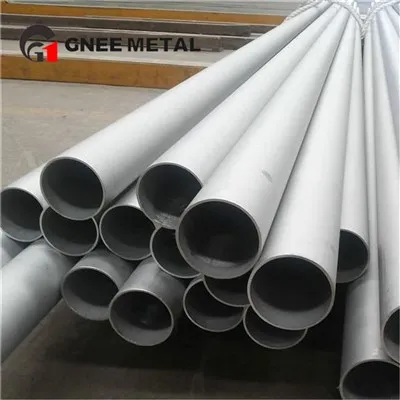
Grade 7 Titanium (Ti-0.15Pd, UNS R52400) for Chemical Processing
Oct 17, 2025
What Is Grade 7 Titanium?
Grade 7 titanium, designated UNS R52400 and commonly written Ti-0.15Pd, is a commercially pure titanium modified by a small palladium addition of 0.12 to 0.25 percent. The palladium changes the electrochemistry of the material rather than its mechanical character: it shifts the corrosion potential into the passive range, so the protective oxide film survives in reducing acids and hot chloride media where plain CP titanium begins to corrode. The result is a material with the strength and weldability of Grade 2 and corrosion resistance suited to the harshest chemical process streams.
Chemical Composition
| Element | Composition |
|---|---|
| Titanium | Balance |
| Palladium | 0.12-0.25% |
| Iron | Max 0.30% |
| Oxygen | Max 0.25% |
| Carbon | Max 0.08% |
| Nitrogen | Max 0.03% |
| Hydrogen | Max 0.015% |
The material is covered by ASTM B265 (sheet, strip, plate), B348 (bar and billet), B338 (seamless and welded tube), B861 (seamless pipe), and B862 (welded pipe), with ASME SB equivalents for pressure equipment. The European material number is 3.7235.
Mechanical Properties
| Property | Value |
|---|---|
| Density | 4.51 g/cm³ |
| Tensile strength | Min 345 MPa |
| Yield strength | Min 275 MPa |
| Elongation | Min 20% |
| Modulus of elasticity | About 105 GPa |
Because the mechanical specification matches Grade 2, designers can use familiar CP titanium data for wall thickness and pressure calculations while gaining the corrosion margin of the palladium-bearing grade.
Why Palladium Works
Palladium acts as a cathodic alloying element. In a reducing acid such as dilute hydrochloric or sulfuric acid, plain titanium would normally depolarize and corrode; palladium instead promotes cathodic hydrogen reduction on the surface, holding the potential in the passive range where the TiO₂ film stays intact. The same mechanism suppresses pitting and crevice corrosion in hot chloride solutions. In practice, Grade 7 tolerates acid concentrations and temperatures that would cause Grade 2 to pit, crack, or dissolve.
Wrought Forms and Fabrication
Grade 7 is available in all standard wrought forms: seamless and welded tube and pipe for heat exchangers and process lines, rod and bar for fasteners and fittings, plate and sheet for vessels and linings, wire for welding filler and mesh, and foil for gaskets and shims. It welds like Grade 2: GTAW, plasma arc, or electron beam under inert shielding, with matching filler ERTi-7. Forming, machining, and pickling practice follow CP titanium guidelines, and the weld zone retains the corrosion benefit of the base metal when filler is matched.
Applications in Chemical Processing
Chlor-alkali production: cells, brine heaters, and chlorine coolers operating in wet chlorine and hot brine.
Pulp and paper: bleach plant washers, mixers, and piping handling chlorine dioxide and hypochlorite.
Seawater and desalination: evaporators, brine heaters, and condenser tubing exposed to concentrated hot brine.
Power generation: fasteners, tube sheets, and structural elements in high-pressure, high-temperature auxiliary systems.
Air pollution control: scrubbers and ducting handling corrosive gases and condensates.
Nuclear waste processing: vessels and piping for aggressive acidic streams where downtime is unacceptable.
Grade 7 versus Grade 2
Where the two grades differ is only in corrosion resistance. Grade 2 is the economical choice for seawater, oxidizing acids, and general chemical service; Grade 7 is justified when the stream is a reducing acid, hot chloride, or when crevice geometries cannot be eliminated. Buyers should weigh the palladium premium against the cost of tube replacement, process contamination, and unplanned shutdowns in critical service.
Frequently Asked Questions
Is Grade 7 titanium an alloy or a pure grade?
It is classified as a commercially pure titanium with a palladium addition, but in practice it is treated as a corrosion-resistant grade. The base is CP titanium, so mechanical properties match Grade 2.
Why not just use Grade 2 everywhere?
Grade 2 corrodes or pits in reducing acids and hot chlorides. Grade 7 maintains passivity in those media, which is why chemical plants specify it for the most aggressive streams.
Does Grade 7 titanium cost much more than Grade 2?
Yes, the palladium addition raises the alloy price noticeably. The premium is accepted where it buys reliability: fewer leaks, longer tube life, and lower maintenance cost in critical equipment.
Can Grade 7 tubes be welded to Grade 2 equipment?
Welding Grade 7 to Grade 2 is possible using ERTi-2 or ERTi-7 filler with proper inert shielding. For maximum corrosion performance in the weld, matching filler and full shielding of the heat-affected zone are recommended.
What standards govern Grade 7 titanium tube?
ASTM B338 covers seamless and welded tube for condensers and heat exchangers; ASTM B861 and B862 cover pipe. ASME SB-338 is the corresponding pressure-vessel code.
Is Grade 7 suitable for seawater desalination?
Yes. It is commonly specified for brine heaters, evaporators, and condenser tubes, particularly where crevice corrosion at tube-to-tubesheet joints would be a risk with Grade 2.