
ASME SB338 Titanium Seamless Alloy Cold Drawn Pipe: Grades, Sizes and Testing
Oct 17, 2025 ASTM-B338-Titanium.pdf
What ASME SB338 Covers
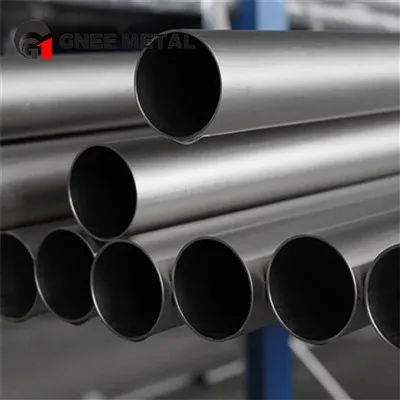
ASME SB338 is the boiler and pressure vessel code adoption of ASTM B338, covering seamless and welded titanium and titanium alloy tube for condensers and heat exchangers. The specification sets chemical composition limits, tensile requirements, flattening and flaring behavior, and the non-destructive examination options for tube product. Because it is referenced under Section II, material supplied to SB338 is accepted for code-constructed heat transfer equipment in power, chemical, and marine service.
Grades Commonly Supplied
The specification covers a wide range of titanium grades. For general heat exchanger service, Grade 1 and Grade 2 provide the best formability and weldability; Grade 3 offers higher strength for higher pressure duty; Grade 7 and Grade 11 add palladium for resistance to reducing acids and crevice corrosion; Grade 9 balances moderate strength with excellent cold formability; Grade 12 adds molybdenum and nickel for elevated temperature strength and improved corrosion resistance in reducing media.
Cold Drawn Seamless Manufacturing Route
Seamless tube under SB338 begins as an extruded or pierced hollow, then is reduced to final dimensions by cold drawing or cold pilgering. Cold working improves dimensional accuracy, surface finish, and mechanical properties, and the tube is subsequently annealed to restore ductility. The cold drawn route is preferred where wall thickness uniformity and leak tightness are critical, such as high-pressure condensers and seawater coolers.
Commercial Size Range
Typical supply ranges for SB338 titanium tube are 0.059 to 24.41 inches outside diameter with wall thicknesses from 0.0158 to 0.787 inch, and lengths up to 59 feet. Wall thickness tolerance, ovality, and straightness are controlled by the specification, and tighter tolerances are available by agreement for precision heat exchanger bundles.
Testing and Inspection
SB338 requires tensile testing, flattening, and flaring or flange tests on representative samples, plus hydrostatic or pneumatic testing. For critical service, supplementary ultrasonic, eddy current, or radiography examination can be specified. Chemical composition is verified by product analysis, and hardness testing is available on request. Buyers should confirm the required test certificates, including material test reports with heat numbers, before shipment.
Frequently Asked Questions
What is the difference between ASME SB338 and ASTM B338?
ASME SB338 is the code adoption of ASTM B338; chemical and mechanical requirements are essentially identical, and SB338 is the version accepted for ASME Section VIII and Section I construction.
Can SB338 tube be used in seawater service?
Yes. Grades 1 and 2 are widely used in seawater-cooled condensers; Grade 7 is selected where crevice corrosion or reducing conditions are a concern.
Is cold drawn titanium tube stronger than annealed tube?
Cold drawn tube is supplied in the annealed condition after drawing; the annealed temper restores ductility while the drawing step improves dimensional control and surface quality.
How is leak tightness verified on seamless tube?
Seamless tube is verified by hydrostatic or pneumatic testing, with eddy current or ultrasonic examination available as supplementary requirements for higher integrity service.
What certificates should a buyer request?
Request an EN 10204 3.1 material test certificate with heat number, chemical analysis, tensile results, and the applied non-destructive examination method.