
Performance Characteristics of Titanium Alloy CNC Machining
Sep 09, 2025
Products Description
High-speed CNC Machining Of Metal Parts
Material Characteristics
Low Density and High Strength
The density of titanium alloy is generally around 4.5 g/cm³, approximately 60% of the density of steel, but its strength is comparable to that of high-strength steel. In the aerospace industry, critical components such as aircraft wing spars and landing gears use titanium alloy to reduce structural weight while ensuring part strength and reliability. This effectively reduces the aircraft's overall weight and improves fuel efficiency.
Excellent Corrosion Resistance
At room temperature, titanium alloy forms a dense oxide film in the air. This oxide film exhibits strong chemical stability, effectively resisting corrosion from seawater, acids, alkalis, and other media. For example, in marine engineering, components such as ship propellers and seawater valves made of titanium alloy can operate in seawater for extended periods without corrosion, significantly extending equipment service life.
High-Temperature Resistance
Different types of titanium alloys exhibit varying high-temperature resistance capabilities, generally maintaining stable performance in high-temperature environments ranging from 400°C to 600°C. In certain high-temperature components of aerospace engines, such as compressor blades and turbine discs, titanium alloy can withstand the冲刷 of high-temperature gases and thermal stress, ensuring normal engine operation under high-temperature conditions.
Machining Difficulty-Related Characteristics
High Cutting Forces
Titanium alloy has a relatively low elastic modulus, making it prone to elastic deformation during CNC machining. This requires cutting tools to overcome greater resistance during machining, resulting in increased cutting forces. For example, during titanium alloy milling, cutting forces can be 1-2 times greater than when machining ordinary carbon steel. This demands sufficient rigidity from the machine tool; otherwise, machining accuracy may decline, and machine vibrations may occur.
High Cutting Temperatures
Due to titanium alloy's poor thermal conductivity (thermal conductivity is only 1/5 to 1/7 that of steel), most of the heat generated during cutting concentrates near the cutting edge and is difficult to dissipate quickly. For instance, during titanium alloy turning, temperatures in the cutting zone can exceed 1000°C. Such high temperatures not only accelerate tool wear but may also cause surface burning of the titanium alloy material, affecting machining quality.
Rapid Tool Wear
Titanium alloy exhibits high chemical activity, and under high temperatures and pressures, it easily undergoes chemical reactions with tool materials. Simultaneously, due to high cutting forces and temperatures, tools endure significant mechanical and thermal loads during machining. For example, when drilling titanium alloy, carbide drill bits wear out much faster than when drilling ordinary steel, necessitating frequent tool changes and increasing machining costs.
Pronounced Work Hardening
During titanium alloy machining, the material surface undergoes work hardening due to the挤压 action of the cutting edge. The hardness of the work-hardened layer can be 1-2 times higher than that of the base material, making subsequent machining more challenging. For instance, if the work-hardened layer is not treated promptly after rough machining, tools will wear out quickly during finishing, and achieving good surface quality will be difficult.


Machining Accuracy and Surface Quality-Related Characteristics
Difficulty in Controlling Machining Accuracy
Titanium alloy's coefficient of thermal expansion is smaller than that of steel, meaning temperature changes have a relatively minor impact on dimensional accuracy during machining. However, due to the combined effects of high cutting forces, significant elastic deformation, and work hardening, controlling the dimensional accuracy of titanium alloy parts is challenging. For example, when CNC milling titanium alloy parts with complex curved surfaces, achieving high dimensional precision requires precise control of cutting parameters and tool paths, as well as high machine tool accuracy and stability.
High Surface Quality Requirements
Titanium alloy parts used in high-end applications, such as aerospace and medical devices, require extremely strict surface quality. On one hand, titanium alloy machining is prone to surface defects such as tearing and burrs. On the other hand, surface roughness directly affects part fatigue strength and corrosion resistance. For instance, titanium alloy implants in medical devices must have very smooth surfaces to avoid adverse effects on human tissues. This necessitates the use of appropriate tools, cutting parameters, and machining processes during CNC machining to ensure surface quality.
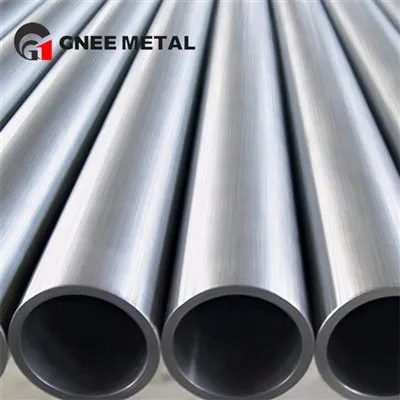
Titanium product forms available from GNEE
|
Material
|
Pure titanium and Titanium alloy
|
|
Titanium Grade
|
Grade 1-Unalloyed titanium
Grade 2-Unalloyed titanium
Grade 3-Unalloyed titanium
Grade 7-Unalloyed titanium plus 0.12 to 0.25 %palladium
Grade 9-Titanium alloy (3 % aluminum, 2.5 % vanadium)
Grade 12-Titanium alloy (0.3 % molybdenum, 0.8 % nickel),
|
|
Standard
|
ASTM B338/ASME SB338, ASTM B337/ASME SB337, ASTM B861/ASME SB861, ASTM B862/ASME SB862,AMS4911,AMS4928
|
|
Shape
|
Round Square Rectangle
|
|
Type
|
Seamless/Welded
|
|
|
Seamless titanium tube: Titanium sponge-Compacting electrodes-melting-Forge-Bar billets-Extruding-Rolled-Straightening-Seamless tube
Welded titanium tube: Titanium sponge-Compacting electrodes-melting-Forge-Plate billets-Hot rolled-Cold rolled-Titanium scrap-Welded-Welded tube |
|
Surface
|
Polishing, picking, acid washed, black oxide
|
|
Application
|
1) General service industries (petroleum, food, chemical, paper, fertilizer, fabric, aviation and nuclear
2) Fluid, gas and oil transport
3) Pressure and heat transmission
4) Construction and ornament
5) Boiler heat exchangers
6) Motorbycle and bike
|
|
Material Milling Certificate
|
According to. EN 10204.3.1
Including Chemical composition and Mechanical property |
|
Grade |
Gr1, Gr2, Gr3,Gr4,Gr5, Gr7, Gr6,Gr9, Gr11, Gr12 ,Gr16, Gr17,Gr25 |
|||
|
Size |
All sizes can be customized |
|||
|
Application |
Metallurgy, electronics, machinery, medical treatment, chemical industry, petroleum, medical treatment, aerospace |
|||
|
Feature |
High corrosion resistance, low density, good thermal stability |
|||
|
Technology |
Hot Forged, Hot Rolled, Cold Rolled, Annealing, Pickling |
|||
|
Surface |
Bright, Polished, Pickling, Acid cleaning, Sandblasting |
|||
|
Packing |
Export Standard Woodcase |
|||
|
Delivery time |
10-25days according to the quantity and process of the product |
|||
|
Quality and test |
Hardness test, Bending test, Hydrostatic etc. |
|||
|
Grade |
GR1,GR2,GR3,GR5,GR6,GR7,GR9,GR11,GR12, etc. |
|
Standard |
ASTM B265,ASTM F136,ASTM F67,AMS4928 |
|
Size |
0.5-5.0mm x 1000mm x 2000-3500mm (Thickness x Width x Length) |
|
Application |
Metallurgy, electronics, machinery, medical treatment, chemical industry, petroleum, medical treatment, aerospace |
|
Supply status |
M (Y/ R/ ST) |
|
Feature |
High corrosion resistance, low density, good thermal stability |
|
Technics |
Hot Forged, Hot Rolled, Cold Rolled, Annealing, Pickling |
|
Surface |
Bright, Polished, Pickling, Acid cleaning, Sandblasting |
|
Packing |
Export Standard Woodcase |
|
Payment terms |
T/T, L/C, D/A, D/P, Escrow, Western Union, PayPal |
|
Certificate |
ISO 9001:2008; The third test report; TÜV Rheinland; |
|
Delivery time |
7-15days according to the quantity and process of the product |
|
Quality and test |
Hardness test, Bending test, Hydrostatic etc. |
|
Material |
Pure titanium and Titanium alloy |
|
Titanium Grade |
GR1/GR2/GR3/Gr4/GR5/GR7/GR9/GR12/Gr5Eli/Gr23
ERTi-1/ERTi-2/ERTi-3/ERTi-4/ERTi-5Eli/ERTi-7/ERTi-9/ERTi-11/ERTi-12 Ti15333/Nitinol Alloy |
|
Standard |
AWS A5.16/ASTM B863/ASME SB863, ASTMF67, ASTM F136, ISO-5832-2(3) etc |
|
Shape |
Titanium Coil Wire/Titanium Spool Wire/Titanium Straight Wire |
|
Wire Gauge |
Dia(0.06--6) *L |
|
Process |
Bar billets-hot rolling-drawing-annealing-strength-pickling |
|
Surface |
Polishing, picking, acid washed, black oxide |
|
Main Technique |
Hot Forged; Hot Rolled; Cold drawn; Straighten etc |
|
Material Milling Certificate |
According to. EN 10204.3.1 |
|
Application |
Welding, Industry, Medical, Aerospace, Electronic etc |
|
Material Available |
Aluminum, Stainless Steel, Carbon Steel, Brass, Bronze, Copper, Titanium and etc |
|
Surface Treatment Available |
Anodized, Nickel Plated, Zinc Plated, Chrome Plated, Passivation, Electrophoresis, Electropolishing, Painting, Powder Coated, etc |
|
Certificate &Standard |
ISO9001 certified factory with good quality control and all of our products are 100% inspected before delivery. |
|
Equipments |
Over 28 CNC Milling Machines (3,4, 5 Axis) & 22 CNC Turning machines can support your large order demand. |
|
Design |
OEM & ODM are welcome, and also we have a R&D team and can help your design and develop your products |
|
Application |
Different kinds of cars, machinery, home appliance, electronic products, electric appliance, stationery, computers, power |
|
MOQ |
No quantity limitation |
|
Samples |
Welcome you to request samples to test and check the quality. |
|
Delivery & Shipping |
We can deliver to over 50 countries all over the world, shipping by DHL, FedEx, UPS, etc around 3 to 5 days |
GNEE is a specialized manufacturer and exporter of high-quality titanium products, including pipes, sheets, bars, wires, and fabricated parts.
We utilize advanced CNC machining, rolling, and welding equipment to ensure precision manufacturing. All products undergo strict chemical, mechanical, and non-destructive testing to guarantee compliance with international standards.
Our export-safe packaging includes wooden crates and waterproof wrapping to ensure secure delivery. If you have any needs, please feel free to contact us immediately:info@gneemetal.com

8000+