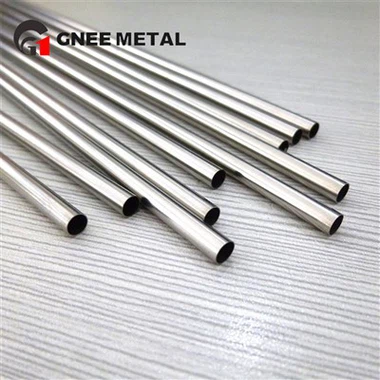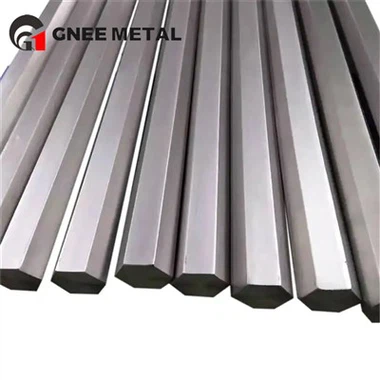

Niobium Capillaries
Mar 11, 2024
niobium tube niobium capillary tube pure niobium tube niobium alloy tube
Specification: Φ≥1mm
Brand:
Pure niobium RO4200, purity 299.95%.
Pure niobium RO4210, 99.99% purity
Niobium-zirconium alloy R04261 (NbZr1)
Niobium-tungsten alloy Nb521
Niobium-titanium alloy NbTi50
Niobium-titanium alloy NbTi55


Appearance: The inner and outer surfaces of the tubes show a uniform metallic luster, without oxidation, hydrogenation discoloration, scratches, deformation, burrs, etc.
Characteristics: Niobium (Niobium) has a density of 8.57g/cm³, a melting point of 2477°C, and a boiling point of 4744°C. It is a silver-gray color with a high density and a low density.
Niobium is a silver-gray, soft and ductile rare high melting point metal and is currently the most important superconducting material.
Niobium has good low-temperature plasticity and can be cold-pressure processed into plates, rods, wires and other forms. Superconductivity is best at very low temperatures, such as around minus 260°C, when its resistance is close to zero. Niobium does not react with air at room temperature and does not oxidize completely when red hot in oxygen. Niobium is strong at high temperatures and still has sufficient strength, plasticity and thermal conductivity above 1000℃. Niobium can be directly chemically synthesized with sulfur, nitrogen and carbon at high temperatures. Niobium does not react with inorganic acids or bases, and is insoluble in aqua regia, but soluble in hydrofluoric acid.
Uses: Petrochemical industry heat exchanger tubes, thermometer protection tubes, corrosion-resistant high-temperature industry, aerospace engines, weapons propulsion, rocket missile liquid two-component engine, nuclear reactors, submersibles, gas turbines, automobile engines, diesel engines, high-temperature furnaces with heat tape, high-temperature molds, high-temperature fixtures, and high-temperature crucible on the manufacture of.