



Grade 1 Titanium Tube
Material Grade: Grade 1 / GR1 / Gr.1 / UNS R50250
Material Type: Commercially Pure Titanium
Product Types: Seamless Titanium Tube / Welded Titanium Tube
Applicable Standards: ASTM B338 / ASTM B861 / ASTM B862
Outside Diameter (OD): Approx. 3–114.3 mm
Wall Thickness (WT): Approx. 0.5–11 mm
Density: 4.51 g/cm³
Description
What Is Grade 1 Titanium Tube?

Grade 1 Titanium Tube, also known as GR1 Titanium Tube, Gr.1 Titanium Tube, or UNS R50250 Titanium Tube, is made from commercially pure titanium. It is characterized by high ductility, excellent formability, low density, and good corrosion resistance.
Among commercially pure titanium grades, Grade 1 has relatively low mechanical strength but offers the highest ductility. This makes GR1 titanium tubing suitable for applications where forming performance, corrosion resistance, and lightweight construction are more important than high tensile strength.
Grade 1 titanium tubes are used in heat exchangers, condensers, chemical processing equipment, desalination systems, and other industrial applications.
Key Characteristics of GR1 Titanium Tubes
Commercially pure titanium: Grade 1 is an unalloyed titanium grade with controlled levels of oxygen, iron, carbon, nitrogen, and hydrogen.
High ductility: Its relatively low strength and high elongation make it suitable for forming and bending operations.
Corrosion resistance: Provides good resistance in many oxidizing environments, including seawater under suitable service conditions.
Low density: Approximately 4.51 g/cm³, making it significantly lighter than many conventional engineering metals.
Good weldability: Can be welded using qualified titanium welding procedures with appropriate atmospheric protection.
Multiple product forms: Available as seamless or welded tubing depending on the applicable standard and manufacturing capability.
Grade 1 Titanium Tube Chemical Composition
Grade 1 titanium is an unalloyed titanium material. Its properties are influenced by the controlled content of interstitial elements and impurities, particularly oxygen, iron, nitrogen, carbon, and hydrogen.
The following table shows the typical maximum chemical composition limits associated with Grade 1 titanium under commonly used ASTM product specifications. The applicable product standard and edition should be checked when preparing a purchase order.
| Element | Symbol | Maximum Content (Weight %) |
|---|---|---|
| Nitrogen | N | 0.03 |
| Carbon | C | 0.08 |
| Hydrogen | H | 0.015 |
| Iron | Fe | 0.20 |
| Oxygen | O | 0.18 |
| Titanium | Ti | Balance |
When purchasing GR1 titanium tubes, buyers should check:
Whether the material is certified as Grade 1 / UNS R50250.
Whether chemical composition meets the specified ASTM product standard.
Whether the heat number on the tube or package matches the Mill Test Certificate.
Whether the material certificate provides traceable chemical analysis results.
Grade 1 Titanium Tube Mechanical Properties
Grade 1 titanium has lower tensile and yield strength than Grade 2 titanium, but it provides higher elongation and better formability.
The following values are commonly specified minimum mechanical requirements for Grade 1 tubing under ASTM B338. Actual acceptance requirements must be checked against the applicable standard edition and product form.
| Mechanical Property | Requirement |
|---|---|
| Tensile Strength | Min. 240 MPa |
| Yield Strength (0.2% Offset) | Min. 138 MPa |
| Elongation | Min. 24% |
| Density | Approx. 4.51 g/cm³ |
| Melting Point | Approx. 1,668°C |
Grade 1 Titanium Tube Specifications and Dimensions
GR1 titanium tubes can be manufactured in different outside diameters, wall thicknesses, and lengths according to the product standard, manufacturing method, and order requirements.
Product Specifications
| Specification | Product Information |
|---|---|
| Product Name | Grade 1 Titanium Tube |
| Alternative Names | GR1 Titanium Tube / Gr.1 Titanium Tube |
| Material Grade | Grade 1 |
| UNS Number | R50250 |
| Material Type | Commercially Pure Titanium |
| Product Forms | Seamless Tube / Welded Tube |
| Heat Exchanger Tube Standard | ASTM B338 |
| Seamless Titanium Pipe Standard | ASTM B861 |
| Welded Titanium Pipe Standard | ASTM B862 |
| Density | Approx. 4.51 g/cm³ |
| Dimensional Description | Outside Diameter × Wall Thickness × Length |
| Inspection Documentation | MTC and agreed inspection records |
GR1 Titanium Tube Size Range
The following is an indicative manufacturing reference range for initial inquiries, not a guaranteed production or stock range. Actual dimensions depend on the manufacturing process, material condition, applicable standard, and production equipment.
| Dimension | Indicative Reference Range |
|---|---|
| Outside Diameter (OD) | 3–114.3 mm |
| Wall Thickness (WT) | 0.5–11 mm |
| Tube Length | Up to approximately 18,000 mm for suitable cold-reduced products |
| Product Form | Straight Seamless Tubes |
| Special Dimensions | Subject to technical review and production feasibility |
For larger diameters or heavier walls, buyers should provide the required dimensions and application details for a separate manufacturing review. Welded tube dimensions may follow a different production range.
Request Customized GR1 Titanium Tube Sizes
Grade 1 Titanium Seamless Tube vs. Welded Tube
Grade 1 titanium is available in different tube manufacturing forms, including seamless and welded products. The choice depends on the applicable standard, equipment design, dimensional requirements, and inspection conditions.
| Comparison Item | GR1 Seamless Titanium Tube | GR1 Welded Titanium Tube |
|---|---|---|
| Manufacturing Method | Produced from titanium billet through piercing and subsequent tube processing | Formed from titanium strip or sheet and joined by longitudinal welding |
| Longitudinal Weld | No longitudinal weld seam | Contains a longitudinal weld seam |
| Main Quality Focus | Material properties, dimensions, and tube integrity | Material properties, dimensions, and weld integrity |
| Typical Standard | ASTM B338 / ASTM B861, depending on product | ASTM B338 / ASTM B862, depending on product |
| Inspection Focus | Dimensional, mechanical, and specified integrity tests | Dimensional, mechanical, and specified weld inspection |
| Selection Factors | Design requirements, dimensions, pressure, and applicable standard | Design requirements, weld qualification, inspection, and applicable standard |


When Should Buyers Choose GR1 Seamless Tubes?
Seamless Grade 1 tubes may be selected when:
The project specification explicitly requires seamless construction.
The equipment design does not permit longitudinal welded tubing.
The required dimensions can be manufactured through the available seamless production route.
The applicable standard specifies seamless tubing or pipe.
When Should Buyers Choose GR1 Welded Tubes?
Welded Grade 1 tubes may be considered when:
The applicable product standard permits welded construction.
The tube dimensions and mechanical requirements can be achieved.
The welding process and inspection requirements meet project specifications.
The buyer accepts the specified weld inspection and documentation.
For condenser and heat exchanger applications, ASTM B338 covers both seamless and welded titanium tubes. The buyer should still confirm any additional project restrictions before selecting the manufacturing method.
Other Grade 1 Titanium Tube Configurations
| Product Type | Main Characteristics | Potential Applications |
|---|---|---|
| GR1 Straight Titanium Tube | Fixed or specified straight length | Heat exchangers, process equipment |
| GR1 Thin-Wall Titanium Tube | Reduced wall thickness for weight and space requirements | Heat transfer equipment, lightweight assemblies |
| GR1 Small-Diameter Titanium Tube | Compact OD for precision assemblies | Instruments and specialized equipment |
| GR1 Precision Titanium Tube | Tighter dimensional and surface requirements by agreement | Precision equipment |
| GR1 Coiled Titanium Tubing | Continuous or long-length configuration, subject to manufacturing feasibility | Specialized fluid and heat transfer systems |
| GR1 Polished Titanium Tube | Improved surface appearance or specified finish | Equipment and visible assemblies |
Grade 1 vs. Grade 2 vs. Grade 3 vs. Grade 4 Titanium Tubes
Grade 1, Grade 2, Grade 3, and Grade 4 are commercially pure titanium grades with different strength and ductility characteristics.
| Grade | UNS Number | Relative Strength | Main Characteristics | Typical Selection Consideration |
|---|---|---|---|---|
| Grade 1 | R50250 | Lowest | Highest ductility among common CP grades | Forming and bending requirements |
| Grade 2 | R50400 | Higher than Grade 1 | Balanced strength and corrosion resistance | General industrial applications |
| Grade 3 | R50550 | Higher than Grade 2 | Higher strength with reduced ductility | Higher mechanical strength requirements |
| Grade 4 | R50700 | Highest among these four grades | High strength, lower formability | Applications requiring greater strength |
Is Grade 1 Better Than Grade 2 Titanium?
Neither grade is universally better. They are selected for different mechanical requirements.
Choose Grade 1 when:
Higher ductility is important.
The tube requires forming or bending.
The design allows for its lower minimum strength.
The operating environment is suitable for Grade 1 titanium.
Choose Grade 2 when:
Higher tensile and yield strength are required.
The application needs a stronger commercially pure titanium grade.
The equipment design benefits from Grade 2's higher strength.
For heat exchanger and condenser projects, the final selection should consider the applicable tube standard, wall thickness, design conditions, and tube-to-tubesheet connection requirements.
Grade 1 vs. Grade 3 Titanium Tube
Grade 3 provides higher strength than Grade 1 but has lower ductility. It may be considered when the design requires greater mechanical strength and the manufacturing process can accommodate its forming characteristics.
Grade 1 vs. Grade 4 Titanium Tube
Grade 4 is the strongest of the four commonly referenced commercially pure titanium grades. It is selected when strength is a more important design factor than the high formability associated with Grade 1.
Applications of Grade 1 Titanium Tubes
Grade 1 titanium tubing is used in industrial systems where corrosion resistance, formability, and low weight are important. Its suitability depends on the actual chemical medium, temperature, flow conditions, and mechanical design.

Heat Exchangers and Condensers
Grade 1 titanium tubes are used in shell-and-tube heat exchangers, condensers, evaporators, and cooling systems. Their corrosion resistance and excellent ductility make them suitable for tube expansion and heat exchanger fabrication.
Chemical Processing Equipment
Grade 1 titanium tubing is used in selected chemical processing equipment where resistance to corrosive process media is required. Material selection must consider the specific chemicals, concentration, temperature, and operating conditions.


Desalination and Seawater Systems
Titanium tubes are used in desalination plants and seawater cooling equipment because of their excellent resistance to seawater corrosion. They can be used in selected evaporators, condensers, and seawater heat transfer systems.
Typical equipment: Desalination evaporators, seawater condensers, seawater cooling systems.
Medical and Specialized Equipment
Grade 1 titanium is used in certain medical-related material applications because of its ductility and corrosion resistance. It may be considered for selected medical equipment components and specialized assemblies. For implant-related applications, the required material specification and product form must be verified separately.
Typical equipment: Specialized medical equipment, selected instrument components, non-implantable medical device assemblies.

ASTM Standards for Grade 1 Titanium Tubes
The applicable standard depends on the tube or pipe product form and its intended service.
| Standard | Product Scope | Relevant Use |
|---|---|---|
| ASTM B338 | Seamless and welded titanium and titanium alloy tubes for condensers and heat exchangers | Heat exchanger, condenser, and evaporator tubing |
| ASTM B861 | Seamless titanium and titanium alloy pipe | General corrosion-resisting and elevated-temperature service |
| ASTM B862 | Welded titanium and titanium alloy pipe | General corrosion-resisting and elevated-temperature service |
| ASTM F67 | Unalloyed titanium for surgical implant applications | Implant material product forms specifically listed in the standard |
Grade 1 Titanium Tube Surface Finish and Delivery Condition
Surface condition can affect appearance, corrosion performance, cleanliness, and subsequent fabrication.
| Surface / Condition | Description | Common Consideration |
|---|---|---|
| Annealed | Supplied in an annealed condition where specified | Formability and mechanical properties |
| Pickled | Surface oxide and scale removed by chemical treatment | Clean metallic surface |
| Ground | Surface material removed mechanically | Surface defect removal and dimensional control |
| Polished | Surface finish improved by mechanical or other specified processes | Appearance or surface requirements |
| Bright / Finished Surface | Surface condition defined by the manufacturing route and purchase specification | Visual and application requirements |
Pickled Titanium Tube

Quality Control and Inspection
| Inspection Item | Inspection Content |
|---|---|
| Chemical Composition | Verification of N, C, H, Fe, O, Ti and other specified elements |
| Tensile Test | Tensile strength, yield strength, elongation |
| OD Measurement | Outside diameter measurement |
| Wall Thickness Measurement | Wall thickness at specified locations |
| Length Measurement | Overall tube length |
| Ovality Check | Maximum and minimum OD comparison |
| Straightness Check | Straightness over specified length |
| Surface Inspection | Scratches, cracks, dents, scale, and other defects |
| Weld Seam Inspection | Weld appearance and specified seam examination |
| NDT | Applicable non-destructive examination where required |
| Hydrostatic / Other Tests | Tests required by the applicable standard and purchase order |
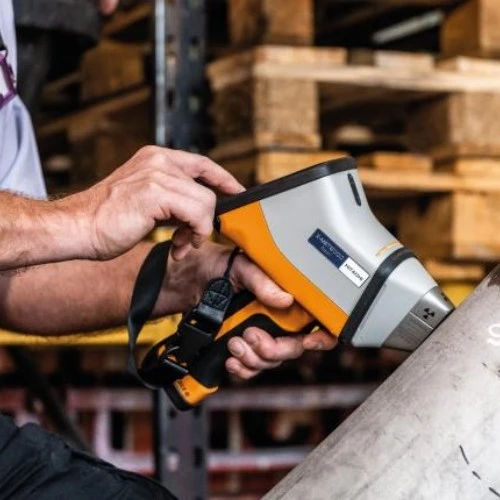
Titanium Tube Spectrometer Testing

Titanium Tube Ultrasonic Testing (UT)
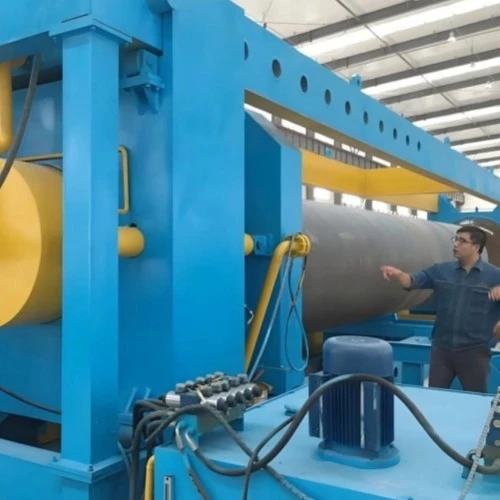
Titanium Tube Hydrostatic Testing

Titanium Tube Dimensional Inspection

Titanium Tube Flattening Test
Packaging and Delivery
Titanium tubes should be protected during handling, storage, and transportation to reduce surface damage, contamination, and deformation.
Typical packaging considerations include:
Protective caps or suitable end protection where required
Plastic wrapping or protective materials
Bundling by size and material grade
Clear labels showing grade, dimensions, quantity, and batch identification
Suitable wooden cases or export packaging for shipment
Protection against impact and surface abrasion
For long-distance export orders, packaging should be selected according to tube length, wall thickness, transportation method, and handling requirements.
Before shipment, buyers can specify labeling requirements, packing lists, material traceability, and any project-specific export documentation.
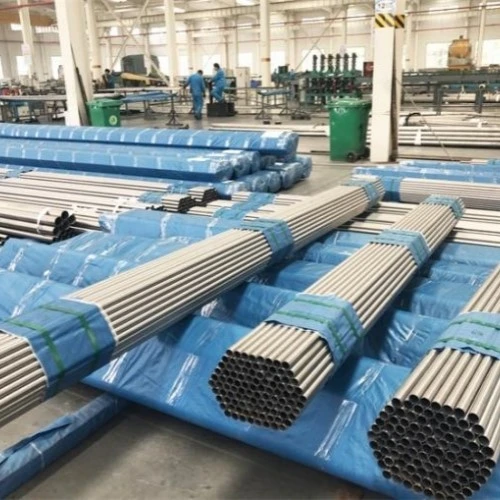
Bundled Titanium Tubes with Protective Wrapping
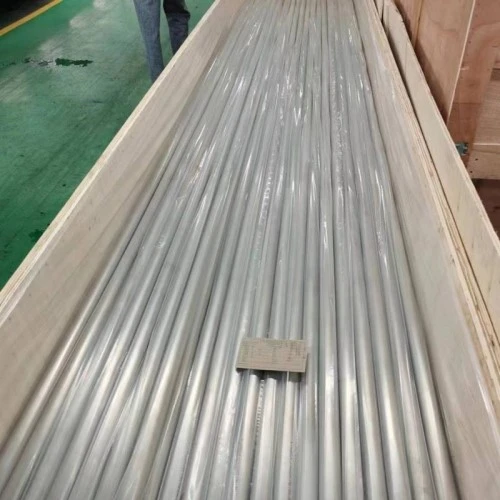
Titanium Tubes in Wooden Crates with Protective Film

Titanium Tubes with Paper Protective Wrapping
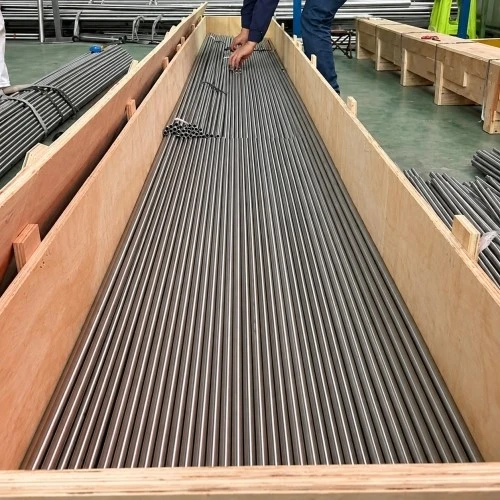
Titanium Tubes Packed into Export Wooden Crates
FAQ
Q: What is GR1 titanium?
A: GR1 is another common designation for Grade 1 titanium. Its UNS designation is R50250. It is a commercially pure titanium grade known for high ductility, good corrosion resistance, and excellent formability.
Q: Is Grade 1 titanium the same as UNS R50250?
A: Yes. Grade 1 titanium is identified as UNS R50250 in relevant ASTM product specifications.
Q: What is the difference between Grade 1 and Grade 2 titanium tubes?
A: Grade 1 has lower strength and higher ductility than Grade 2. It is often selected for forming and bending requirements, while Grade 2 is widely used where a higher strength level is needed.
Q: Is Grade 1 titanium suitable for heat exchangers?
A: Yes. Grade 1 is included in ASTM B338, which covers titanium and titanium alloy tubes for condensers and heat exchangers. The suitability of a specific tube depends on the operating conditions and equipment design.
Q: Is Grade 1 titanium used in medical applications?
A: Grade 1 titanium is included in ASTM F67 for surgical implant material product forms. However, ordinary industrial GR1 titanium tubes are not automatically implant-grade products. Medical device and implant-related tubing requires a defined product specification, traceability, testing, and applicable regulatory documentation.
Q: What is the difference between Grade 1 seamless and welded titanium tubes?
A: Seamless tubes have no longitudinal weld seam and are manufactured through a hollow-forming and tube-reduction route. Welded tubes are formed from flat-rolled titanium material and joined along a longitudinal seam. The correct choice depends on the applicable standard, design, inspection requirements, and project conditions.
Q: Can Grade 1 titanium tubes be bent or expanded?
A: Grade 1 has excellent ductility and is often selected for bending, flaring, and tube expansion. Actual forming performance depends on tube dimensions, wall thickness, delivery condition, tooling, and forming parameters.
Q: What standards apply to GR1 titanium tubes?
A: Commonly relevant standards include ASTM B338 for condenser and heat exchanger tubing, ASTM B861 for seamless titanium pipe, and ASTM B862 for welded titanium pipe. ASTM F67 applies to specified unalloyed titanium product forms for surgical implant applications, not automatically to ordinary tubing.
Q: Can you manufacture custom GR1 titanium tube dimensions?
A: Custom dimensions can be reviewed according to OD, wall thickness, length, tolerance, manufacturing method, and required standard. Please provide a drawing or dimension list so production feasibility can be checked.
Q: What documents are available with Grade 1 titanium tubes?
A: Depending on the order and agreed inspection scope, documents may include an MTC, chemical analysis, mechanical test results, dimensional inspection report, and specified NDT or other test reports.
Request a Quote for Grade 1 Titanium Tubes
Are you sourcing Grade 1 Titanium Tube, GR1 Titanium Tubing, or UNS R50250 Titanium Tube for an industrial or specialized application?
Send us the following information to help us evaluate your requirements:
Material grade and product standard
Seamless or welded construction
Outside diameter and wall thickness
Required length and quantity
Surface finish and delivery condition
Application and operating environment
Inspection and certification requirements
If you have a technical drawing, material specification, or existing tube sample, you can send it together with your inquiry.
Hot Tags: grade 1 titanium tube, China grade 1 titanium tube manufacturers, suppliers, factory, titanium, Titanium Gr2 Alloy Pipe, Titanium Pipe Welding, Gr9 Titanium Tube, Titanium Flex Pipe, Gr5 Titanium Straight Piping, Gr23 Titanium Tube


