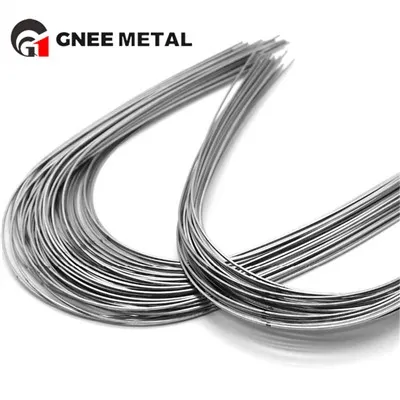


Gr1 ERTi-1 Titanium Wire
ERTi-1 Grade 1 is the lowest strength unalloyed (or commercially pure CP) grade. grade 1 is used in applications where ductility is critical, such as explosive cladding, loose lining, stencils, and deep drawing applications. It is also used in electrolytic applications such as coated anode substrates for the production of chlorine and sodium chlorate.
Description
ER Ti-1 is the purest grade and is suitable for welding titanium grades 1, 2, 3 and 4. However, the mechanical properties are much lower than those of grades 2, 3 and 4 titanium. The weld deposit is ductile and has excellent resistance to corrosive oxidizing environments. The alloy is used in the chemical industry and has excellent weldability.
Products Description
characteristics
Low density
Excellent corrosion resistance in acids, alkalis and salts
High heat transfer capacity
Good biocompatibility
Low coefficient of thermal expansion
Excellent strength to density ratio
Good low and high temperature strength
rofessional titanium material supplier - GNEE

Chemical Requirements
| CHEMICAL COMPOSITION OF TITANIUM WELDING WIRE FILLER | ||||||||||||
| CLASSIFICATION | (Weight %, Max or Range) | |||||||||||
| AWS A5.16 | UNS No | Ti | C | O | N | H | Fe | Al | V | Pd | Mo | Ni |
| ERTi 1 | R50100 | Rem. | 0.03 | 0.03-0.10 | 0.012 | 0.005 | 0.08 | |||||
| ERTi 2 | R50120 | Rem. | 0.03 | 0.08-0.16 | 0.015 | 0.008 | 0.12 | |||||
| ERTi 3 | R50125 | Rem. | 0.03 | 0.13-0.20 | 0.02 | 0.008 | 0.16 | |||||
| ERTi 4 | R50130 | Rem. | 0.03 | 0.18-0.32 | 0.025 | 0.008 | 0.25 | |||||
| ERTi 5 | R56400 | Rem. | 0.03 | 0.12-0.20 | 0.03 | 0.015 | 0.22 | 5.5-6.7 | 3.5-4.5 | |||
| ERTi 7 | R52401 | Rem. | 0.03 | 0.08-0.16 | 0.015 | 0.008 | 0.12 | 0.12-0.25 | ||||
| ERTi 9 | R56320 | Rem. | 0.03 | 0.08-0.16 | 0.02 | 0.008 | 0.25 | |||||
| ERTi 12 | R53401 | Rem. | 0.03 | 0.08-0.16 | 0.015 | 0.008 | 0.15 | 0.2-0.4 | 0.6- 0.9 | |||
| ERTi 23 | R56408 | Rem. | 0.03 | 0.03-0.11 | 0.012 | 0.005 | 0.2 | 5.5-6.5 | 3.5-4.5 | |||
Large-scale factory production

FAQ
Q: Is GR1 Titanium magnetic?
A: No, GR1 Titanium is paramagnetic, meaning it has a very weak magnetic susceptibility and is effectively non-magnetic. This is beneficial for applications in MRI or other sensitive electronic environments.
Q: Can GR1 Titanium handle sulfuric or hydrochloric acid?
A: Generally, no. GR1 has excellent resistance to oxidizing acids (like nitric acid) but poor resistance to reducing acids (like sulfuric and hydrochloric) unless they are highly diluted or contain specific oxidizing inhibitors. Always consult corrosion tables for specific media.
Q: What is the best welding method for GR1 Titanium?
A: Gas Tungsten Arc Welding (GTAW or TIG) with high-purity argon shielding (99.999%+) is the standard. Proper shielding of both the front and back of the weld is critical to prevent atmospheric contamination (oxygen, nitrogen) which embrittles the weld.
Q: Is GR1 Titanium safe for medical implants and food contact?
A: Yes. Its excellent biocompatibility makes it suitable for permanent implants (ASTM F67). Its non-toxic and corrosion-resistant properties also make it suitable for food processing equipment, provided proper surface finishes and cleaning protocols are used.
Trustworthy Team

Customer visits

GNEE Participation in Exhibitions

Hot Tags: gr1 erti-1 titanium wire, China gr1 erti-1 titanium wire manufacturers, suppliers, factory, titanium, Pure Gr1 Titanium Wire, titanium Gr5 filler wire, Titanium Gr23 Weld Wire, Titanium Coiled Wire, Thin Titanium Wire, Gr2 titanium filler wire