What Are The Structural Changes in Gr4 Titanium Rods During Hot Extrusion Processing?
Apr 13, 2024
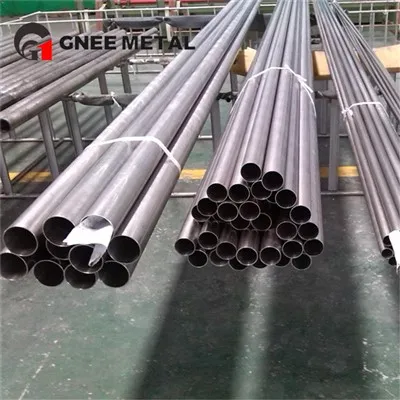
Industrially pure titanium contains a moderate amount of impurities, has high strength and plasticity, and is suitable for making structural materials. The low thermal conductivity of titanium and titanium alloy billets will cause a great temperature difference between the surface layer and the inner layer during hot extrusion, and the temperature difference can reach 200~250 degrees when the temperature of the extrusion cylinder is 400 degrees.
In the suction strengthening and billet section has a large temperature difference under the joint influence of the billet surface and the center of the metal to produce very different strength properties and plastic properties, in the extrusion process will cause very uneven deformation, in the surface layer of the large additional tensile stresses, to become in the extrusion of the surface of the product to form cracks and cracks in the root cause.
So far, the extrusion process of titanium rods must be lubricated. The main reason for this is that titanium forms fusible eutectic crystals with iron-based or nickel-based alloy die materials at temperatures of 980 degrees and 1030 degrees, resulting in strong die wear. When graphite lubricants are used, deep longitudinal scratch lines can be formed on the surface of the product, which is a consequence of titanium rods and titanium alloy rods adhering to the work on the mold.


Chemical composition of Titanium Gr 4
| Ti | Fe | C | O | H | N |
| % | % | % | % | % | |
| bal | 0.3 | 0.08 | 0.25 | 0.015 | 0.03 |
Characteristics of Titanium Gr 4
| annealed | specification values (ASTM F67) |
| tensile strength Rm | ≥ 550 |
| yield-strength Rp0.2 | ≥ 483 |
| elongation A | ≥ 15% |