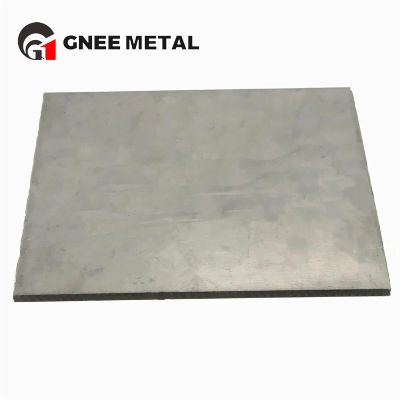

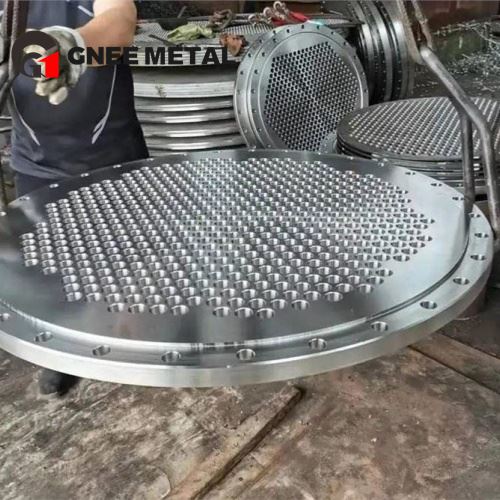
Titanium Tube Sheet
Material Grades: Grade 1, Grade 2, Grade 7, Grade 12
Thickness: Approximately 10–150 mm
Diameter: Approximately 100–2,000 mm
Shape: Round, Square, Rectangular
Tube Hole Diameter: Commonly designed according to heat exchanger tube outside diameter and connection method
Tube Hole Pattern: Triangular Pitch, Square Pitch
Tube Hole Machining: Drilled, Reamed, Grooved
Surface Condition: Machined, Ground, Pickled
Manufacturing Processes: CNC Turning, CNC Drilling, Milling, Reaming
Description
What Is a Titanium Tube Sheet?
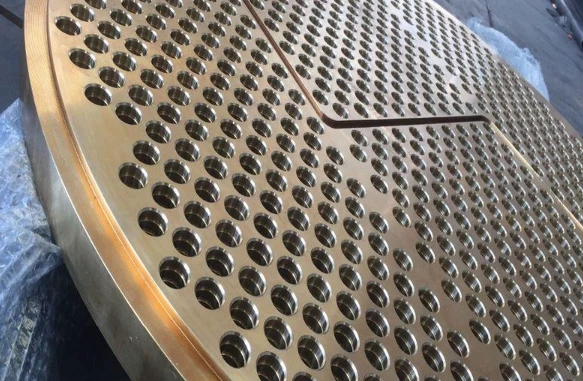
A titanium tube sheet is a flat or shaped plate with multiple precision-machined holes used to support and connect heat exchanger tubes. It is typically installed at one or both ends of a shell-and-tube heat exchanger.
The tube sheet performs several important functions:
Supports heat exchanger tubes: Holds the tubes in their designed positions and maintains the required spacing.
Separates fluid channels: Helps isolate the tube-side and shell-side fluids.
Provides tube connections: Allows tubes to be mechanically expanded, welded, or connected using a combination of both methods.
Maintains structural integrity: Withstands the loads and operating conditions specified in the equipment design.
Titanium Tube Sheet vs. Titanium Plate
A titanium plate is a flat raw material, while a titanium tube sheet is a machined component with a specific structural and connection function.
| Comparison | Titanium Plate | Titanium Tube Sheet |
|---|---|---|
| Product form | Flat titanium material | Machined plate or shaped component |
| Main function | General material for fabrication | Supports and connects heat exchanger tubes |
| Tube holes | Not normally included | Precision-drilled according to drawings |
| Machining requirements | Cutting and surface finishing | CNC drilling, reaming, grooving, and facing |
| Dimensional requirements | Plate thickness and external dimensions | Hole diameter, pitch, position, flatness, and overall dimensions |
| Typical applications | Chemical equipment, tanks, and industrial fabrication | Shell-and-tube heat exchangers, condensers, and evaporators |
Solid Titanium Tube Sheet vs. Titanium Clad Tube Sheet
Titanium tube sheets can be designed using different material structures.
Solid Titanium Tube Sheet: Manufactured entirely from titanium. It is suitable when the tube sheet requires titanium throughout its thickness.
Titanium Clad Tube Sheet: Combines a titanium corrosion-resistant layer with a structural base metal. It may reduce titanium consumption in suitable equipment designs.
The choice between solid titanium and titanium-clad construction depends on the design code, corrosion exposure, structural requirements, and tube-to-tubesheet connection design.
Send us your tube sheet drawings and material requirements for a technical review and quotation.
Titanium Tube Sheet Specifications
|
Specification |
Details |
|---|---|
|
Material Grades |
Grade 1, Grade 2, Grade 7, Grade 12 |
|
Thickness |
Approximately 10–150 mm (indicative reference) |
|
Diameter |
Approximately 100–2,000 mm (indicative reference) |
|
Shape |
Round, Square, Rectangular |
|
Raw Material Form |
Titanium Plate, Titanium Forging |
|
Raw Material Standards |
ASTM B265 (Plate); ASTM B381 (Forgings) |
|
Tube Hole Diameter |
Designed according to tube outside diameter and connection method |
|
Tube Hole Pattern |
Triangular Pitch, Square Pitch |
|
Tube Hole Machining |
Drilling, Reaming, Grooving |
|
Surface Condition |
Machined, Ground, Pickled |
|
Machining Processes |
CNC Turning, CNC Drilling, Milling, Reaming |
|
Dimensional Requirements |
Hole Diameter, Hole Pitch, Hole Position, Roundness, Flatness |
Tube Hole Specifications
Tube hole dimensions must be determined according to the heat exchanger tube size and the selected connection method.
Important parameters include:
Tube Hole Diameter: The finished diameter of each tube hole.
Tube Pitch: The center-to-center distance between adjacent holes.
Hole Position: The location of each hole relative to the tube sheet reference points.
Edge Distance: The distance between the outer tube holes and the tube sheet boundary.
Groove Dimensions: Required when mechanical expansion or another specified connection design uses grooved holes.
Tube hole diameter, pitch, position tolerance, and surface finish should be confirmed against the approved engineering drawing. They should not be selected using a generic size range without considering the tube connection design.
Titanium Grades for Tube Sheets
Titanium grade selection directly affects corrosion resistance, strength, ductility, and machining considerations.
For heat exchanger tube sheets, Grade 2 is a common general-purpose material, while other grades can be selected for specific corrosion environments or mechanical requirements.
Common Titanium Grades
| Titanium Grade | Material Type | Main Characteristics | Typical Selection |
|---|---|---|---|
| Grade 1 | Commercially Pure Titanium | High ductility, good formability, excellent corrosion resistance in many environments | Applications requiring good ductility |
| Grade 2 | Commercially Pure Titanium | Balanced strength, ductility, and corrosion resistance | General heat exchanger tube sheets |
| Grade 7 | Palladium-Added Titanium | Enhanced resistance in certain reducing acidic environments | Selected chemical processing equipment |
| Grade 12 | Titanium Alloy | Contains molybdenum and nickel, offering improved resistance in selected environments | Demanding industrial corrosion applications |
Grade 2 Titanium Tube Sheet
Grade 2 titanium is widely considered for industrial heat exchanger tube sheets because it provides a practical balance of mechanical properties and corrosion resistance.
Its main advantages include:
Good resistance to seawater and many chloride-containing environments.
Balanced tensile strength and ductility.
Good weldability when appropriate procedures are used.
Established industrial use in heat exchangers and chemical equipment.
Grade 7 and Grade 12 Titanium Tube Sheets
Grade 7 and Grade 12 are considered when the operating environment requires characteristics beyond those of commercially pure Grade 2.
Grade 7: Palladium addition improves corrosion resistance in certain reducing acidic environments.
Grade 12: Molybdenum and nickel additions provide improved resistance in selected reducing and hot chloride environments.
The final selection should be based on actual process conditions, including chemical concentration, temperature, pressure, and impurities.
Contact Us for Material Selection
Equivalent Grades of Titanium Tube Sheet
| ASTM Grade | Common Material Description | Chinese Grade Reference | Material Characteristics |
|---|---|---|---|
| Grade 1 | Commercially Pure Titanium | TA1 | High ductility and good formability |
| Grade 2 | Commercially Pure Titanium | TA2 | Balanced strength and corrosion resistance |
| Grade 7 | Palladium-Added Titanium | TA9 | Enhanced resistance in certain reducing acidic environments |
| Grade 12 | Titanium-Molybdenum-Nickel Alloy | TA10 | Improved resistance in selected industrial environments |
Standards for Titanium Tube Sheet Raw Materials
The applicable material standard depends on whether the starting material is plate, sheet, or forging.
ASTM B265: Covers titanium and titanium alloy strip, sheet, and plate.
ASTM B381: Covers titanium and titanium alloy forgings.
ASTM B338: Covers seamless and welded titanium and titanium alloy tubes for condensers and heat exchangers.
For finished tube sheets, the purchase specification should also define machining tolerances, inspection requirements, material traceability, and any applicable equipment construction code.
Titanium Tube Sheet Design and Tube Hole Layout
Tube hole layout is one of the most important design considerations for titanium tube sheets. It determines the number of tubes that can be installed, the spacing between tubes, and the available space for tube-to-tubesheet connections.
The final layout is normally provided or approved by the heat exchanger designer.
Common Tube Hole Patterns
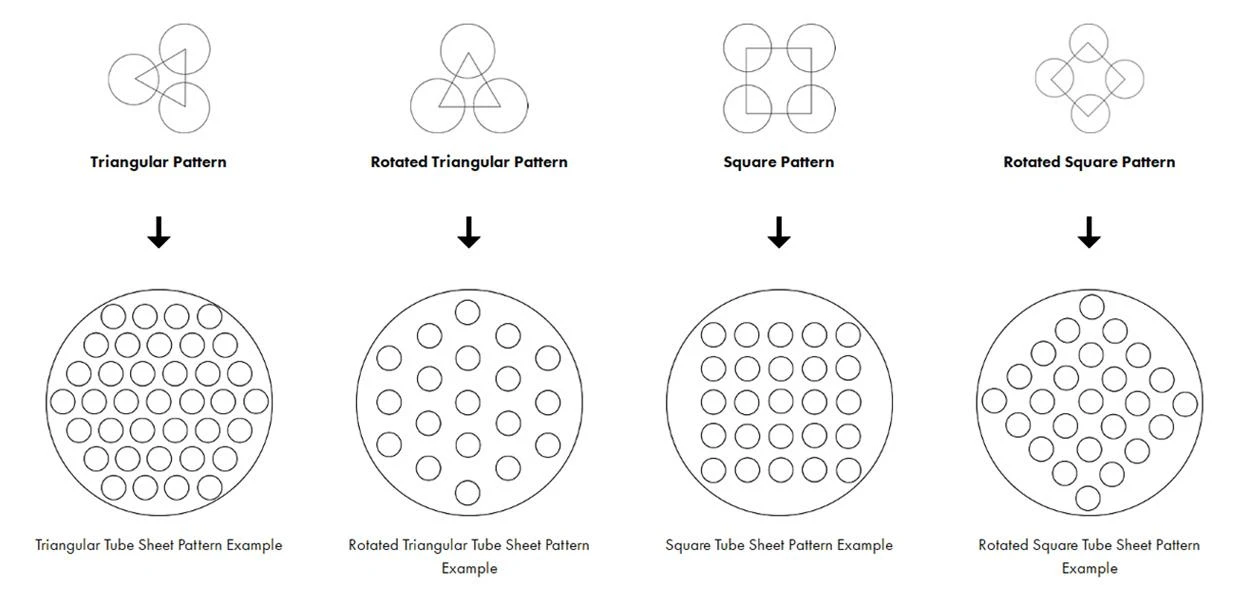
Triangular Pitch
In a triangular arrangement, tube holes are positioned in a triangular pattern.
Main characteristics:
Allows a relatively high tube count within a given tube sheet area.
Commonly used when compact tube arrangement is important.
May make mechanical cleaning between tubes more difficult, depending on the equipment design.
Square Pitch
In a square arrangement, tube holes are positioned in a regular square pattern.
Main characteristics:
Provides more open spaces between adjacent tube rows.
Can facilitate mechanical cleaning of the outside of tubes.
May accommodate specific shell-side flow and maintenance requirements.
Important Tube Sheet Design Parameters
| Design Parameter | Description |
|---|---|
| Tube Hole Diameter | Finished diameter of each tube hole |
| Tube Pitch | Center-to-center distance between adjacent tube holes |
| Tube Hole Quantity | Total number of tubes accommodated by the tube sheet |
| Edge Distance | Distance between the outer tube holes and the plate edge |
| Tube Sheet Thickness | Thickness required by the equipment design |
| Pass Partition Grooves | Machined grooves used in multi-pass channel arrangements |
| Tube Hole Position | Coordinate location of each hole |
| Ligament Width | Remaining material between adjacent holes |
Ligament width and hole spacing are important for maintaining sufficient strength around the tube connections. Their dimensions should be checked against the equipment design and applicable construction code.
Tube-to-Tubesheet Joint Types
The connection between the heat exchanger tubes and tube sheet is critical for preventing leakage and maintaining equipment performance.
The connection method affects tube hole dimensions, surface finish, groove design, and machining tolerances.
Tube Expansion
Tube expansion uses mechanical or hydraulic force to expand the tube inside the tube sheet hole.
Main characteristics:
Creates close contact between the tube outside surface and the tube hole.
Commonly used for mechanical tube-to-tubesheet connections.
Requires suitable hole diameter, surface condition, and expansion depth.
Expansion parameters must be controlled to avoid damaging the tube or tube sheet.
Tube-to-Tubesheet Welding
Tube-to-tubesheet welding creates a welded connection between the tube end and the tube sheet.
Main characteristics:
Provides a welded joint according to the specified joint design.
Requires suitable welding preparation and procedure qualification.
May be used where leak-tight connections are required.
Requires attention to titanium shielding and contamination control.
Titanium welding requires adequate shielding protection to prevent oxygen, nitrogen, and hydrogen contamination at elevated temperatures.
Welded and Expanded Joint
Some heat exchanger designs use both welding and mechanical expansion.
This approach may be selected when the design requires additional joint reliability or a particular combination of sealing and mechanical retention.
The connection sequence and acceptance criteria must follow the approved engineering design.
Comparison of Tube-to-Tubesheet Connections
| Connection Type | Main Method | Important Machining Considerations |
|---|---|---|
| Mechanical Expansion | Expanding the tube inside the hole | Hole diameter, surface finish, and expansion groove requirements |
| Welding | Welding the tube to the tube sheet | Joint preparation, edge geometry, and welding access |
| Welded and Expanded | Combining welding and expansion | Hole dimensions, groove design, and welding sequence |
The tube-to-tubesheet connection method should be confirmed before machining begins, because it directly affects the required hole dimensions and surface preparation.
Discuss Your Machining Requirements
Mechanical and Physical Properties of Titanium Tube Sheet
Titanium tube sheet performance depends on the selected grade, product form, thickness, and material condition.
For heat exchanger applications, the material must provide sufficient strength to withstand design loads while maintaining the required corrosion resistance and dimensional stability.
Mechanical Properties of Common Titanium Grades
| Property | Grade 1 | Grade 2 | Grade 7 | Grade 12 |
|---|---|---|---|---|
| Material Type | Commercially Pure Titanium | Commercially Pure Titanium | Palladium-Added Titanium | Titanium Alloy |
| Tensile Strength | Lower strength among common CP grades | Higher than Grade 1 | Generally comparable to Grade 2 | Higher-strength alloy grade |
| Ductility | High | Good | Good | Depends on product condition |
| Corrosion Resistance | Excellent in many oxidizing environments | Excellent in many industrial environments | Enhanced in certain reducing acidic environments | Improved in selected reducing environments |
The table provides a qualitative comparison. Actual minimum tensile strength, yield strength, and elongation values must be taken from the applicable material standard and the relevant product thickness range.
Physical Properties of Titanium
Titanium has several physical characteristics that influence heat exchanger design.
Density: Approximately 4.51 g/cm³.
Melting Point: Approximately 1,668°C for commercially pure titanium.
Thermal Conductivity: Relatively low compared with copper and many common steels.
Elastic Modulus: Approximately 105–115 GPa, depending on grade and condition.
Titanium's relatively low thermal conductivity should be considered during heat exchanger thermal design. Tube sheet material selection and tube-side performance are separate design considerations and should not be evaluated using corrosion resistance alone.
Corrosion Resistance of Titanium Tube Sheet
Titanium tube sheets are commonly selected for equipment exposed to seawater, chloride-containing fluids, and various industrial chemical environments.
Titanium forms a stable passive oxide film on its surface, which contributes to its corrosion resistance in many service conditions.
Seawater Corrosion Resistance
Grade 2 titanium is widely used in seawater heat exchangers, condensers, and cooling systems.
Its corrosion resistance makes it suitable for many seawater environments, including applications where conventional carbon steel or some stainless steels may require additional corrosion protection.
Chloride Corrosion Resistance
Titanium generally provides strong resistance to chloride-induced pitting and crevice corrosion in many aqueous environments.
However, service temperature, deposits, crevice conditions, and chemical impurities can affect performance. Actual operating conditions should always be reviewed.
Chemical Processing Environments
Different titanium grades may be selected for different chemical environments.
Grade 2: Common general-purpose selection for many oxidizing chemical environments.
Grade 7: Considered for certain reducing acidic environments.
Grade 12: Considered for selected hot chloride and reducing environments.
Corrosion at Tube-to-Tubesheet Joints
The tube-to-tubesheet connection is an important area to consider because it can create localized crevices and potential leakage paths.
Important considerations include:
Correct tube and tube sheet material selection.
Suitable hole dimensions and surface finish.
Proper tube expansion or welding procedure.
Prevention of contamination during titanium welding.
Inspection of completed tube connections.
Corrosion resistance depends on the complete assembly, not only the titanium grade. The tube sheet, tubes, welds, gaskets, and operating conditions must be evaluated together.
Manufacturing Process of Titanium Tube Sheet
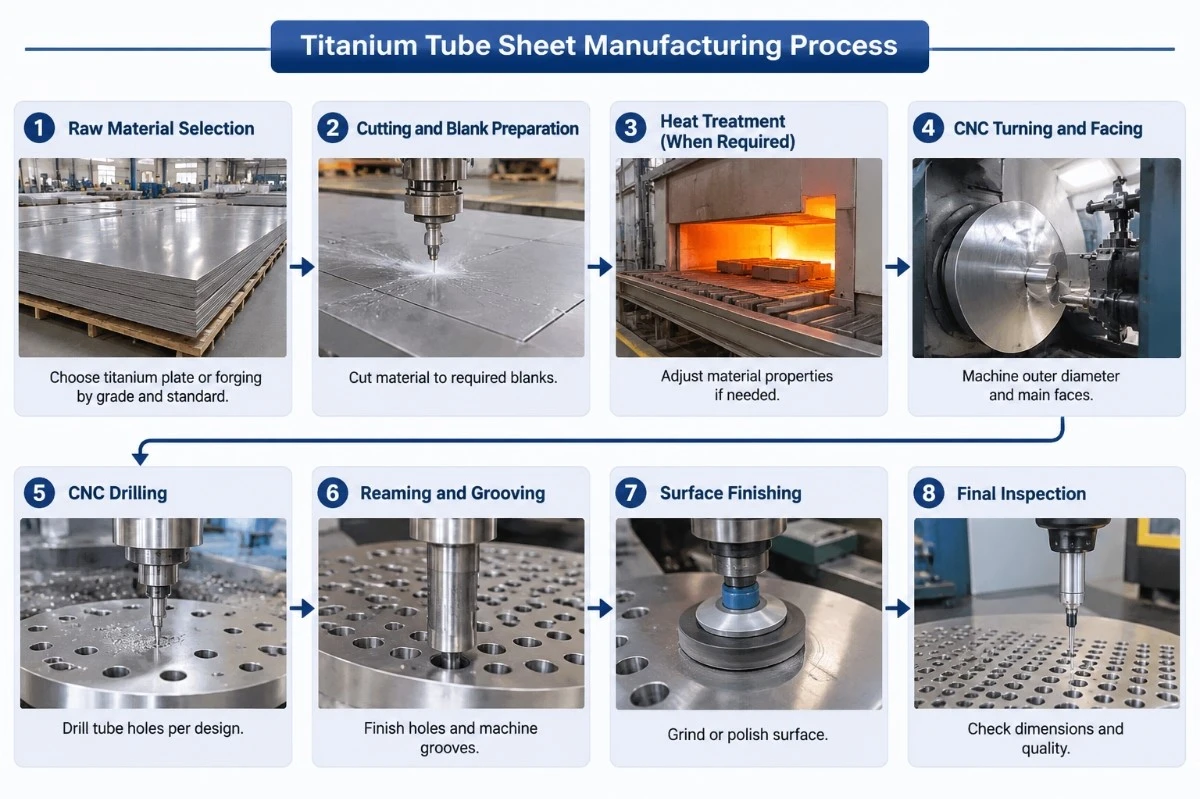
1. Raw Material Selection
Select titanium plate or forging according to the required grade, thickness, dimensions, and product standard.
2. Cutting and Blank Preparation
Cut the raw material to the required blank dimensions, allowing sufficient machining allowance.
3. Heat Treatment When Required
Carry out heat treatment when required by the material condition, manufacturing procedure, or technical specification.
4. CNC Turning and Facing
Machine the external diameter and main faces to achieve the required dimensions and surface condition.
5. CNC Drilling
Drill the tube holes according to the approved hole layout and machining coordinates.
6. Reaming and Grooving
Finish the tube holes to the required diameter and surface condition. Machine expansion grooves when specified by the connection design.
7. Surface Finishing
Carry out grinding, polishing, or other specified finishing operations.
8. Final Inspection
Check overall dimensions, hole diameter, hole position, flatness, surface quality, and other agreed requirements.
Applications of Titanium Tube Sheet
Titanium tube sheets are used in equipment where heat transfer and corrosion resistance are both important. Their applications include seawater cooling, chemical processing, marine systems, and industrial heat exchange.
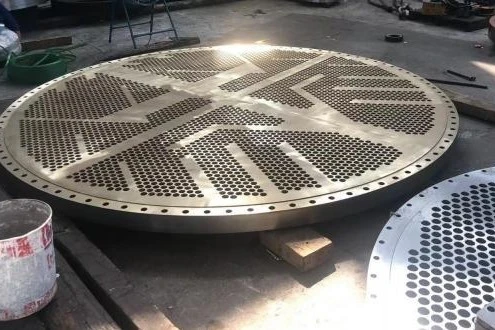
Heat Exchangers
Shell-and-Tube Heat Exchangers, Condensers, Evaporators
Common Grades: Grade 2, Grade 7
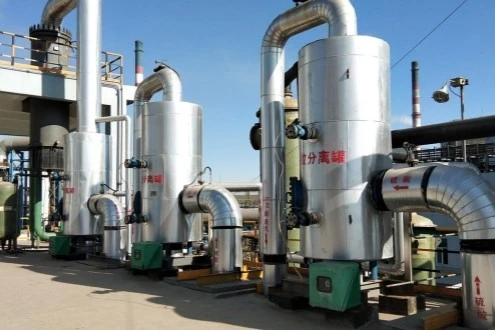
Chemical Processing Equipment
Chemical Heat Exchangers, Reactors, Process Vessels
Common Grades: Grade 2, Grade 7, Grade 12
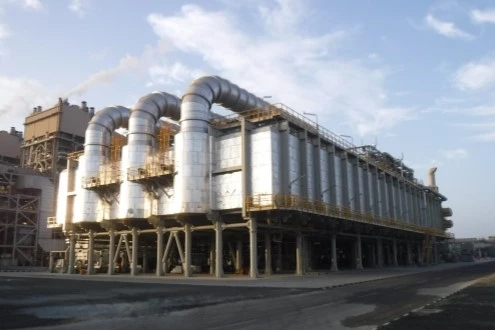
Seawater Desalination
Desalination Heat Exchangers, Brine Heaters, Evaporators
Common Grades: Grade 2
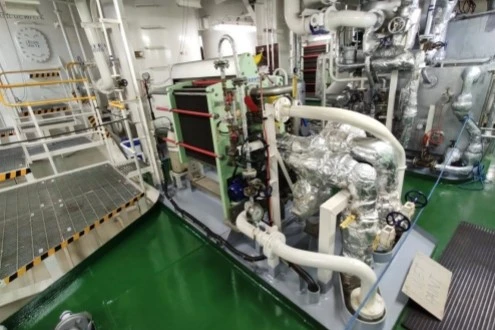
Marine Engineering
Marine Condensers, Seawater Coolers, Shipboard Heat Exchangers
Common Grades: Grade 2

Power Generation
Surface Condensers, Cooling Water Heat Exchangers, Condenser Tube Sheets
Common Grades: Grade 2
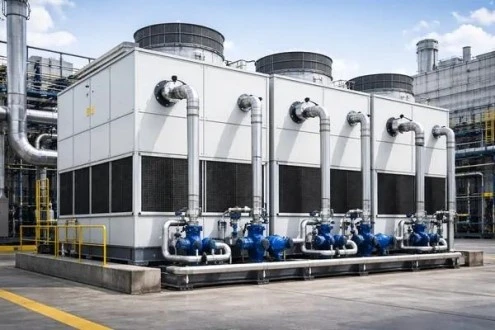
Industrial Cooling Systems
Industrial Water Coolers, Process Coolers, Cooling Heat Exchangers
Common Grades: Grade 2, Grade 7
Quality Inspection and Testing of Titanium Tube Sheet
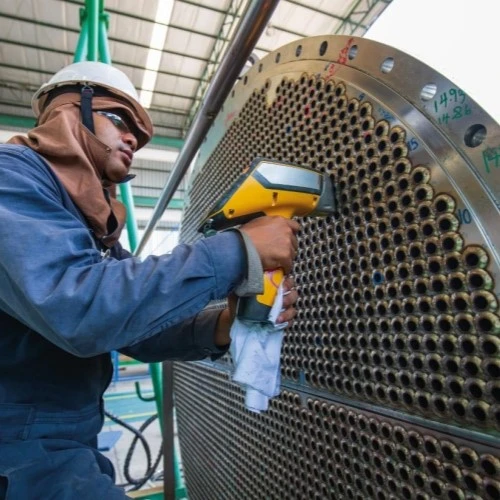
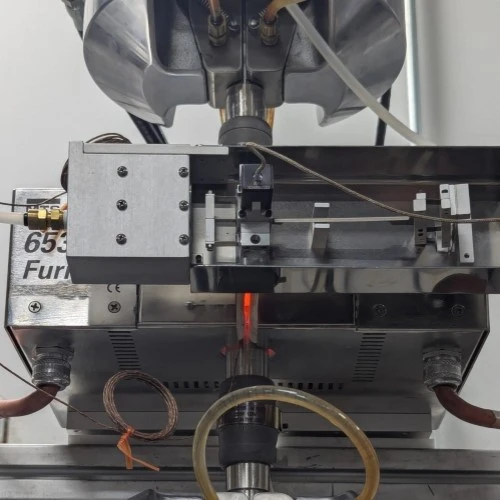
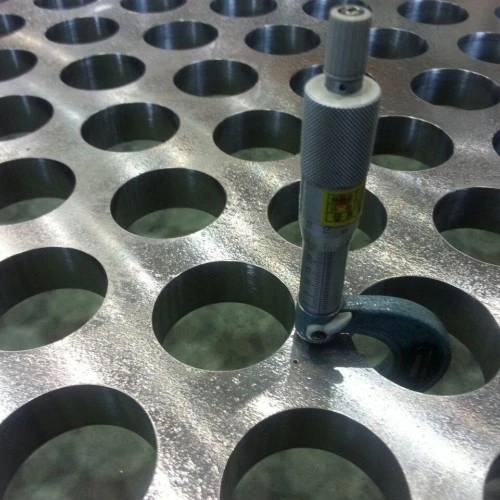
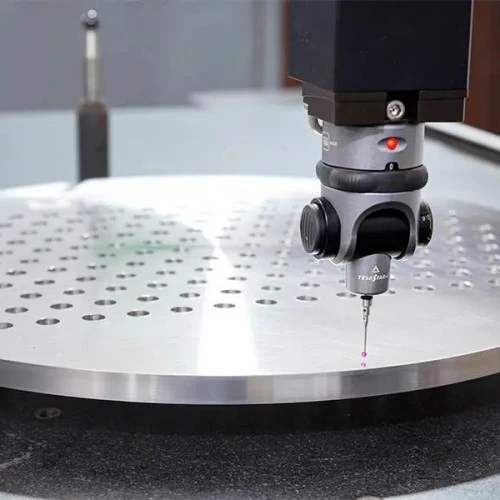
| Inspection Item | Inspection Method |
|---|---|
| Chemical Composition | Chemical Analysis |
| Tensile Properties | Tensile Test |
| Hardness | Hardness Test |
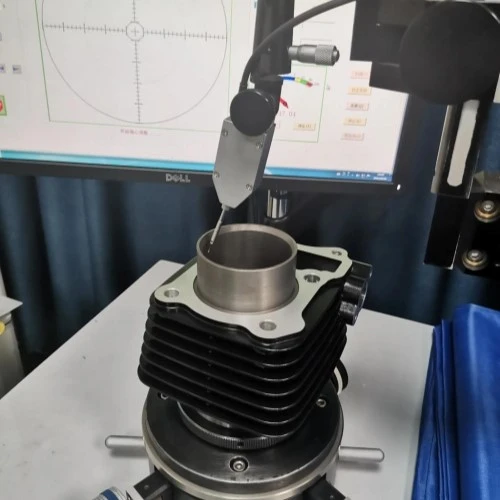
| Tube Hole Diameter | Precision Measurement |
| Tube Hole Position | Coordinate Measurement |
| Hole Roundness | Precision Measuring Instruments |
| Flatness | Surface Measurement |
| Surface Quality | Visual Inspection |
| Internal Material Quality | Ultrasonic Testing (UT), when specified |
Tube Hole Dimensional Inspection
Tube hole inspection is especially important because the dimensions directly affect tube installation and connection.
Important inspection parameters include:
Hole Diameter: Verify the finished diameter against the drawing.
Hole Position: Confirm the location of each hole.
Hole Pitch: Check the center-to-center distance between adjacent holes.
Hole Roundness: Evaluate the finished hole geometry.
Groove Dimensions: Verify expansion grooves when specified.
Surface Finish: Check the hole surface for burrs and machining defects.
Coordinate measuring machines and suitable precision measuring instruments can be used according to the required tolerance and inspection plan.
Packaging and Delivery of Titanium Tube Sheet
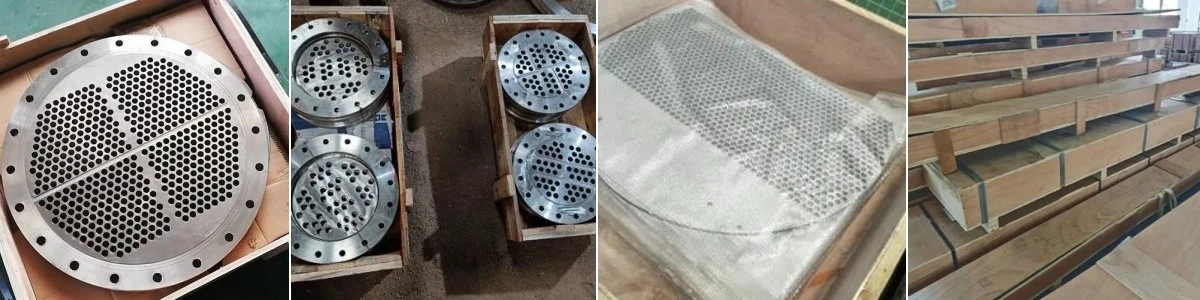
Surface Protection: Use protective film or suitable protective materials to reduce scratches and contamination.
Tube Hole Protection: Use suitable plugs or covers to prevent foreign materials from entering the holes.
Edge Protection: Protect machined edges from impact during handling.
Wooden Case Packaging: Use suitable export wooden cases or reinforced pallets according to product weight and dimensions.
Moisture Protection: Apply suitable protective wrapping for international transportation.
Product Identification: Mark the material grade, dimensions, quantity, order number, and handling information.
FAQ
Q: What titanium grade is commonly used for heat exchanger tube sheets?
A: Grade 2 titanium is a common choice for general heat exchanger tube sheets because it provides a good balance of strength, ductility, and corrosion resistance.
Grade 1, Grade 7, and Grade 12 may also be selected according to the operating environment and design requirements.
Q: What is the difference between Grade 1 and Grade 2 titanium tube sheets?
A: Grade 1 has higher ductility and lower strength, while Grade 2 offers higher strength with good corrosion resistance and formability.
Grade 2 is generally more common for industrial heat exchanger tube sheets, while Grade 1 may be considered when higher ductility is required.
Q: Can titanium tube sheets be manufactured from ASTM B265 titanium plate?
A: Yes. Titanium plate conforming to ASTM B265 can be used as a starting material for machining tube sheets, provided the required thickness, material condition, and dimensions are suitable.
For components made from titanium forgings, ASTM B381 may be applicable.
Q: What tube hole patterns are available for titanium tube sheets?
A: Two common arrangements are triangular pitch and square pitch.
Triangular pitch can accommodate a relatively high number of tubes in a given area, while square pitch can provide more space for mechanical cleaning between tube rows.
The final arrangement depends on the heat exchanger design.
Q: What is the difference between drilled and grooved tube holes?
A: A drilled tube hole is a basic machined hole used to accommodate the heat exchanger tube.
A grooved tube hole includes one or more machined grooves to support mechanical tube expansion when required by the connection design.
Q: Can titanium tube sheets be machined according to customer drawings?
A: Yes. Titanium tube sheets can be evaluated for machining according to customer drawings.
The drawing should include material grade, overall dimensions, tube hole diameter, hole quantity, pitch, hole arrangement, tolerances, and required surface finish.
Q: How is the dimensional accuracy of titanium tube sheets inspected?
A: Dimensional inspection can include hole diameter measurement, coordinate measurement, hole pitch verification, roundness inspection, flatness measurement, and overall dimensional checks.
The inspection method should match the tolerance requirements in the approved drawing.
Q: What information is required to quote a titanium tube sheet?
A: Please provide:
Titanium grade and material standard.
Overall diameter, width, length, and thickness.
Tube hole diameter and quantity.
Tube pitch and hole arrangement.
Groove requirements.
Tube-to-tubesheet connection method.
Dimensional tolerances and inspection requirements.
Order quantity and delivery destination.
A complete technical drawing is the best reference for evaluating machining feasibility and preparing an accurate quotation.
Request a Titanium Tube Sheet Quotation
We support titanium tube sheet inquiries for heat exchanger manufacturers, chemical equipment producers, marine engineering companies, and industrial equipment projects.
To evaluate your requirements, please send:
Required titanium grade.
Tube sheet dimensions and thickness.
Tube hole layout and machining details.
Applicable material standards and inspection requirements.
Technical drawings and order quantity.
Hot Tags: titanium tube sheet, China titanium tube sheet manufacturers, suppliers, factory, titanium, Gr1 Titanium Sheet Metal, Gr4 titanium alloy sheet, High Quality Grade 1 Titanium Plate for Medical, pure Gr7 titanium sheet, Ti6AL4V Sheet Gr5 Titanium Plate, Titanium Plate