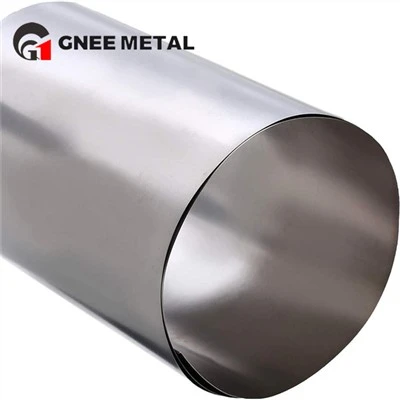

Grade 2 Titanium Foil for Structured Packing Manufacturing
Nov 20, 2026
What Is Grade 2 Titanium Structured Packing?
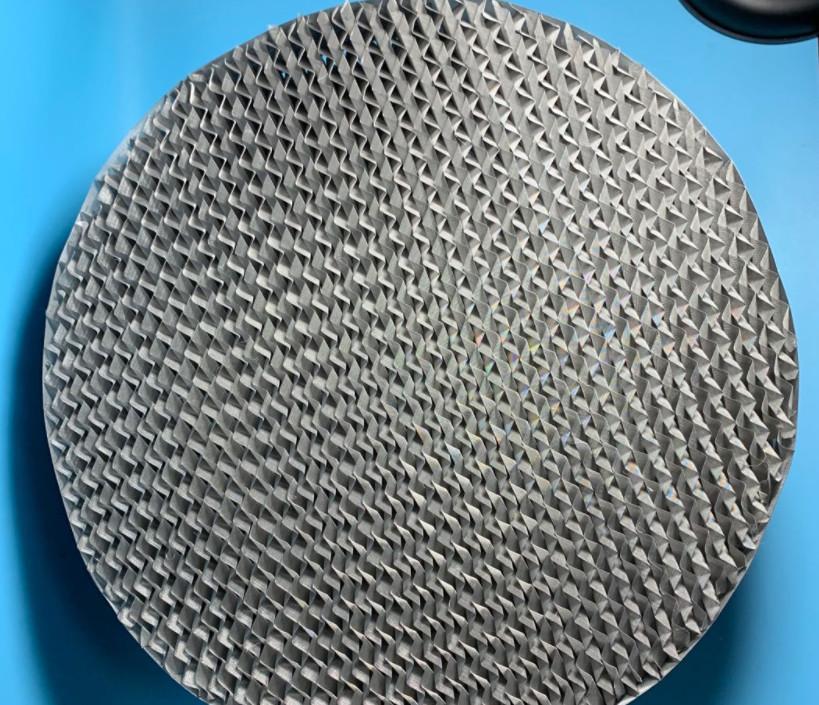
Structured packing is an internal component used in distillation columns, absorption towers, and other gas-liquid separation equipment. It is designed to provide a large contact area between rising vapor and descending liquid, supporting mass transfer inside the column.
When titanium is specified as the construction material, thin titanium sheets or strips may be processed into the corrugated elements used in the packing structure.
What Is Structured Packing?
Structured packing is generally made from regularly arranged sheets of thin metal. The sheets are formed into corrugated profiles and assembled in layers to create defined flow channels.
Depending on the design, the sheets may also contain perforations or surface textures to influence liquid distribution and gas-liquid contact.
Common characteristics include:
Corrugated sheet structure: Creates regular channels for vapor and liquid flow.
Layered arrangement: Forms a structured packing module with a defined geometry.
Perforations or surface texturing: Used in certain designs to influence fluid distribution.
Modular construction: Allows packing sections to be installed inside industrial columns.
Why Is Titanium Used in Structured Packing?
Most structured packing is manufactured from materials selected according to the operating environment and equipment design. Stainless steel is widely used, while titanium may be specified for applications where its corrosion resistance offers an advantage.
Grade 2 titanium can be considered when:
The process medium is compatible with commercially pure titanium.
Corrosion resistance is an important material selection factor.
Thin metal sheets need to undergo corrugation or other forming operations.
Lower material density is beneficial to the equipment design.
Where Is Grade 2 Titanium Used?
For structured packing manufacturing, thin titanium materials may be used to produce:
| Component | Material Form | Manufacturing Purpose |
|---|---|---|
| Corrugated packing sheets | Titanium foil / thin sheet | Forming the wave-shaped packing elements |
| Perforated packing sheets | Titanium foil / thin sheet | Producing openings in designs that require perforation |
| Packing layers | Formed titanium sheets | Assembling the structured packing modules |
Why Choose Grade 2 Titanium for Structured Packing?
Grade 2 is a commercially pure titanium grade widely used in industrial applications. It is often considered for chemical equipment because it combines useful mechanical properties with corrosion resistance in suitable environments.
For structured packing manufacturers, four material characteristics deserve particular attention.
Corrosion Resistance in Chemical Processing
Titanium develops a stable oxide film on its surface, which contributes to its corrosion resistance in many environments.
Grade 2 titanium performs well in many oxidizing and chloride-containing conditions. This makes it a material worth evaluating for selected chemical processing equipment.
Formability for Thin Corrugated Sheets
Structured packing sheets need to be formed into consistent corrugated profiles. Depending on the design, the material may also undergo perforation, bending, and other processing operations.
Grade 2 titanium offers a useful balance of strength and ductility for many industrial sheet-forming applications.
Low Density and Lightweight Construction
Grade 2 titanium has a density of approximately 4.51 g/cm³.
This is lower than the density of common stainless steel grades. For thin-sheet components and large assembled structures, lower material density can help reduce component weight.
Strength and Mechanical Performance
Grade 2 provides higher strength than Grade 1 while retaining useful ductility for many industrial applications.
Its mechanical properties make it suitable for a range of fabricated sheet components, provided the selected thickness and material condition meet the design requirements.
For structured packing, the material must be strong enough for the intended forming and service conditions without sacrificing the required geometry.
Grade 2 Titanium Foil Specifications for Structured Packing
|
Specification |
Supply Range / Details |
|---|---|
|
Titanium Grade |
Grade 2 / GR2 |
|
Standard |
ASTM B265, where applicable |
|
Thickness |
0.05–0.50 mm |
|
Width |
50–600 mm |
|
Length |
Custom cut lengths |
|
Supply Form |
Coil / Strip / Sheet |
|
Material Condition |
Annealed |
|
Surface Finish |
Bright / Matte |
|
Edge Condition |
Slit Edge / Mill Edge, subject to availability |
Key Material Requirements for Corrugation and Perforation
Thickness Consistency
Consistent thickness helps manufacturers maintain stable forming conditions and achieve more uniform corrugated profiles.
Thickness variations may affect:
Corrugation depth and profile consistency.
Forming pressure and tooling adjustment.
Finished sheet dimensions.
Fit between assembled packing layers.
Buyers should define the required thickness tolerance clearly and confirm how thickness will be measured during inspection.
Surface Quality
Thin titanium material should be checked for visible defects that could affect forming or the finished packing.
Common inspection concerns include:
Scratches and surface marks.
Cracks or edge damage.
Dents and local deformation.
Surface contamination.
Other defects specified in the purchase requirements.
A clean, consistent surface is especially important when the material will undergo repeated forming operations.
Forming Performance
Corrugation requires the sheet to deform into a repeated wave-shaped profile without unacceptable cracking or surface damage.
Forming performance depends on several factors:
Titanium grade.
Material condition.
Thickness and thickness tolerance.
Forming direction.
Tooling and bend radius.
Processing parameters.
For a new packing design, manufacturers may need to conduct a forming trial using the proposed material before confirming a large production order.
Perforation Quality
Some structured packing designs use perforated sheets, while others rely on different surface geometries.
Where perforation is required, the material needs to support the specified hole pattern and manufacturing method.
Important considerations include:
Hole diameter.
Hole spacing and arrangement.
Edge quality.
Burr formation.
Local deformation around the holes.
Perforation requirements should be provided by the packing manufacturer. They are design parameters, not universal specifications for all titanium structured packing.
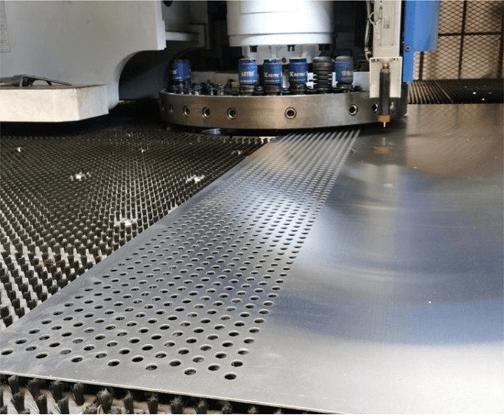
Titanium sheet perforation
How Grade 2 Titanium Foil Is Processed into Structured Packing
Grade 2 titanium foil or thin sheet is a raw material, not a finished structured packing product. It needs to go through further manufacturing operations before it becomes part of a column packing module.
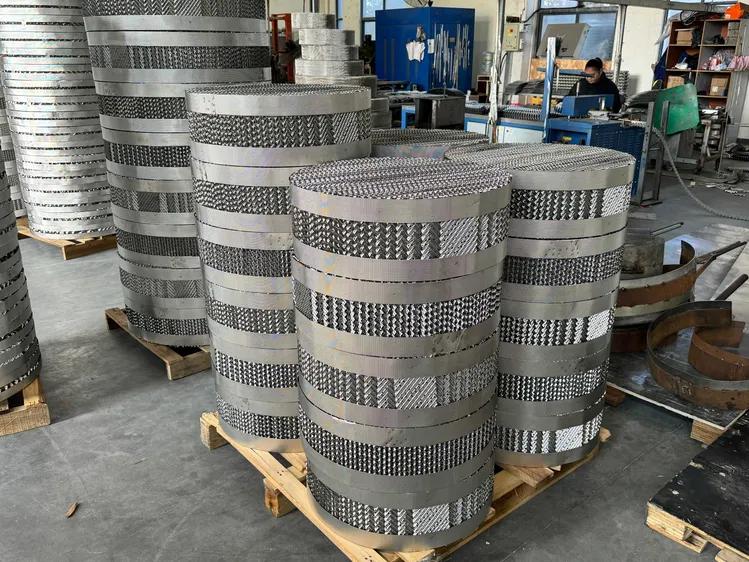
orrugation and Assembly of Metal Structured Packing
Raw Material Inspection
The incoming titanium material is checked against the purchase specification.
Typical checks include:
Grade identification and material documentation.
Thickness and width.
Surface condition.
Material condition.
Heat or batch traceability.
Checking the material before processing helps reduce the risk of discovering specification problems after forming has started.
Cutting and Preparation
The titanium sheet or strip is prepared according to the required dimensions.
Cutting methods depend on material thickness, production equipment, and the required edge quality.
The material should be handled carefully to prevent scratches, dents, or contamination before forming.
Perforation
For packing designs that require perforations, the sheets are processed using the specified hole pattern.
The hole size, spacing, and arrangement are determined by the packing design.
After perforation, manufacturers may inspect hole dimensions, burrs, and local deformation.
Corrugation
Corrugation forms the repeated wave-shaped profile used in structured packing.
The material must be suitable for the selected forming process. Inconsistent thickness or unsuitable material condition may make it more difficult to maintain a uniform profile.
Layering and Assembly
The corrugated sheets are arranged according to the packing design to create the required channel structure.
The arrangement, orientation, and module dimensions influence the geometry of the finished packing.
Final Inspection
Before installation or shipment, the finished packing modules may be checked for dimensional accuracy, assembly quality, and visible defects.
Grade 2 Titanium Foil vs Stainless Steel Foil for Structured Packing
Titanium and stainless steel are both used in industrial equipment manufacturing, but their suitability depends on the operating environment and project requirements.
| Comparison | Grade 2 Titanium | Stainless Steel |
|---|---|---|
| Density | Approx. 4.51 g/cm³ | Common grades are generally around 7.9–8.0 g/cm³ |
| Corrosion Resistance | Excellent in many suitable chemical environments | Depends on grade and process medium |
| Formability | Good for suitable thin-sheet applications | Depends on stainless steel grade and condition |
| Material Cost | Generally higher | Generally lower |
| Material Selection | Selected corrosive applications | Broad range of industrial applications |
When Is Grade 2 Titanium Worth Considering?
Grade 2 titanium is worth evaluating when the process environment presents corrosion challenges that conventional stainless steel may not handle adequately.
Potential reasons include:
The process medium is compatible with titanium but aggressive toward the selected stainless steel grade.
Corrosion resistance is a major factor in equipment service life.
Lower material density is beneficial to the design.
The project specification requires commercially pure titanium.
When May Stainless Steel Be More Economical?
Stainless steel may be the more economical option when its corrosion resistance and mechanical properties are sufficient for the operating environment.
For less aggressive process conditions, using titanium may increase material cost without providing a necessary performance benefit.
The right material is the one that meets the service requirements at an acceptable total cost-not necessarily the material with the highest corrosion resistance.
Inspection and Quality Requirements for Grade 2 Titanium Foil
|
Inspection Item |
Inspection Content |
|---|---|
|
Chemical Composition |
Titanium grade and chemical element analysis |
|
Tensile Strength |
Tensile strength testing |
|
Yield Strength |
Yield strength testing |
|
Elongation |
Elongation after fracture |
|
Thickness Tolerance |
Measurement of material thickness |
|
Width and Length |
Dimensional measurement |
|
Surface Quality |
Check for scratches, cracks, dents, and other visible defects |
|
Flatness |
Flatness inspection |
|
Edge Condition |
Inspection of edges for damage and irregularities |
|
Material Traceability |
Heat number and batch identification |
|
Material Test Certificate |
Chemical and mechanical test results |
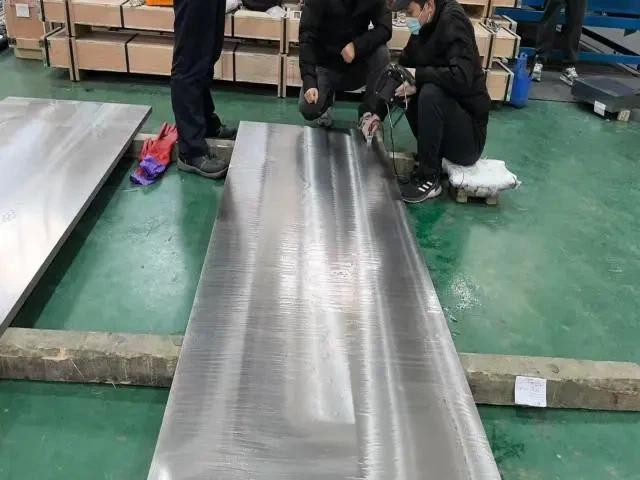
Grade 2 Titanium Sheet Quality Inspection
Grade 2 Titanium Foil Supplier for Industrial Applications
We supply titanium materials for industrial equipment manufacturers and international procurement projects.
Our product range includes titanium foil, sheet, plate, and strip in commercially pure and selected alloy grades. Grade 2 titanium is one of the material options for buyers looking for corrosion-resistant titanium materials for chemical processing equipment.
Titanium Materials We Supply
| Product Form | Grades | Standard / Specification |
|---|---|---|
| Titanium Foil | Confirmed according to available supply | Confirmed according to product form and order specification |
| Titanium Sheet | GR1, GR2, GR7, GR12 | ASTM B265, where applicable |
| Titanium Plate | GR1, GR2, GR7, GR12 | ASTM B265 |
| Titanium Strip | Confirmed according to available supply | ASTM B265, where applicable |
Actual product availability, dimensions, surface conditions, and material specifications should be confirmed before ordering.
What Information Should You Include in Your Inquiry?
To help us evaluate your requirements, please provide:
Titanium grade: Grade 2 / GR2.
Product form: Foil, thin sheet, or strip.
Thickness and width: Required dimensions and tolerances.
Quantity: Required weight or number of pieces.
Material standard: ASTM B265 or another agreed specification.
Application: Structured packing or other chemical equipment.
Documentation: MTC and any additional inspection requirements.
If you have a technical drawing or existing material specification, please include it with your inquiry.
Looking for Grade 2 titanium foil or thin sheet for structured packing manufacturing? Contact us with your material requirements. We will review the requested specifications and confirm the available supply options.