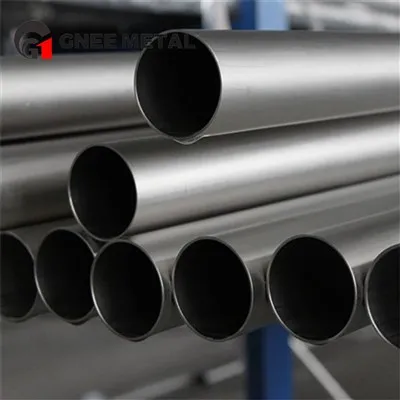
Titanium Grades Compared: GR1, GR2, GR3, GR4, GR7
May 18, 2026
GR1 titanium pipe is the softest and most ductile, ideal for deep drawing. GR2 is the most economical and widely used, offering balanced strength and corrosion resistance. GR7 contains palladium (Pd), drastically improving corrosion resistance in aggressive environments – but is significantly more expensive.
Material Type and Composition
GR1 through GR4 are unalloyed titanium, with increasing oxygen content enhancing strength but reducing ductility. GR7 contains palladium, which drastically improves corrosion resistance in aggressive environments.
| Grade | Type | Key Composition | Characteristics |
|---|---|---|---|
| GR1 | CP-Ti (softest) | 99.5% Ti, ≤0.18% O | Highest ductility, excellent formability |
| GR2 | CP-Ti (standard) | 99.2% Ti, ≤0.25% O | Balanced strength and corrosion resistance |
| GR3 | CP-Ti (medium strength) | 99.1% Ti, ≤0.35% O | Higher strength than GR1/GR2 |
| GR4 | CP-Ti (strongest CP) | 98.9% Ti, ≤0.40% O | Highest strength among CP grades |
| GR7 | Ti-0.15% Pd alloy | 99.1% Ti, 0.12-0.25% Pd | Superior corrosion resistance |

Mechanical Properties
As oxygen content increases from GR1 to GR4, strength increases and ductility decreases.
| Grade | Tensile Strength (MPa) | Yield Strength (MPa) | Elongation (%) | Hardness (HV) |
|---|---|---|---|---|
| GR1 | 240-370 | 170-310 | ≥24 | 100-150 |
| GR2 | 345-480 | 275-410 | ≥20 | 150-200 |
| GR3 | 450-600 | 380-520 | ≥18 | 200-250 |
| GR4 | 550-750 | 485-620 | ≥15 | 250-300 |
| GR7 | 345-480 | 275-410 | ≥20 | 150-200 |
Corrosion Resistance
GR7 outperforms all other CP-Ti grades in reducing acids and chloride-heavy environments due to palladium's catalytic effect.
| Environment | GR1-GR4 Performance | GR7 Performance |
|---|---|---|
| Seawater | Good | Excellent |
| Chloride solutions | Moderate | Exceptional |
| Oxidizing acids (HNO₃) | Good | Excellent |
| Reducing acids (HCl, H₂SO₄) | Poor | Excellent |
| Alkaline solutions | Good | Excellent |
GR1-GR4 perform well in oxidizing conditions but struggle in reducing acids. For HCl or H₂SO₄ environments, GR7 is essential.
Processing and Fabrication
| Grade | Formability | Weldability | Machinability |
|---|---|---|---|
| GR1 | Excellent (best for deep drawing) | Excellent | Good |
| GR2 | Very good | Excellent | Good |
| GR3 | Good | Good | Moderate |
| GR4 | Fair (prone to cracking) | Good | Moderate |
| GR7 | Very good | Excellent | Good |
GR1 titanium forming/bending is excellent – GR1 is preferred for sheet metal and tube forming. GR4 is harder to form but offers higher strength. How to weld GR1 titanium – GR1 and GR2 have excellent weldability; GR7 welds similarly to GR2 but requires care to avoid contamination.
Price and Supply
| Grade | Relative Cost | Market Availability |
|---|---|---|
| GR1 | Low-Medium | Widely available |
| GR2 | Medium (most economical) | Most common grade |
| GR3 | Medium-High | Limited use |
| GR4 | High | Specialty applications |
| GR7 | Very high (due to Pd) | Limited, high-performance use |
GR1 titanium price per kg is low-medium. GR2 is the most economical and widely used. GR7 is significantly more expensive due to palladium content.
Application
| Grade | Typical Applications for Pipe and Tube |
|---|---|
| GR1 | Chemical processing linings, GR1 titanium heat exchanger, marine components, medical implants (ductility-focused) |
| GR2 | Aerospace structures, desalination plants, GR1 titanium heat exchanger, surgical instruments |
| GR3 | Pressure vessels, hydraulic systems, airframe components |
| GR4 | High-strength fasteners, cryogenic vessels, orthopedic implants |
| GR7 | Chemical processing (HCl, H₂SO₄), offshore oil & gas, pharmaceutical reactors, extreme marine environments |
Grade Selection
| If your priority is... | Choose... |
|---|---|
| Maximum ductility and formability | GR1 |
| General corrosion resistance and cost-efficiency | GR2 |
| Higher strength than GR1/GR2 | GR3 |
| Highest strength among CP grades | GR4 |
| Extreme corrosion resistance (HCl, wet chlorine, chlorides) | GR7 (best but expensive) |
FAQ
Q1: What is the difference between GR1, GR2, GR3, GR4, and GR7 titanium pipe?
A: GR1 has the highest ductility (≥24% elongation) and lowest strength – best for deep drawing. GR2 offers balanced strength and corrosion resistance – the most economical. GR3 and GR4 have increasing strength but reduced ductility. GR7 contains 0.12-0.25% palladium, providing exceptional corrosion resistance in reducing acids and chlorides, with similar strength to GR2.
Q2: Which grade is strongest – GR1, GR2, GR3, GR4, or GR7?
A: GR4 is the strongest commercially pure titanium grade (tensile 550-750 MPa, yield 485-620 MPa). GR3 is next (450-600 MPa tensile), then GR2 and GR7 (345-480 MPa tensile), and finally GR1 (240-370 MPa tensile).
Q3: Which grade is most ductile?
A: GR1 is the most ductile, with minimum 24% elongation. This makes GR1 titanium for deep drawing the ideal choice for complex formed shapes like bellows, expansion joints, and deep-drawn components.
Q4: What is the difference between GR2 and GR7 titanium tube?
A: GR2 and GR7 have similar mechanical properties. The key difference is that GR7 contains 0.12-0.25% palladium, giving it exceptional corrosion resistance in reducing acids (HCl, H₂SO₄) and chlorides – environments where GR2 performs poorly. However, GR7 is significantly more expensive.
Q5: Which grade is best for seawater applications?
A: GR7 offers excellent corrosion resistance in seawater. GR1 through GR4 are rated Good. For most seawater applications, GR1 or GR2 are sufficient. For extreme marine environments or offshore oil & gas, GR7 is recommended.
Q6: Can GR1 titanium pipe be used for heat exchangers?
A: Yes, GR1 titanium heat exchanger tubes are used in chemical processing and marine applications. For higher strength requirements, GR2 or GR3 are also common. For extreme corrosive environments (HCl, H₂SO₄), GR7 is required.
Q7: Is GR1 titanium pipe suitable for medical implants?
A: Yes, medical grade 1 titanium (ASTM F67 grade 1) is used for implants where ductility is key. For load-bearing implants requiring higher strength, GR4 is used for orthopedic implants.
Q8: What is the chemical composition of GR1 vs GR7?
A: GR1 titanium chemical composition is 99.5% Ti, ≤0.18% O, ≤0.20% Fe. GR7 has similar base composition plus 0.12-0.25% palladium, which dramatically improves corrosion resistance.
Q9: How to weld GR1 titanium pipe?
A: How to weld GR1 titanium – GR1 and GR2 have excellent weldability. Use GTAW (TIG) with ERTi-1 filler for GR1. GR7 welds similarly to GR2; use ERTi-7 filler. Proper argon shielding is critical for all grades.
Q10: Which grade is most cost-effective for general use?
A: GR2 is the most economical and widely used. GR1 is low-medium cost, ideal when formability is the priority. GR7 is very high cost and should only be used when extreme corrosion resistance is required.
Q11: What is the yield strength of GR1 titanium pipe?
A: GR1 titanium yield strength ranges from 170-310 MPa. GR2: 275-410 MPa, GR3: 380-520 MPa, GR4: 485-620 MPa, GR7: 275-410 MPa.
Q12: Is GR7 worth the higher cost?
A: GR7 is significantly more expensive due to palladium content. It is worth the cost only when the application demands exceptional corrosion resistance in reducing acids (HCl, H₂SO₄) or chlorides. For general corrosive environments, GR2 is more cost-effective.
Q13: What is the density of titanium grade 1 pipe?
A: Titanium grade 1 density is 4.51 g/cm³ – the same for all CP grades (GR1 through GR7).
Q14: Can GR1 titanium pipe be used for pressure vessels?
A: GR1 is not recommended for pressure vessels requiring high strength. GR3 or GR4 are better suited for pressure vessels. GR1 is better for chemical processing linings and heat exchangers.
Q15: What is the hardness difference between GR1 and GR4?
A: Grade 1 titanium hardness is 100-150 HV. GR4 hardness is 250-300 HV – approximately twice as hard. This reflects the significant strength increase from GR1 to GR4.