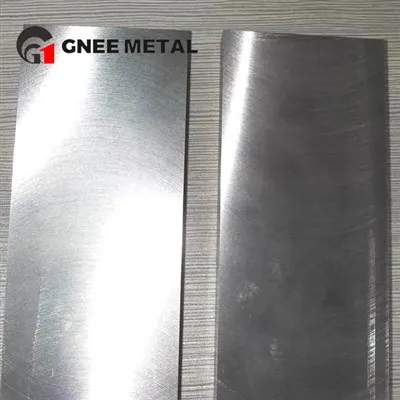

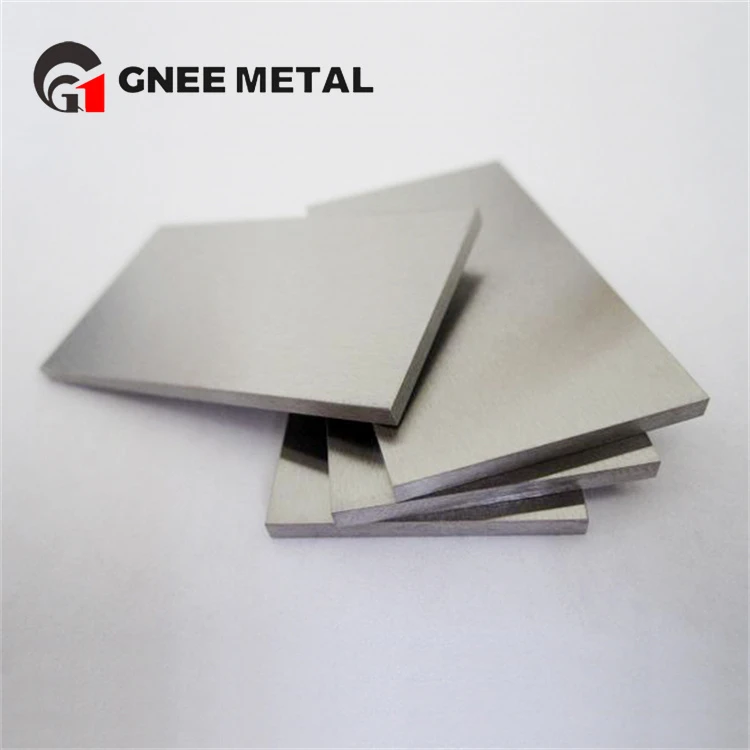
Hot Rolled Titanium Plate
Grades: ASTM Grade 1, 2, 3, 4, 5, 7, 9, 12, 23
Standards: ASTM B265, ASME SB265, GB/T 3621
Thickness: 3–100 mm
Width: 1,000–2,000 mm
Length: 2,000–6,000 mm
Surface Finishes: Hot Rolled, Pickled, Sandblasted, Ground
Delivery Condition: Annealed and other specified conditions
Description
What Is Hot Rolled Titanium Plate?
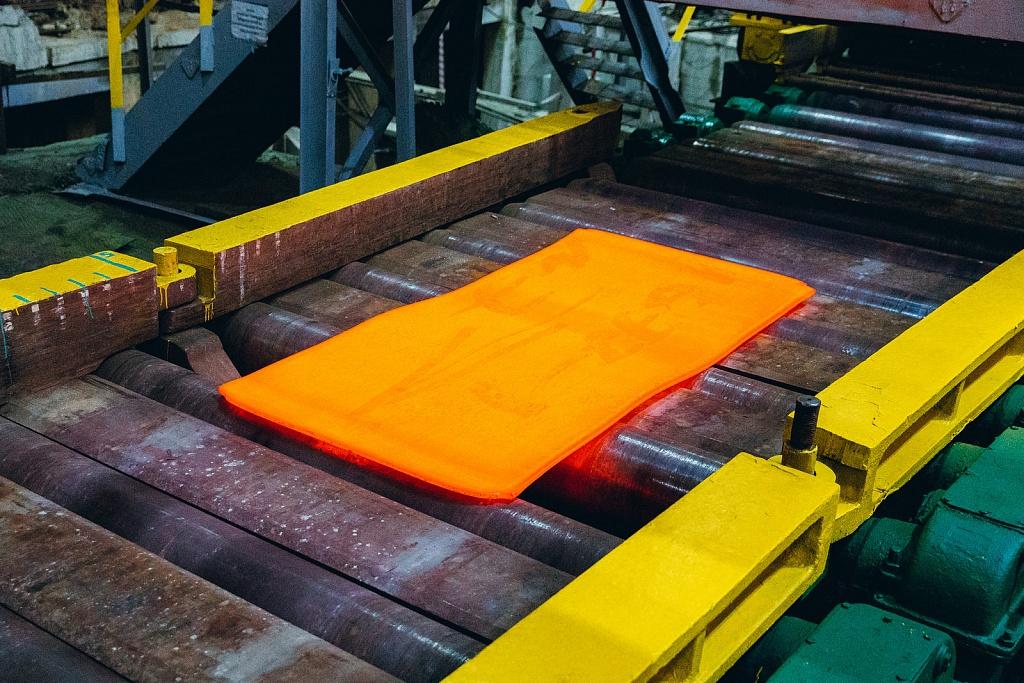
Hot Rolled Titanium Plate is manufactured by heating titanium slabs and reducing their thickness through high-temperature rolling. It is widely used in chemical processing equipment, heat exchangers, marine engineering, power generation, and heavy industrial applications requiring corrosion resistance, structural strength, and reliable material performance.
Compared with cold rolled titanium sheet, hot rolled titanium plate is particularly suitable for thicker sections, large structural components, pressure-bearing equipment, and parts requiring extensive machining or fabrication. It is available in commercially pure titanium and titanium alloy grades, with different surface finishes and delivery conditions.
Hot Rolled Pure Titanium Plate
Manufactured from commercially pure titanium grades, including:
Grade 1: High ductility and excellent formability.
Grade 2: Balanced strength, corrosion resistance, and weldability.
Grade 3: Higher strength than Grade 2.
Grade 4: Highest strength among the commercially pure titanium grades.
These materials are commonly selected for chemical processing equipment, heat exchangers, storage tanks, and corrosion-resistant structures.
Hot Rolled Titanium Alloy Plate
Manufactured from titanium alloys with specific mechanical and corrosion-resistance characteristics.
Common grades include:
Grade 5 (Ti-6Al-4V): High strength and excellent strength-to-weight ratio.
Grade 7 (Ti-0.15Pd): Enhanced corrosion resistance in reducing environments.
Grade 9 (Ti-3Al-2.5V): Good strength and formability.
Grade 12 (Ti-0.3Mo-0.8Ni): Improved resistance to crevice corrosion.
Grade 23 (Ti-6Al-4V ELI): High fracture toughness and ductility.
Hot Rolling Process of Titanium Plate
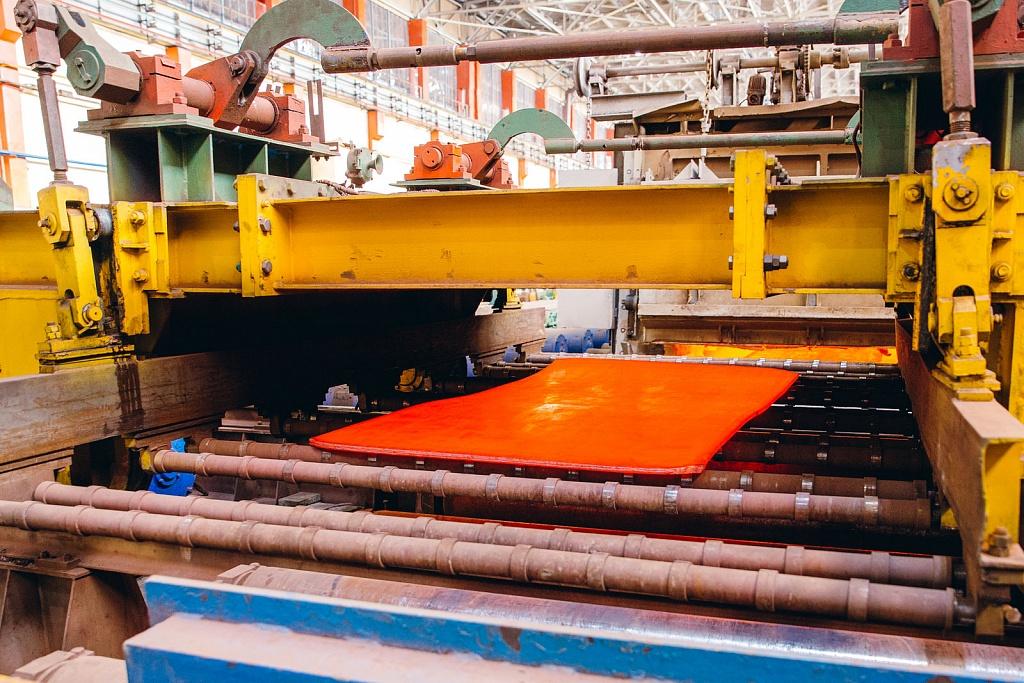
The production of hot rolled titanium plate involves several controlled manufacturing stages. Heating temperature, rolling reduction, deformation conditions, and subsequent surface treatment all affect the final plate quality.
Production site for hot rolled titanium alloy plates
1. Titanium Slab Preparation
Titanium ingots are melted and processed into slabs suitable for rolling. The slab is inspected for surface and internal defects before entering the heating stage.
2. Slab Heating
The titanium slab is heated to an appropriate rolling temperature. Heating conditions must be controlled to ensure sufficient plasticity while limiting excessive oxidation and oxygen diffusion into the surface.
3. Hot Rolling
The heated slab passes through rolling mills in multiple passes. Each pass reduces the slab thickness until the required plate dimensions are achieved.
Rolling temperature, reduction ratio, and deformation conditions influence the material's microstructure and mechanical properties.
4. Hot Straightening
After rolling, the titanium plate may undergo straightening to correct warping and improve flatness.
5. Heat Treatment
Heat treatment, including annealing, may be applied to obtain the required metallurgical condition and mechanical properties.
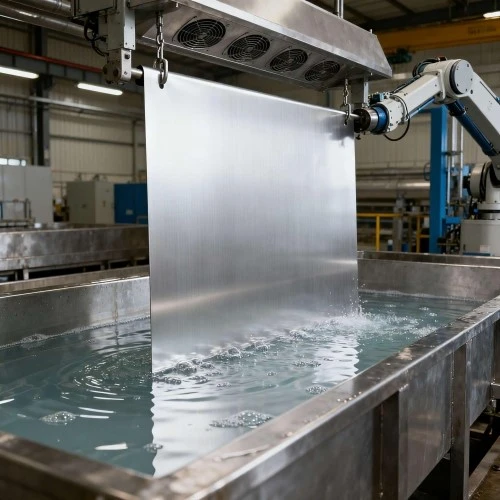
6. Descaling and Surface Cleaning
High-temperature processing produces an oxide layer on the titanium surface. This layer must be removed through suitable mechanical or chemical methods.
7. Pickling and Surface Finishing
Pickling removes residual oxide scale and surface contamination. Additional grinding or other finishing processes may be applied according to surface requirements.
8. Cutting and Final Inspection
The finished titanium plate is cut to the required dimensions and inspected for thickness, width, length, flatness, surface quality, and other specified requirements.
Hot Rolled Titanium Plate vs. Cold Rolled Titanium Plate
Hot rolled and cold rolled titanium plates differ mainly in their manufacturing processes, thickness ranges, surface conditions, and dimensional characteristics.
| Comparison | Hot Rolled Titanium Plate | Cold Rolled Titanium Plate |
|---|---|---|
| Manufacturing Process | Rolling at elevated temperatures | Rolling at room temperature after hot processing |
| Typical Thickness | 3–100 mm | Approximately 0.3–6 mm |
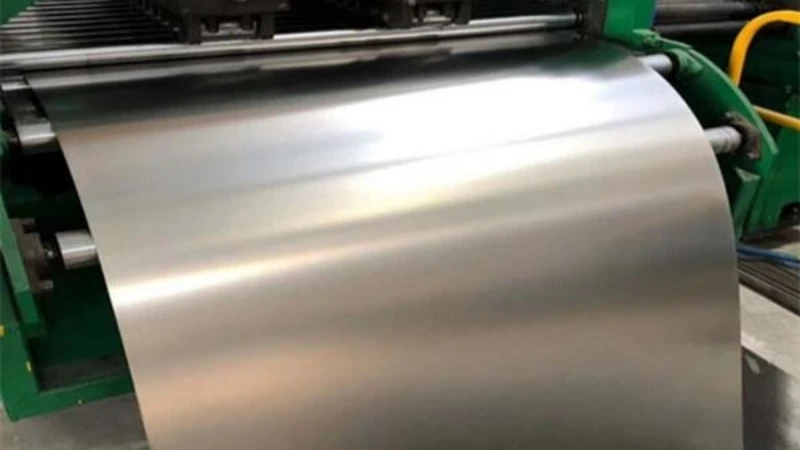
| Surface Condition | Usually requires descaling or further finishing | Generally smoother and more uniform |
| Thickness Control | Depends on rolling and finishing process | Generally tighter thickness control |
| Mechanical Characteristics | Depends on grade and final heat treatment | May exhibit increased strength and hardness from work hardening |
| Common Processing | Heavy machining, cutting, welding | Precision forming, bending, stamping |
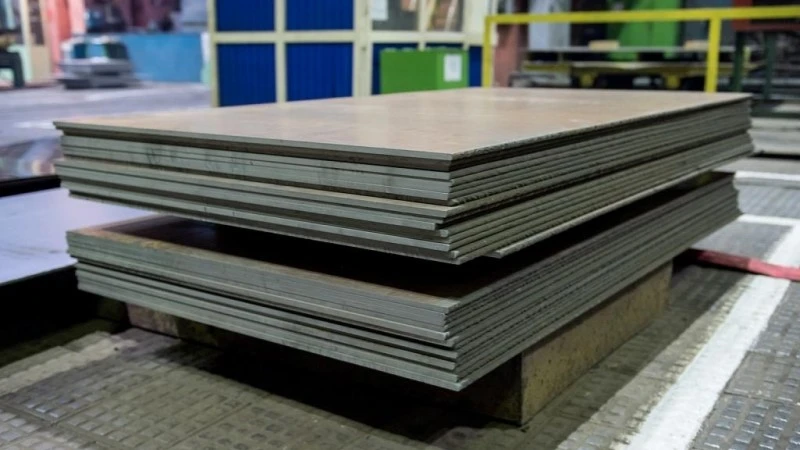
| Typical Applications | Pressure vessels, reactors, thick structural parts | Thin-wall components, precision parts |
When Should You Choose Hot Rolled Titanium Plate?
The required plate thickness is relatively large, particularly for heavy industrial components.
The material will be used in pressure vessels, reactors, or large equipment structures.
The plate requires substantial machining, cutting, or fabrication.
Large-format titanium plates are needed for industrial manufacturing.
When Is Cold Rolled Titanium Plate More Suitable?
A smoother surface finish is important.
Thin and relatively precise thicknesses are required.
The material will undergo precision forming or stamping.
Tight dimensional control is a major purchasing requirement.
The choice between hot rolled and cold rolled titanium plate should be based on the required thickness, dimensional tolerances, surface finish, and fabrication process.
Hot Rolled Titanium Plate Specifications
We offer hot rolled titanium plates in different grades, thicknesses, and dimensions for industrial manufacturing and engineering applications.
| Specification | Available Range |
|---|---|
| Product Type | Hot Rolled Titanium Plate |
| Material | Commercially Pure Titanium / Titanium Alloy |
| Grades | Grade 1, 2, 3, 4, 5, 7, 9, 12, 23 |
| Standard | ASTM B265 / ASME SB265 / GB/T 3621 |
| Thickness | 3–100 mm |
| Width | 1,000–2,000 mm |
| Length | 2,000–6,000 mm |
| Manufacturing Process | Hot Rolled |
| Delivery Condition | Annealed / Other specified conditions |
| Surface | Hot Rolled / Pickled / Sandblasted / Ground |
| Edge Condition | Mill Edge / Cut Edge |
| Inspection | Chemical Analysis / Tensile Test / Dimensional Inspection / Surface Inspection |
| Documentation | Mill Test Certificate / EN 10204 3.1 |
Common Hot Rolled Titanium Plate Dimensions
| Thickness (mm) | Common Width (mm) | Common Length (mm) |
|---|---|---|
| 3–5 | 1,000–1,500 | 2,000–4,000 |
| 6–10 | 1,000–2,000 | 2,000–6,000 |
| 12–20 | 1,000–2,000 | 2,000–6,000 |
| 25–40 | 1,000–2,000 | 2,000–6,000 |
| 45–60 | 1,000–2,000 | 2,000–6,000 |
| 65–100 | 1,000–2,000 | 2,000–6,000 |
Thickness is one of the most important factors when selecting hot rolled titanium plate. Thicker plates are commonly used for heavy equipment, machined components, and structural applications, while thinner plates are more suitable for sheet fabrication and lighter structures.
Applicable Standards
ASTM B265: Titanium and titanium alloy strip, sheet, and plate.
ASME SB265: Titanium and titanium alloy strip, sheet, and plate for ASME applications.
GB/T 3621: Titanium and titanium alloy plates and sheets.
Titanium Grades Available in Hot Rolled Plates
Different titanium grades offer different combinations of strength, ductility, corrosion resistance, and fabrication performance.
The selection of a hot rolled titanium plate should be based on the operating environment and mechanical requirements of the final equipment.
| Titanium Grade | Common Equivalent | Main Characteristics | Typical Applications |
|---|---|---|---|
| Grade 1 | TA1 | High ductility, excellent formability | Chemical equipment, tank linings |
| Grade 2 | TA2 | Balanced strength and corrosion resistance | Heat exchangers, pressure vessels |
| Grade 3 | TA3 | Higher strength than Grade 2 | Industrial structures |
| Grade 4 | TA4 | High strength among CP grades | Industrial equipment |
| Grade 5 | TC4 | High strength-to-weight ratio | Aerospace, structural parts |
| Grade 7 | TA9 | Enhanced corrosion resistance with Pd | Chemical processing |
| Grade 9 | TA18 | Good strength and formability | Tubing components, aerospace |
| Grade 12 | TA10 | Improved crevice corrosion resistance | Heat exchangers, chemical equipment |
| Grade 23 | TC4 ELI | High fracture toughness and ductility | Aerospace, biomedical components |
How to Select the Right Titanium Grade?
For general industrial corrosion resistance: Grade 2 is a common choice because it provides a balance of strength, ductility, and corrosion resistance.
For more demanding chemical environments: Grade 7 and Grade 12 may be considered depending on the chemical medium, temperature, and concentration.
For high-strength structural applications: Grade 5 is commonly selected because of its high strength-to-weight ratio.
For applications requiring enhanced ductility and fracture toughness: Grade 23 may be appropriate, subject to the component design and applicable requirements.
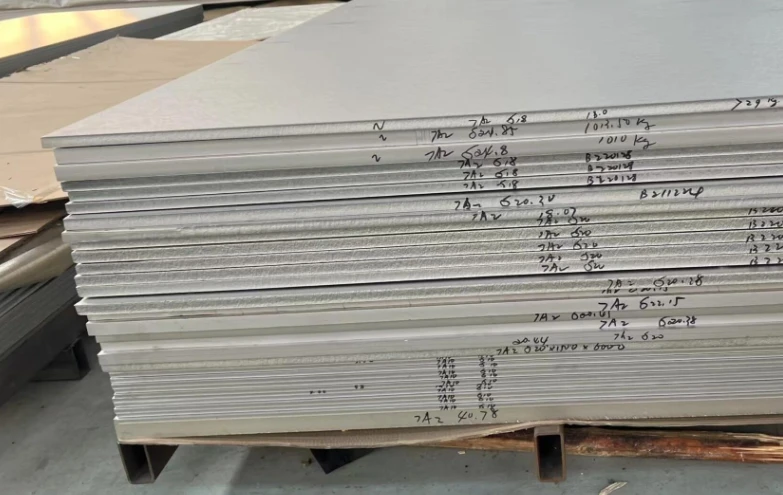
Industrial titanium plates
Surface Finishes of Hot Rolled Titanium Plate
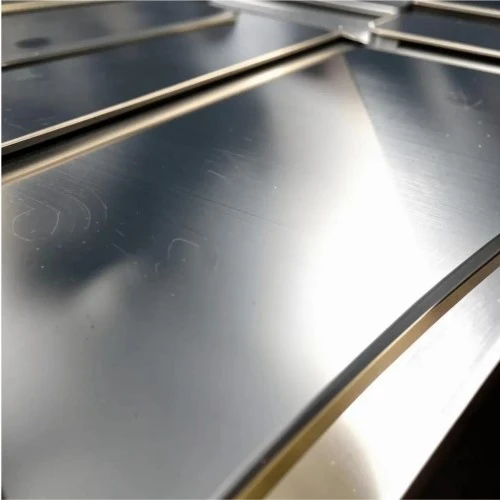
The surface condition of hot rolled titanium plate is influenced by rolling temperature, oxidation, descaling, and subsequent finishing operations.
Choosing the correct surface finish is important for welding, machining, coating, forming, and final equipment appearance.
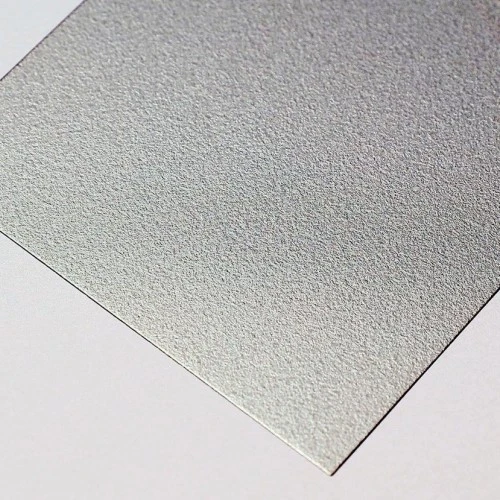
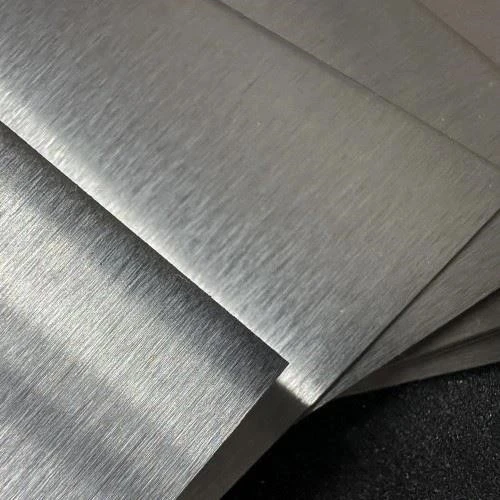
| Surface Finish | Processing Method | Surface Characteristics | Typical Applications |
|---|---|---|---|
| Hot Rolled Surface | Directly obtained after hot rolling, with basic surface treatment | May retain oxide scale, dark areas, and rolling marks | Heavy industrial components, further machining |
| Pickled Surface | Chemical pickling to remove oxide scale | Clean, relatively uniform metallic surface | Chemical equipment, heat exchangers, welding fabrication |
| Sandblasted Surface | Abrasive blasting to clean and texture the surface | Uniform matte appearance with a textured finish | Industrial equipment, surface preparation |
| Ground Surface | Mechanical grinding using abrasive tools | Smoother surface with reduced surface irregularities | Precision machining, components requiring improved surface quality |
How to Choose the Right Surface Finish?
Hot Rolled Surface: Suitable when the plate will undergo further machining or surface treatment.
Pickled Surface: A good option when oxide scale removal and a clean metallic surface are required.
Sandblasted Surface: Suitable for applications requiring a uniform matte texture or specific surface preparation.
Ground Surface: Recommended when improved surface smoothness and reduced surface irregularities are important.
Heat Treatment and Delivery Conditions
Heat treatment is an important part of hot rolled titanium plate production. It helps control the material's metallurgical condition and mechanical properties.
Different titanium grades require different heat treatment procedures. The treatment temperature and holding time must be selected according to the material grade, plate thickness, and applicable technical requirements.
As-Rolled Condition
As-rolled titanium plate is supplied after the rolling process without a subsequent annealing treatment.
Retains the metallurgical condition resulting from rolling.
May require additional processing depending on the final application.
Should not be assumed to meet annealed delivery requirements.
Annealed Condition
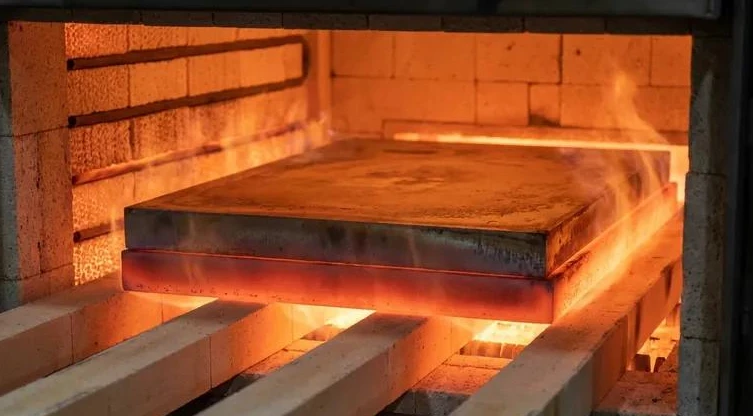
Annealing involves heating the titanium plate to a specified temperature followed by controlled cooling.
Helps reduce residual stresses.
Improves ductility and fabrication performance where applicable.
Provides a specified metallurgical condition for industrial applications.
Stress Relief Treatment
Stress relief treatment may be applied to reduce residual stresses introduced during manufacturing or fabrication.
Helps improve dimensional stability.
Can reduce the risk of distortion during subsequent machining.
Must be performed within the appropriate temperature range for the selected grade.
Titanium alloy plate inside a high-temperature industrial furnace
Mechanical Properties of Hot Rolled Titanium Plate
The mechanical properties of hot rolled titanium plate depend on the titanium grade, thickness, heat treatment condition, and applicable product standard.
| Grade | Tensile Strength (MPa) | Yield Strength (MPa) | Elongation (%) |
|---|---|---|---|
| Grade 1 | 240 | 170 | 24 |
| Grade 2 | 345 | 275 | 20 |
| Grade 3 | 450 | 380 | 18 |
| Grade 4 | 550 | 483 | 15 |
| Grade 5 | 895 | 828 | 10 |
| Grade 7 | 345 | 275 | 20 |
| Grade 9 | 620 | 483 | 15 |
| Grade 12 | 483 | 345 | 18 |
| Grade 23 | 860 | 795 | 10 |
Note: Values are indicative reference values for product selection. Actual acceptance limits vary by standard edition, product thickness, and material condition. Grade 23 and other alloy grades require particular attention to the applicable thickness range.
Cutting and Fabrication of Hot Rolled Titanium Plate
Hot rolled titanium plate is commonly processed into equipment components, structural parts, and custom-fabricated products.
Due to titanium's relatively low thermal conductivity and high chemical reactivity at elevated temperatures, cutting and fabrication require suitable tools, processing parameters, and protective measures.
CNC Machining
CNC milling and turning are used to manufacture precision components from thicker titanium plates.
Important considerations:
Use sharp cutting tools and appropriate tool materials.
Maintain suitable cutting speeds and feed rates.
Ensure sufficient cooling and chip removal.
Consider machining allowance when ordering thick plates.
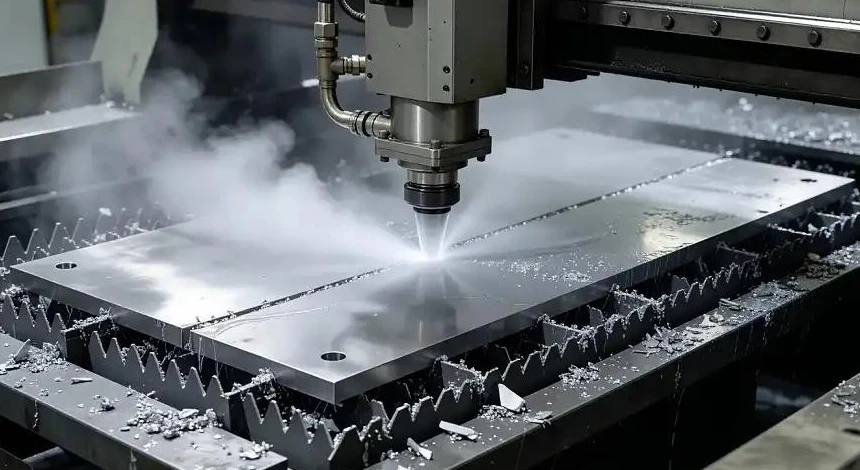
Waterjet Cutting
Waterjet cutting uses a high-pressure water stream, usually with abrasive particles, to cut titanium plate.
Produces no significant heat-affected zone.
Suitable for complex profiles and thick plate cutting.
Helps reduce thermal distortion.
Waterjet Cutting of Thick Titanium Plate
Plasma Cutting
Plasma cutting can be used for industrial titanium plate cutting where appropriate process controls and protective measures are available.
Suitable for relatively thick plate sections.
Requires control of cutting parameters and edge quality.
Additional edge finishing may be necessary.
Saw Cutting
Mechanical sawing is suitable for straight cuts and smaller plate sections.
Provides controlled cutting for selected thicknesses.
Can be used for preparation before machining.
Requires suitable blades and cutting conditions.
Drilling and Milling
Titanium plates can be drilled and milled to produce holes, slots, mounting surfaces, and other machined features.
Tool selection, cutting parameters, and heat management are important to prevent excessive tool wear and surface damage.
Welding and Fabrication
Titanium plates can be welded using suitable procedures, commonly including TIG/GTAW and other qualified welding methods.
Use high-purity shielding gas.
Protect the weld pool and the hot metal around it from atmospheric contamination.
Clean surfaces thoroughly before welding.
Apply qualified welding procedures for the specific grade and thickness.
Applications of Hot Rolled Titanium Plate
Hot rolled titanium plate is used in equipment and structures where a combination of corrosion resistance, strength, and fabrication performance is required.
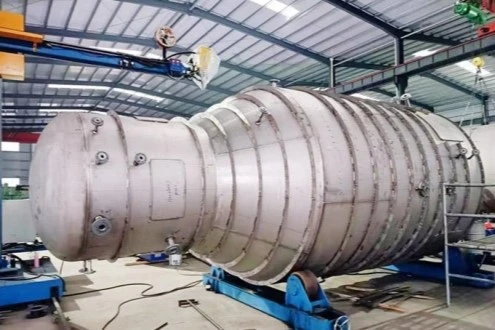
Chemical Processing
Reactor linings, chemical storage tanks, pressure vessel components, and equipment shells.
Common grades: Grade 2, Grade 7, Grade 12.
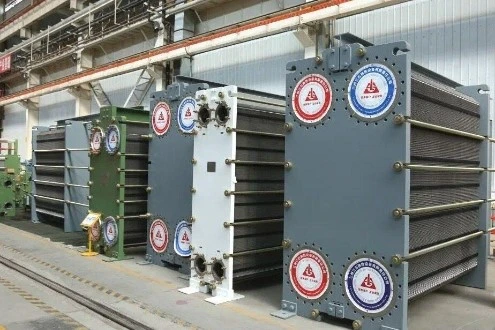
Heat Exchangers
Tube sheets, exchanger plates, equipment supports, and corrosion-resistant structural parts.
Common grades: Grade 2, Grade 7, Grade 12.
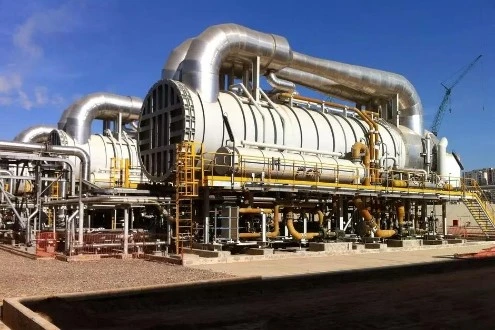
Marine Engineering
Seawater system components, marine equipment structures, and desalination equipment.
Common grades: Grade 2, Grade 7, Grade 12.
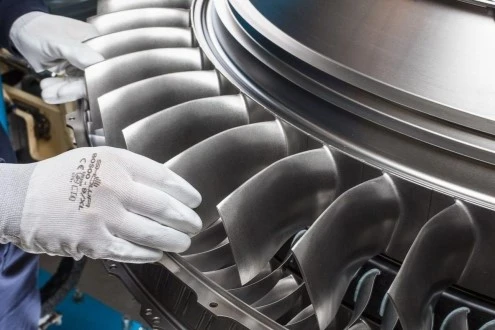
Aerospace Industry
Aircraft structural parts, machined brackets, and load-bearing components.
Common grades: Grade 5, Grade 23.
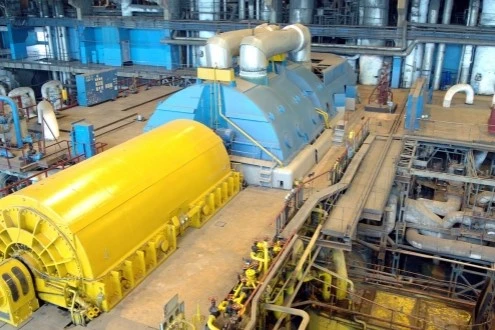
Power Generation
Condenser components, cooling system parts, and corrosion-resistant equipment structures.
Common grades: Grade 2, Grade 7, Grade 12.
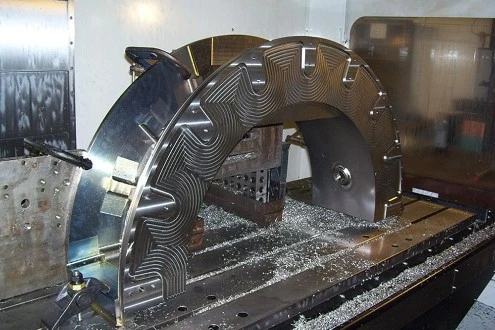
Industrial Machinery
Machined plates, equipment bases, structural parts, and custom industrial components.
Common grades: Grade 2, Grade 5, Grade 12.
Quality Inspection and Testing
Quality inspection ensures that hot rolled titanium plate meets the required chemical, mechanical, dimensional, and surface quality specifications.
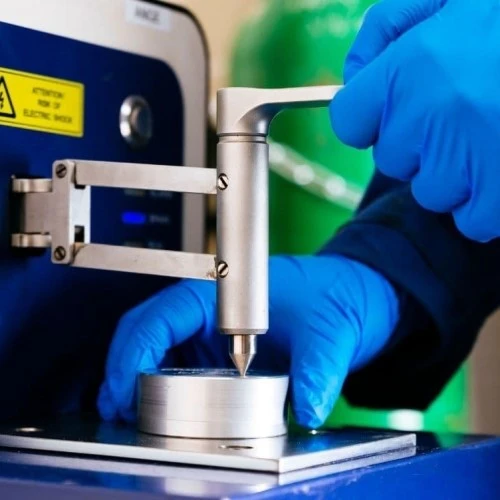
Chemical Analysis
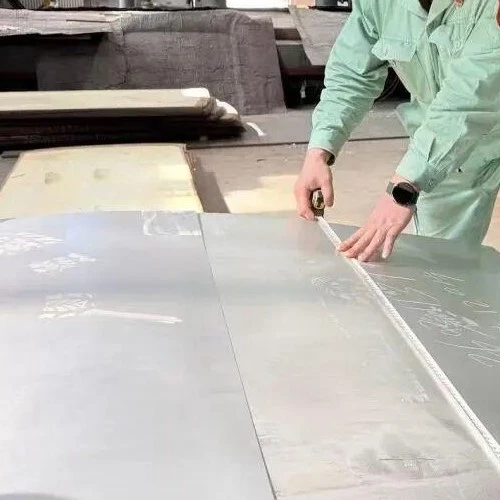
Dimensional Inspection
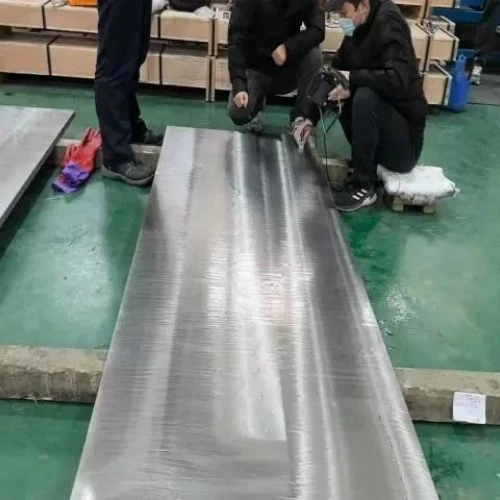
Surface Inspection
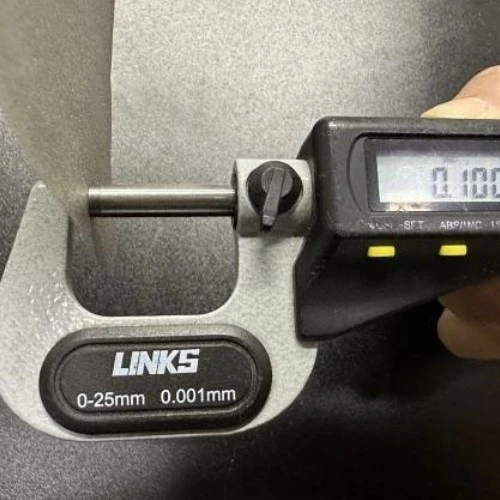
Thickness Tolerance
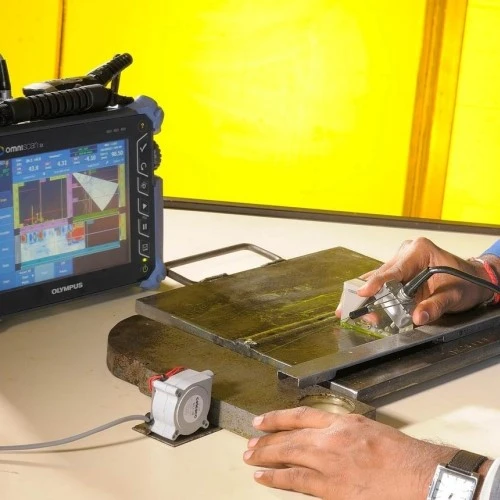
Ultrasonic Testing
| Inspection Item | Inspection Details | Purpose |
|---|---|---|
| Chemical Composition | Analysis of titanium and alloying elements | Verify material grade |
| Tensile Test | Tensile strength, yield strength, elongation | Check mechanical properties |
| Thickness Inspection | Measurement at specified positions | Verify thickness |
| Width and Length Inspection | Dimensional measurement | Confirm plate dimensions |
| Flatness Inspection | Check plate deformation and flatness | Evaluate fabrication suitability |
| Surface Inspection | Check cracks, scratches, pits, and scale | Assess surface quality |
| Ultrasonic Testing | Internal defect detection when specified | Check internal soundness |
| Material Traceability | Heat number and MTC verification | Ensure material identification |
Packaging and Delivery of Hot Rolled Titanium Plate

Titanium Plates Stacked Inside Wooden Crates

Protective Packaging for Titanium Plates Inside Wooden Crates

Titanium Plates Wrapped with Protective Paper

Titanium Plates Stored in Wooden Crates

Titanium Plates Packed into Wooden Export Crates
Proper packaging protects hot rolled titanium plates from scratches, moisture, contamination, and deformation during storage and transportation.
For export orders, packaging is selected according to plate dimensions, weight, surface finish, and transportation conditions.
Protective Paper and Plastic Film
Plates with finished surfaces may be separated by protective paper or covered with plastic film to reduce surface scratches.
Anti-Scratch Protection
Protective materials are placed between plates or around vulnerable edges to prevent damage during handling and transportation.
Steel Strapping
Steel straps or suitable securing materials are used to hold plate bundles firmly in place.
Wooden Pallets
Wooden pallets provide stable support and make loading and unloading easier.
Export Wooden Cases
For international shipments, titanium plates can be packed in export wooden cases with suitable internal protection and reinforcement.
FAQ
Q: 1. What Is the Difference Between Hot Rolled and Cold Rolled Titanium Plate?
A: Hot rolled titanium plate is produced by rolling titanium at elevated temperatures, while cold rolled titanium plate is processed through additional rolling at lower temperatures.
Hot rolled plate is commonly used for thicker industrial sections, whereas cold rolled plate is often preferred for thinner products requiring better surface and dimensional control.
Q: 2. What Grades Are Available for Hot Rolled Titanium Plate?
A: Common grades include Grade 1, Grade 2, Grade 3, Grade 4, Grade 5, Grade 7, Grade 9, Grade 12, and Grade 23.
Commercially pure titanium grades and titanium alloy grades are available for different industrial applications.
Q: 3. What Is the Standard for Hot Rolled Titanium Plate?
A: The main product standard is ASTM B265, which covers titanium and titanium alloy strip, sheet, and plate.
Other commonly referenced specifications include ASME SB265 and GB/T 3621.
Q: 4. Is Hot Rolled Titanium Plate Supplied in Annealed Condition?
A: Yes. Hot rolled titanium plate can be supplied in annealed condition.
For ASTM B265 orders, the applicable delivery condition and mechanical properties should be clearly specified and verified.
Q: 5. What Surface Finishes Are Available?
A: Common surface finishes include:
Mill Surface
Pickled Surface
Sandblasted Surface
Ground Surface
The appropriate finish depends on the intended application and subsequent processing.
Q: 6. What Is the Maximum Thickness of Hot Rolled Titanium Plate?
A: Commercial hot rolled titanium plates are commonly available in thicknesses of approximately 3–100 mm. Heavier sections may be available through specialized production routes, subject to the grade, dimensions, and manufacturing capability.
Q: 7. Can Hot Rolled Titanium Plate Be Cut to Custom Sizes?
A: Yes. Titanium plates can be processed through waterjet cutting, plasma cutting, saw cutting, and CNC machining.
Cutting dimensions should be determined according to the final component drawing and machining allowance.
Q: 8. What Is the Difference Between Hot Rolled Titanium Sheet and Plate?
A: The distinction generally relates to thickness, product dimensions, and applicable standards.
Titanium sheet usually refers to thinner products, while titanium plate commonly refers to thicker sections. The exact classification should be checked against the relevant material specification.
Q: 9. What Factors Affect Hot Rolled Titanium Plate Price?
A: The price of hot rolled titanium plate is influenced by:
Titanium grade and alloy composition.
Plate thickness, width, and length.
Order quantity and total weight.
Surface finishing requirements.
Heat treatment and delivery condition.
Inspection and certification requirements.
Cutting, machining, and packaging requirements.
Q: 10. What Documents Are Available with Hot Rolled Titanium Plate?
A: Common documentation includes:
Mill Test Certificate (MTC).
Chemical Composition Report.
Mechanical Test Report.
Dimensional Inspection Report.
Ultrasonic Testing Report, when specified.
EN 10204 3.1 Inspection Certificate, where applicable.
Request a Quote for Hot Rolled Titanium Plate
Looking for a reliable source of hot rolled titanium plate for your industrial project?
We supply commercially pure titanium and titanium alloy plates in different grades, thicknesses, surface finishes, and dimensions.
Send us your purchasing requirements, including:
Titanium Grade: Grade 1, Grade 2, Grade 5, Grade 7, Grade 12, or other grades.
Plate Dimensions: Thickness × Width × Length.
Quantity: Required weight or number of plates.
Surface Finish: Mill, Pickled, Sandblasted, or Ground.
Standard: ASTM B265, ASME SB265, or other specifications.
Additional Requirements: Heat treatment, inspection, certification, and packaging.
Hot Tags: hot rolled titanium plate, China hot rolled titanium plate manufacturers, suppliers, factory, titanium, Gr2 99 9 Pure Titanium Sheet, Gr23 Industrial Titanium plate, Gr4 Medical Titanium Plate, Gr9 pure titanium plate, Platinum Coated Titanium Electrodes Plate, Titanium Plate for Orthopedic Implants